Kraken Gains Fed Access: How New Regulation Is Dividing the Crypto Industry
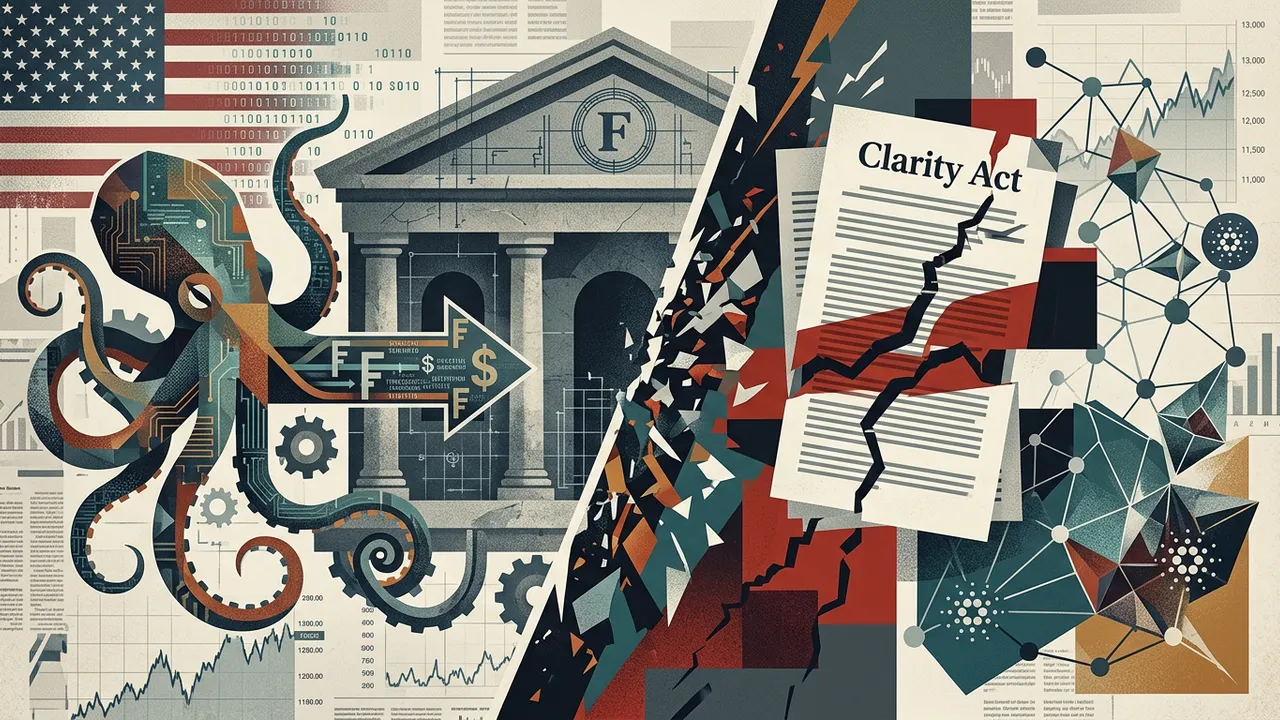
While Kraken becomes the first exchange to gain direct access to Fed systems, Cardano founder Hoskinson warns against the proposed Clarity Act. Regulatory developments in the US show: The battle for the future of the crypto industry is in full swing.
Kraken Gains Fed Access: How New Regulation Is Dividing the Crypto Industry
The regulatory landscape for cryptocurrencies in the US is currently undergoing a historic transformation. Two seemingly contradictory developments illustrate the divisions in American crypto policy: While the Federal Reserve grants the exchange Kraken direct access to its payment systems for the first time, the proposed Clarity Act is making waves throughout the industry. What appears from the outside to be an opening of the traditional financial system reveals itself upon closer inspection as the stage for a fundamental power struggle between banks, crypto companies, and regulatory authorities.
The question is no longer whether cryptocurrencies will be regulated, but how – and whose interests take priority.
The Facts
The Federal Reserve Bank of Kansas City has approved a so-called Limited Purpose Account for Payward Financial, which belongs to Kraken [1]. This gives the crypto exchange direct access to the US central bank's Fedwire system for the first time – an infrastructure previously reserved exclusively for licensed banks [1]. The Wyoming-based institution can now process transactions directly through the Federal Reserve without relying on partner banks [1].
The approval is initially valid for one year and, according to the Federal Reserve, contains specific restrictions and conditions tailored to the company's business model and risk profile [1]. Kraken announced it would introduce use of the account gradually, initially serving institutional clients [1]. This decision comes during a phase of increasing tensions between traditional credit institutions and new market participants from the crypto and fintech sectors [1].
US President Donald Trump positioned himself clearly on the side of the crypto industry in this conflict. On Truth Social, he declared that banks were trying to undermine the so-called Genius Act, which was unacceptable [1]. Trump also called for progress in regulating market structure and emphasized that the US must secure its role as the leading location for the crypto industry [1]. His son Eric Trump was even more explicit: "The institutions that had a monopoly for years and fleeced their customers by offering them nearly zero returns on retail money market accounts while charging accounts with low balances exorbitant fees – are now doing everything in their power to block the crypto industry" [1].
While the Kraken decision is being celebrated as a milestone, the proposed Clarity Act is causing fierce controversy. The bill is intended to create a comprehensive crypto regulatory framework in the US, but negotiations are currently stalled over the contentious question of whether stablecoins should be allowed to generate returns in the form of interest [2]. While Coinbase CEO Brian Armstrong apparently seeks a compromise, Cardano founder Charles Hoskinson exercises sharp criticism.
"All new crypto projects start as securities, only the established ones like Cardano, Ethereum, and XRP will likely fall under grandfather protection," warns Hoskinson [2]. The Clarity Act provides for a clear distinction between "digital commodities" under CFTC oversight and "digital securities" that would fall under SEC jurisdiction [2]. Hoskinson fears that a hostile SEC after a possible change of government could exploit this regulation to their advantage: "Don't you understand that this is a damn wet dream for a hostile SEC?" [2]
The Cardano founder also criticizes the lack of protective mechanisms for developers in the bill and the chaotic crypto policy of the Trump administration [2]. He described his own experiences with the White House as "schizophrenic," as invitations to events were summarily canceled without explanation [2]. "Trump has not created structures to get really good advice from the industry. Instead, he has created this predatory mess," said Hoskinson [2].
Analysis & Assessment
The two developments reveal a fundamental conflict: The US finds itself in a regulatory balancing act between innovation and control. The Federal Reserve's Kraken decision is historically significant because it breaks the banking monopoly on central payment infrastructures for the first time. This could create a precedent that encourages other crypto companies to submit similar applications. However, the one-year limitation and specific conditions show that the Fed is acting cautiously and reserves control mechanisms.
Hoskinson's criticism of the Clarity Act hits a sore spot: A regulatory framework that by definition initially classifies all new projects as securities could actually stifle innovation rather than promote it. The history of SEC enforcement under Gary Gensler has shown how regulatory uncertainty can threaten entire business models. A law that attempts to eliminate this uncertainty through strict categorization could paradoxically be even more restrictive – especially if political sentiment shifts.
The conflict between banks and crypto companies over stablecoin interest also illustrates what is ultimately at stake: market share and revenue streams. Traditional financial institutions see their business model threatened, while crypto companies want to compete on equal footing. The Trump administration positions itself verbally pro-crypto, but the chaotic implementation and lack of involvement of important industry representatives like Hoskinson point to a lack of strategic coherence. The regulatory opening could prove to be a double-edged sword: It legitimizes the industry but also subjects it to stricter oversight and potential political instrumentalization.
Conclusion
• Direct Fed access for Kraken marks a historic breakthrough but could put pressure on other exchanges to meet similar regulatory standards – with significant compliance costs
• Despite good intentions, the Clarity Act threatens to become a regulatory boomerang: The categorization of new projects as securities could stifle innovation in the US and drive developers abroad
• The open confrontation between the banking lobby and the crypto industry shows that this is not about technical regulatory questions, but about a power struggle over the future of the financial system
• Political volatility in Washington makes long-term planning security impossible – regardless of which party governs, crypto regulation remains a pawn of conflicting interests
• For Bitcoin as a decentralized network not controlled by individual companies, these regulatory trench battles could paradoxically be advantageous: The more complicated compliance becomes for central actors, the more attractive the censorship-resistant, permissionless Bitcoin network becomes
Sources
- [1]btc-echo.de
- [2]btc-echo.de
AI-Assisted Content
This article was created with AI assistance. All facts are sourced from verified news outlets.