Crypto's Regulatory Reckoning: Taiwan Criminalizes, America Bankrolls
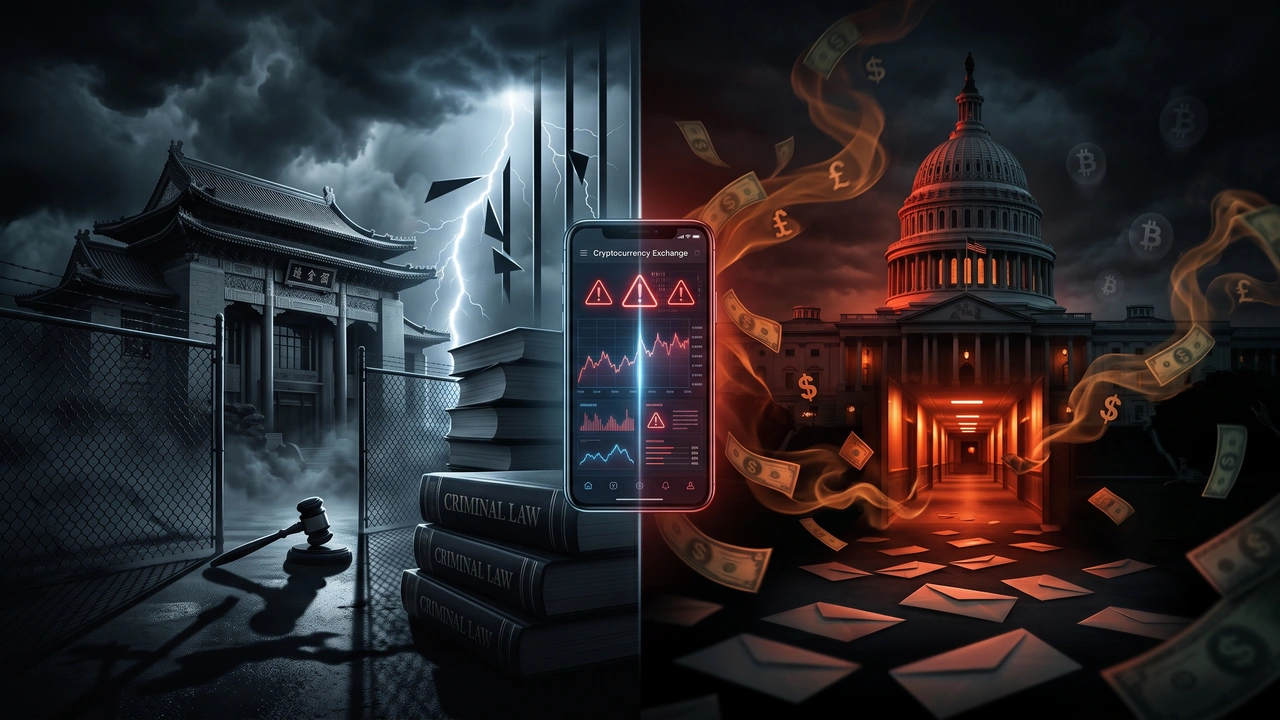
As Taiwan enacts sweeping criminal penalties for unlicensed crypto operators, the U.S. industry is spending at a historic pace to ensure Washington never goes that far - revealing two starkly different theories of how digital assets should be governed.
Key Takeaways
- Taiwan has moved from voluntary registration to mandatory criminal-law enforcement for unlicensed crypto operators, with prison terms up to seven years and fines topping $6 million for fraud - one of the strictest statutory frameworks globally.
- The U.S. crypto industry has deployed $189 million in the current election cycle, representing roughly 37 percent of all disclosed corporate political spending and dwarfing rival sectors like AI and online gambling combined.
- Ripple, Crypto.com, Coinbase, and Gemini together account for the vast majority of that political outlay, with the Fairshake super PAC and Trump's MAGA Inc. as the primary beneficiaries.
- Taiwan's stablecoin rules - dual regulatory approval plus full reserve backing - echo MiCA's approach, hinting at an emerging international standard that lobbying alone cannot prevent.
- The two strategies represent a fundamental fork in the road for crypto governance: statutory credibility through enforcement versus legislative influence through campaign finance, with very different long-term risk profiles for the industry.
Crypto's Regulatory Reckoning: Taiwan Criminalizes, America Bankrolls
Two stories dominated crypto policy circles this week, and at first glance they appear unrelated. One involves a small island democracy codifying prison sentences for rogue token issuers. The other involves a U.S. industry pouring nearly $200 million into American electoral politics. Read together, however, they sketch the outlines of a global struggle over who gets to write the rules for digital assets - and how much it costs to influence the outcome.
The contrast could not be sharper. Taiwan is betting that credibility comes from strict statutory guardrails. The American crypto lobby, meanwhile, is wagering that the fastest path to favorable regulation runs straight through campaign finance. Both approaches carry enormous long-term consequences for Bitcoin and the broader digital asset ecosystem.
The Facts
Taiwan's legislature passed what it calls a comprehensive legal framework for virtual asset service providers, formally adopting legislation that now sits on President Lai Ching-te's desk for signature, expected within ten days [1]. After the president acts, the cabinet will determine when the law actually takes effect - meaning industry participants are watching Taipei closely for the precise start date [1].
The statute's teeth are formidable. Running a crypto exchange or any related virtual asset business without prior authorization from Taiwan's Financial Supervisory Commission will expose operators to up to seven years behind bars and fines reaching approximately $3.14 million [1]. For those found guilty of market manipulation or outright fraud, the penalties escalate dramatically: between three and ten years in custody, with financial penalties that can climb to around $6.28 million [1]. These are not administrative slaps on the wrist - they sit firmly in criminal territory, placing crypto fraud on a legal footing comparable to traditional securities violations.
The new law also imposes structural discipline on the industry in ways that go beyond licensing. Firms must meet elevated cybersecurity benchmarks, keep client funds entirely segregated from their own, and maintain robust internal control mechanisms [1]. Stablecoin issuers face an additional layer of oversight: they need simultaneous sign-off from both the central bank and the financial regulator, plus mandatory full reserve backing for every token they put into circulation [1]. Operators who already completed anti-money-laundering registration under the old regime have a twelve-month runway to apply for the new license, with a further nine months after that to achieve full regulatory clearance [1].
Across the Pacific, the regulatory playbook looks entirely different. According to advocacy group Public Citizen, the crypto sector has collectively directed $189 million into the 2026 U.S. midterm election cycle - a figure that represents roughly 37 percent of all disclosed corporate political spending, which stands at $517 million in total [2]. To put that in perspective: artificial intelligence and Big Tech companies combined have spent around $60 million in the same period, while online gambling operators contributed roughly $45.6 million [2]. Crypto is not just a large donor class; it is the dominant one.
Ripple leads the pack among individual companies, having committed $49.6 million - enough to rank it second among all corporate donors, trailing only Andreessen Horowitz [2]. Crypto.com follows with $38.6 million, and Coinbase has deployed $35.2 million [2]. Add in Gemini and the Winklevoss twins, and just four crypto entities account for approximately $149 million of the $189 million industry total [2]. The money has flowed primarily to two destinations: the crypto-aligned super PAC Fairshake absorbed $82.6 million from the sector, while MAGA Inc. - the committee supporting President Donald Trump - received $56.2 million [2]. Cantor Fitzgerald, known as a banking partner to stablecoin giant Tether, contributed $10 million to the Fellowship PAC [2].
Public Citizen's assessment is pointed: sector-specific political action committees are structurally designed to back candidates whose policy positions align with their funders' commercial interests [2]. The watchdog also cautioned that the disclosed figures almost certainly understate the true scale of crypto's political spending, given the variety of channels through which money can move without immediate public reporting [2].
Analysis & Context
These two developments are not merely parallel news items - they represent competing regulatory philosophies whose outcomes will shape Bitcoin's operating environment for years. Taiwan is pursuing what might be called the Singapore or European model: codify the rules early, make penalties severe enough to deter bad actors, and build institutional credibility that attracts legitimate capital. The approach accepts short-term friction in exchange for long-term market confidence. Notably, Taiwan's treatment of stablecoins - requiring dual regulatory approval and full reserve backing - closely mirrors the direction the EU took with MiCA, suggesting a degree of global regulatory convergence that the industry cannot simply lobby its way out of in every jurisdiction.
The American strategy inverts this logic entirely. Rather than accepting a legislative framework and working within it, U.S. crypto firms are attempting to shape the framework before it hardens - essentially purchasing optionality on future regulation. This is rational behavior from a narrow financial perspective, but it carries a meaningful reputational risk. When a single industry accounts for more than a third of all disclosed corporate political spending in a major election cycle, it invites the kind of scrutiny that can produce backlash legislation. History offers a cautionary note: industries that are perceived as having captured their regulators sometimes face far harsher statutory responses when political winds shift. The pharmaceutical and financial sectors both discovered this dynamic in prior decades.
For Bitcoin specifically, the Taiwan law is actually less threatening than it appears at first read. The statute targets service providers and intermediaries - exchanges, custodians, stablecoin issuers. Self-custodied Bitcoin, held without an intermediary, does not fit neatly into that regulatory perimeter. If anything, a world where custodial crypto services face strict oversight may accelerate interest in Bitcoin's self-sovereign properties.
Sources
- [1]btc-echo.de
- [2]btc-echo.de
AI-Assisted Content
This article was created with AI assistance. All facts are sourced from verified news outlets.