Metaverse Collapse and GameFi Crisis Signal a Failed Hype Cycle
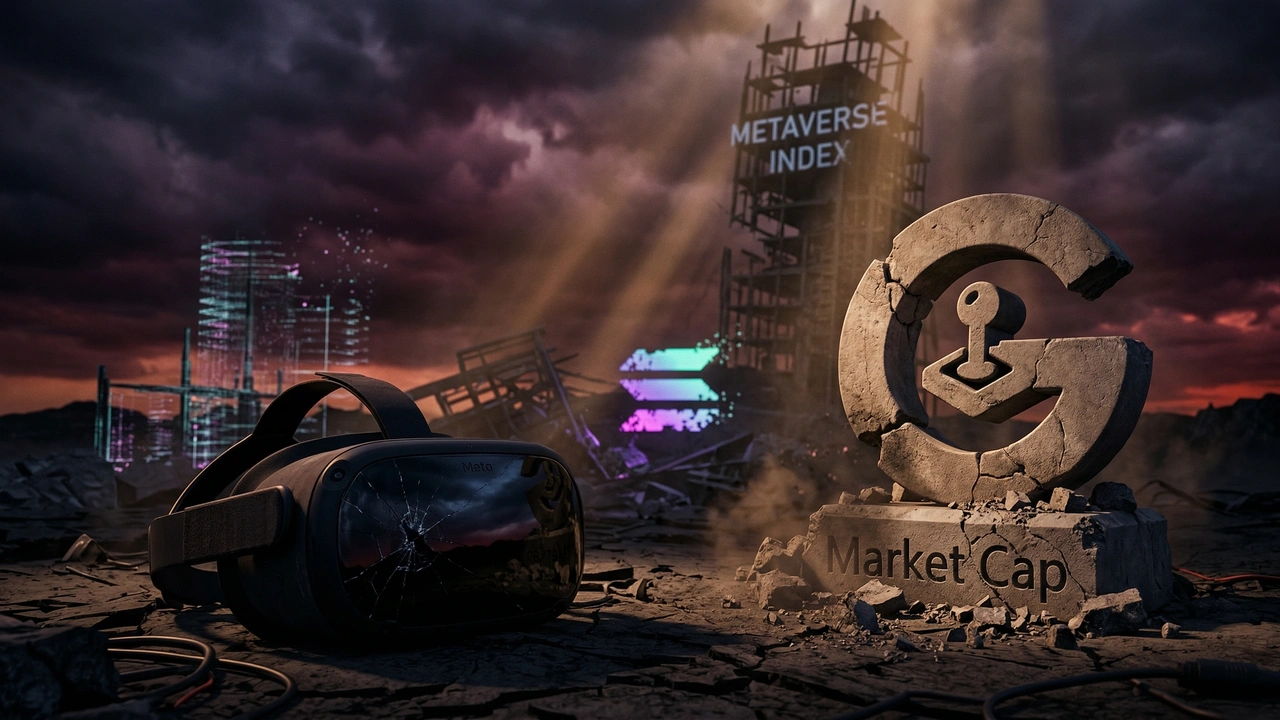
Meta's retreat from VR and a 67% collapse in GameFi market cap tell the same story: the blockchain gaming and metaverse boom was built on speculation, not substance — and the reckoning has arrived.
Key Takeaways
- Meta's Horizon Worlds VR shutdown and a 67% GameFi market cap collapse in 2025 confirm that the metaverse and blockchain gaming hype cycle has definitively ended, not merely paused [1][2].
- The scale of Meta's losses — over $6 billion in a single quarter from Reality Labs — illustrates the danger of deploying capital against an unproven consumer thesis, regardless of a company's size or resources [1].
- Insider skepticism from the Solana Foundation's own president signals that the blockchain gaming narrative has lost credibility even among its former champions, suggesting a prolonged recovery rather than a near-term rebound [2].
- The core failure of blockchain gaming was prioritizing financial mechanics over actual entertainment value — a product design mistake that no amount of tokenomics could fix, and a warning applicable to any crypto project that treats technology as a marketing layer rather than a genuine solution [2].
- For Bitcoin-focused investors, the collapse of speculative adjacent narratives historically acts as a clarifying force, directing attention back to assets with durable fundamentals — Bitcoin's scarcity and utility as a monetary network remain intact regardless of what happens in the GameFi or metaverse sectors.
The Virtual Dream Is Over: What the Metaverse and GameFi Collapse Tell Us About Hype Cycles
Two of the most heavily hyped technological narratives of the early 2020s are now in full retreat. Meta's Horizon Worlds is being quietly shuttered in virtual reality, and blockchain gaming's market capitalization has cratered by two-thirds in a single year. Taken together, these developments represent more than just the failure of individual products — they mark the definitive end of a hype cycle that consumed billions of dollars and years of developer talent, producing almost nothing of lasting value for everyday users.
For the Bitcoin-focused observer, the collapse carries an important signal. Narratives built on speculation and technological novelty, rather than genuine utility, follow a predictable arc. Understanding that arc is essential for navigating what comes next.
The Facts
Meta has officially pulled the plug on Horizon Worlds as a virtual reality experience. The app will disappear from the Quest headset store by the end of March, with a full VR shutdown following on June 15th. Going forward, the platform will exist solely as a mobile application — a dramatic downgrade from the immersive social universe CEO Mark Zuckerberg famously championed in 2021 [1]. The company framed the decision as a "strategic realignment," with the two platforms — VR hardware and Horizon Worlds — to be developed independently, each with a distinct focus [1].
The numbers behind the retreat are sobering. Meta's Reality Labs division, which housed the metaverse push, posted an operating loss of $6.02 billion in Q4 2025 alone, according to CNBC, cited by BTC Echo [1]. Horizon Worlds never managed to attract more than a few hundred thousand monthly active users — a catastrophically small audience given the scale of investment involved [1]. With artificial intelligence now commanding Meta's strategic attention, the metaverse vision that once defined the company's rebrand has effectively been abandoned.
The collapse in blockchain gaming runs parallel and is equally stark. According to a recent report by crypto media platform Chainplay, the total market capitalization of the GameFi sector fell to $7.8 billion by the end of 2025, down from approximately $23.9 billion the year prior — a decline of 67 percent in twelve months [2]. Investor appetite has dried up correspondingly. Funding flows into the sector dropped by roughly one-third year-over-year, falling from $857 million to significantly less, while the number of funded projects more than halved to just 114 [2]. Even BNB Chain, one of the more resilient ecosystems in the space, could not fully absorb the damage [2].
Perhaps most telling is the assessment coming from within the crypto industry itself. Lily Liu, President of the Solana Foundation, responded to news of Meta's Horizon Worlds shutdown with a blunt observation: "Blockchain gaming isn't coming back either" [2]. The comment drew attention precisely because Solana was one of the primary infrastructure layers for GameFi development over recent years, making Liu's candor all the more significant. Critics in the space have pointed to an over-reliance on the "blockchain" label as a marketing tool that alienated mainstream gamers, with one X user summarizing the core problem concisely: "Games need to be fun first; blockchain technology should only enhance the transaction experience" [2].
Analysis & Context
What we are witnessing is the textbook final chapter of a speculative hype cycle — one that Bitcoin veterans will recognize immediately. The pattern is familiar: a genuinely interesting technological concept attracts speculative capital, inflated valuations obscure weak fundamentals, adoption fails to materialize at scale, and the market eventually reprices to reflect reality. Blockchain gaming and the metaverse followed this trajectory almost point for point, mirroring the ICO collapse of 2018 or the NFT market implosion of 2022.
The critical distinction worth drawing, particularly from a Bitcoin perspective, is between technology that solves a real problem and technology that is retrofitted onto a problem it doesn't actually improve. Bitcoin's value proposition — a scarce, decentralized, censorship-resistant monetary network — addresses a demonstrable need that exists independent of market sentiment. By contrast, blockchain gaming largely promised to add financial speculation on top of entertainment, a model that appealed primarily to traders rather than gamers. When token prices fell, the incentive to play collapsed with them, exposing the absence of genuine product-market fit. Meta's metaverse suffered a different but related failure: it tried to mandate a future that users had not asked for, pouring capital into infrastructure for an experience nobody found compelling enough to adopt at scale.
For Bitcoin's broader ecosystem, the washout of these adjacent narratives has a clarifying effect. Capital and developer talent that spent years chasing GameFi yield or metaverse land speculation will now need to find a home elsewhere. Historically, the clearing of failed crypto narratives has ultimately redirected attention — and eventually investment — toward Bitcoin's more durable fundamentals. It also reinforces a broader lesson for the space: the projects that survive are those that prioritize genuine utility over tokenomics engineering or buzzword adoption. The current environment rewards honest product development over hype, and that is a healthy correction regardless of how painful the process is for those caught holding depreciating assets.
Sources
- [1]btc-echo.de
- [2]btc-echo.de
AI-Assisted Content
This article was created with AI assistance. All facts are sourced from verified news outlets.