Mining Industry in Transition: Bitcoin Becomes Capital for AI Expansion
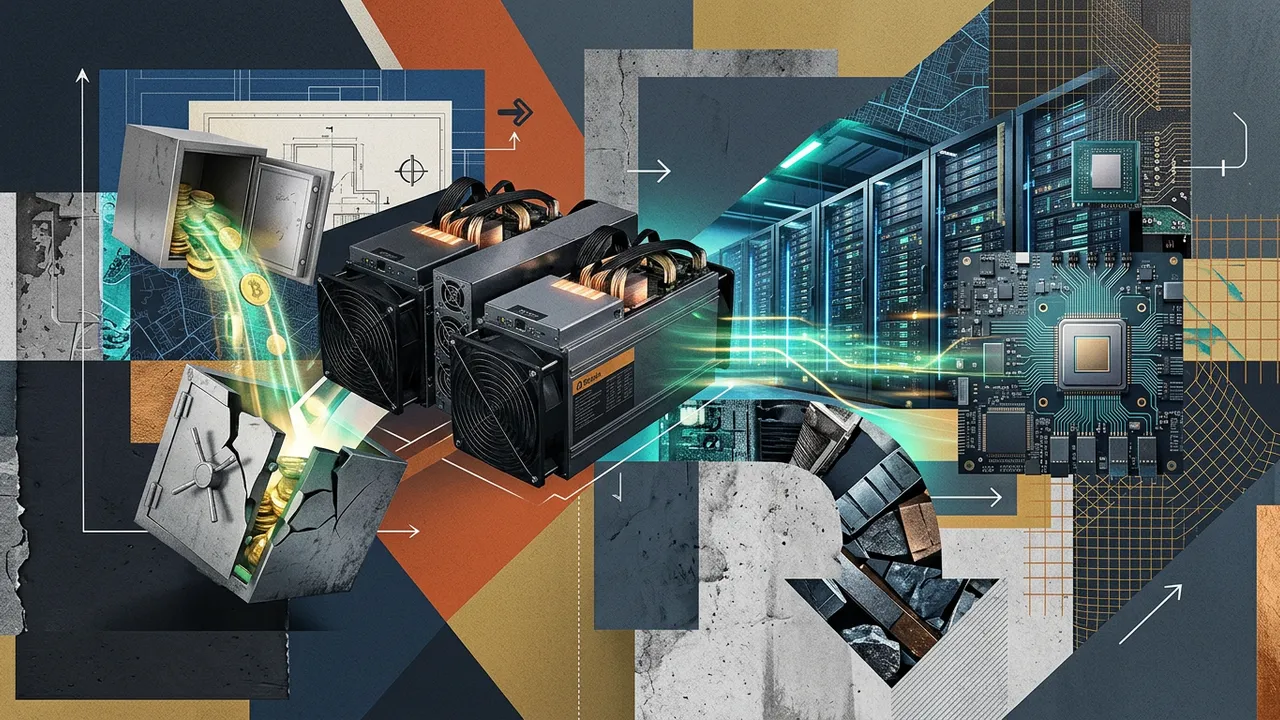
Core Scientific sells its entire Bitcoin reserve, MARA Holdings opens its treasury for sales. The trend toward AI computing is changing fundamental strategies in the mining industry and could create new selling pressure.
Mining Companies Abandon the Hodl Principle – AI Becomes More Important Than Bitcoin
A remarkable shift is taking hold of the Bitcoin mining industry: companies that accumulated Bitcoin as a strategic reserve for years are now actively selling their holdings – not out of necessity, but as a strategic choice. Core Scientific announced this week that it would liquidate nearly all its Bitcoin holdings, while MARA Holdings authorized sales from its treasury for the first time. The common denominator: both companies need capital to expand into lucrative AI and high-performance computing businesses. What may appear as an operational realignment by individual firms points to a fundamental transformation in the mining industry – with potential implications for the Bitcoin market.
The Facts
Core Scientific presented its fourth-quarter 2025 results on Monday, revealing an aggressive selling strategy. The company held 2,537 Bitcoin worth $222 million on its balance sheet as of December 31, 2025 [2]. However, in January alone, Core Scientific sold 1,924 BTC for approximately $175.9 million – at an average price of about $92,000 per coin [1][2]. CFO Jim Nygaard emphasized that the company sold "opportunistically" at "prices significantly above current market levels" [2].
But that's not the end. In its official SEC filing, Core Scientific announced: "We currently expect to dispose of substantially all of our Bitcoin holdings during 2026, subject to market conditions" [2]. CEO Adam Sullivan explained that mining operations are now essentially winding down and are primarily being maintained to fulfill minimum electricity commitments while facilities are being retrofitted for AI applications [2].
Core Scientific is not alone. MARA Holdings, the second-largest Bitcoin treasury company with 53,822 BTC worth approximately $4.7 billion (based on a year-end price of $87,498), also changed its strategy [1]. In an SEC filing, the company disclosed that it had expanded its crypto management strategy for 2026 to now permit sales of Bitcoin from its balance sheet [1]. Previously, MARA pursued a strict "hodl strategy" under which only newly mined Bitcoin could be sold [2].
MARA emphasized in its filing: "Accordingly, we may hold bitcoin for long-term investment purposes and may from time to time also buy or sell bitcoin, depending on market conditions and our capital allocation priorities" [2]. Approximately 28 percent of Bitcoin holdings were already involved in lending, trading, or collateral arrangements, including 9,377 BTC loaned to counterparties and 5,938 BTC as collateral for credit facilities worth $350 million [1]. These lending activities generated $32.1 million in interest income [1].
The trend extends across the entire industry: Riot Platforms sold 1,080 Bitcoin in mid-January to acquire additional land and finance a 10-year deal with AMD. Cango reduced its Bitcoin balance from 8,096 to 3,645 BTC to finance AI expansion and debt reduction. Bitdeer, the largest mining company by hashrate, reduced its Bitcoin holdings to zero [2]. The rationale is similar everywhere: amid the AI boom and billions in investments in AI data centers, more capital can currently be generated than through traditional Bitcoin mining, especially since mining companies already possess the necessary infrastructure and data centers [2].
Analysis & Assessment
This strategic shift marks a turning point for the mining industry and raises fundamental questions about the role of miners in the Bitcoin ecosystem. Historically, mining companies were natural Bitcoin sellers – they must settle operating costs such as electricity, hardware, and personnel in fiat currency. The halving in April 2024 intensified this dynamic by reducing block rewards from 6.25 to 3.125 BTC. MARA mined only 8,799 Bitcoin in 2025, compared to 9,430 the previous year [1].
However, a countertrend emerged over the years: publicly traded miners began accumulating Bitcoin as a strategic reserve, inspired by companies like MicroStrategy (now Strategy). This "hodl strategy" was interpreted as a vote of confidence in Bitcoin and helped attract institutional investors. The current reversal is therefore more than just an operational decision – it signals that many mining firms no longer view Bitcoin primarily as a store of value for their balance sheet, but as a liquidatable resource for other business areas.
The question of market impact can be answered with nuance: Core Scientific held only 256 BTC at the end of 2024 and significantly expanded its reserve in 2025 before now reducing it again [2]. The quantities sold – even by larger miners – are manageable in the context of daily Bitcoin trading volume. As long as MARA Holdings doesn't liquidate its 53,822 BTC on a large scale, direct price pressure should remain limited. Nevertheless, the psychological component should not be underestimated: when former Bitcoin accumulators become sellers, this could weigh on sentiment, especially as it coincides with current price weakness – Bitcoin is currently trading below $67,000 [1].
In the long term, the question arises whether this trend is reversible or whether we are witnessing a permanent realignment of the mining industry. Economic incentives currently clearly favor AI and HPC: higher margins, long-term contracts, and less volatility than Bitcoin mining. Core Scientific has approximately $530 million in liquidity and sees billions in financing potential through data center contracts [1]. Should this strategy prove successful, more miners could follow – raising the question of how Bitcoin hashrate will develop in the medium term, even though it has so far remained stable near its highs [2].
Conclusion
• The strategic shift from "hodling Bitcoin" to "selling Bitcoin for AI expansion" is affecting large parts of the mining industry and marks a fundamental change in the role of publicly traded miners in the Bitcoin ecosystem
• Core Scientific is liquidating nearly its entire Bitcoin reserve, while MARA Holdings is authorizing sales from its 53,822 BTC treasury for the first time – economic incentives in the AI and HPC business currently outweigh Bitcoin accumulation
• Direct selling pressure on the Bitcoin price appears manageable in the short term, as long as MARA doesn't massively liquidate its large holdings – however, the psychological effect of the strategic shift could weigh on sentiment
• The current stability of Bitcoin hashrate near all-time highs shows that other miners are filling the gap, but long-term development remains to be seen if the AI trend captures more large mining companies
• For Bitcoin investors, this means: the historical assumption that publicly traded miners are long-term Bitcoin accumulators no longer holds unconditionally – the industry is diversifying and Bitcoin is increasingly viewed as a financing instrument rather than an end goal
Sources
AI-Assisted Content
This article was created with AI assistance. All facts are sourced from verified news outlets.