Mixed Signals: Bitcoin's Fragile Floor and the Altcoin Bounce
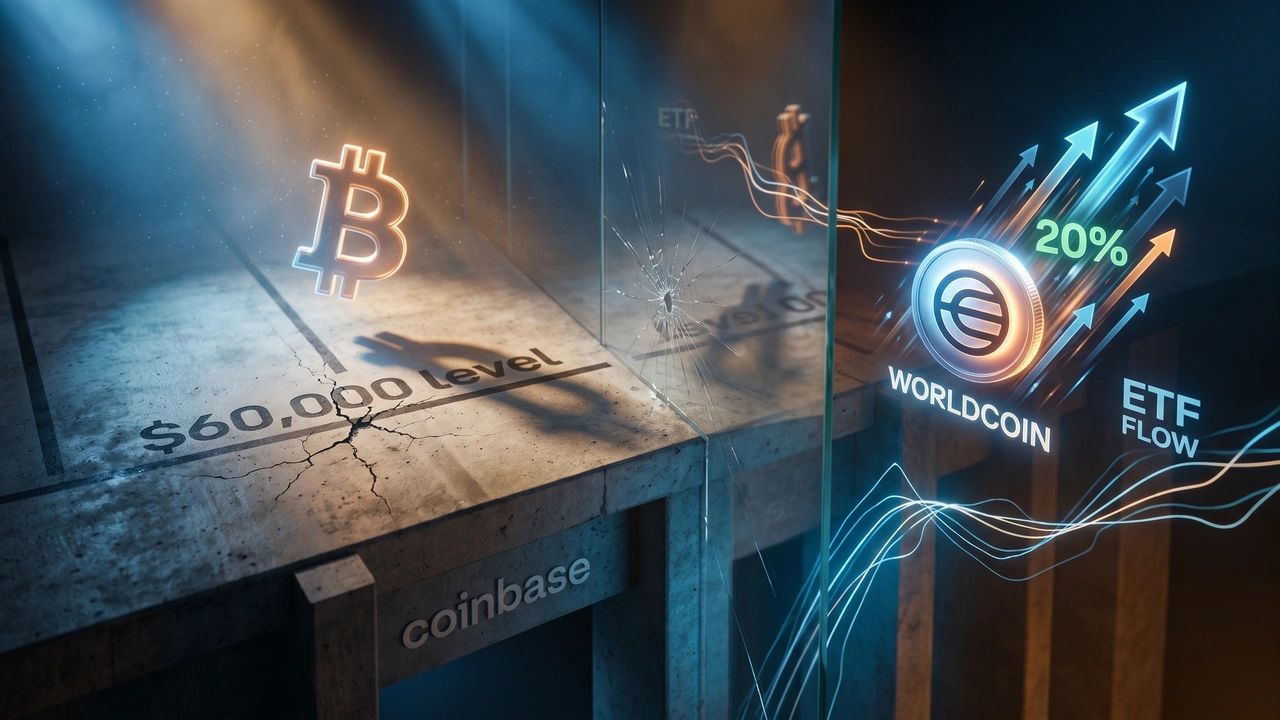
Coinbase CEO Brian Armstrong believes Bitcoin may have already bottomed near $60,000, but on-chain data and sluggish ETF flows tell a more cautious story - while speculative money chases Worldcoin ahead of the OpenAI IPO.
Key Takeaways
- Bitcoin recovered above $66,000 after touching its lowest level since October 2024 near $59,743, but soft ETF inflows and weak demand mean the bottom remains unconfirmed rather than established.
- Armstrong's instinct that the worst may be behind the market carries weight, but his own caveat - that no one can say for certain - is the more analytically honest part of the statement.
- On-chain metrics place Bitcoin near the Realized Price of approximately $53,600, a zone that has historically preceded recoveries, though proximity to value alone is not a sufficient trigger.
- Worldcoin's 20 percent single-day surge is almost entirely narrative-driven, tied to OpenAI IPO speculation rather than project fundamentals - and with RSI near 84.7, the risk of a sharp reversal is elevated.
- The gap between a potential price floor and a confirmed trend reversal may be wide; investors should treat current conditions as transitional rather than resolved.
Mixed Signals: Bitcoin's Fragile Floor and the Altcoin Bounce
Two storylines are competing for the crypto market's attention right now, and together they paint a revealing portrait of where sentiment actually stands in mid-June 2025. Bitcoin is clawing back from a months-long drawdown, with one of the industry's most prominent executives calling a tentative bottom - yet the underlying data refuses to confirm the optimism with any conviction. Simultaneously, speculative capital is flowing into Worldcoin at an almost frantic pace, chasing a narrative rather than fundamentals. Read side by side, these developments expose a market that is neither fully bearish nor confidently bullish: it is, above all else, uncertain.
The Facts
On June 15, Coinbase CEO Brian Armstrong addressed the state of the market in a video that quickly drew attention across the industry. His read: Bitcoin has probably already seen its worst levels. "My instinct says that we've likely already seen the bottom, maybe around the $60,000 level. But nobody can say that for certain," Armstrong told viewers - stopping well short of a firm prediction [1]. Despite the recent turbulence, he maintained a long-term constructive view, describing Bitcoin as a form of digital gold in the making [1].
The context for that remark matters. Earlier in June, Bitcoin slid to approximately $59,743 - its weakest reading since October 2024 and a level that represented a decline of roughly 50 percent from the all-time high of nearly $126,000 set in October 2025 [1]. By Monday, however, the asset had recovered above $66,000, posting a gain of close to three percent across the prior 24-hour window [1]. Armstrong also pointed to Bitcoin's well-documented four-year halving cycle as a framework for interpreting the pullback, noting that prior halving events have historically aligned with rotations between bull and bear markets [1].
The on-chain picture, though, adds important nuance that tempers the recovery narrative. Bitcoin is currently trading near what analysts call the Realized Price - an on-chain metric sitting around $53,600 that historically marks a zone of deep value [1]. In past cycles, proximity to the Realized Price has often preceded meaningful recoveries. Yet demand remains soft, and capital entering via spot Bitcoin ETFs has not yet stabilized into a clear trend [1]. Armstrong himself noted earlier in the month that headline price action does not capture the full market picture - derivatives markets, stablecoin activity, and prediction markets were each showing growth even as spot prices fell [1]. That selective resilience is worth watching, but it does not resolve the core question of whether the $60,000 level represents a genuine floor or simply a pause.
Meanwhile, Worldcoin staged one of the sharper single-day moves in the altcoin space, surging roughly 20 percent over 24 hours to hit $0.60 before settling near $0.59 - a gain of approximately 17.7 percent from its prior close of $0.50 [2]. Market capitalization reached around $2 billion on the move [2]. The catalyst appears to be almost entirely narrative-driven: OpenAI, the artificial intelligence company co-founded by Sam Altman - who is also closely tied to the Worldcoin project - is reportedly preparing for a highly anticipated public market debut, following a similar move by SpaceX the week prior [2]. Investors are essentially betting that Altman's proximity to a major IPO will pull fresh attention toward Worldcoin by association.
From a technical standpoint, WLD's short-term structure looks constructive but stretched. The token is trading well above its 20-period exponential moving average of $0.52 and has been printing a sequence of higher highs and higher lows since June 14 [2]. The relative strength index, however, sits near 84.7 - deep into overbought territory - and Bollinger Band width of roughly $0.12 signals elevated volatility [2]. Analysts assign the bullish scenario, which would require a confirmed daily close above $0.60 and potential extension toward $0.75 to $0.80, a 45 percent probability [2]. A return to the $0.47 Fibonacci retracement level under the bearish case carries a 20 percent probability, with the base case centering on a consolidation range of $0.55 to $0.62 [2].
Analysis & Context
The pattern emerging here is one that veteran Bitcoin observers will recognize: a significant drawdown followed by a credible but unconfirmed tentative low, accompanied by speculative activity in higher-beta assets. This is not unfamiliar territory. In prior cycles, the distance between a price low and a confirmed trend reversal has often stretched across weeks or even a few months, during which the market oscillated painfully before institutional conviction returned. The presence of a well-known executive calling a bottom is psychologically important - it provides a narrative anchor - but it is not the same as a structural confirmation.
The most important distinction to draw here is between proximity to value and the presence of a demand catalyst. Bitcoin near the Realized Price is historically cheap on a cost-basis framework, but cheap assets can stay cheap if the macro environment or investor risk appetite does not shift. The stagnation in spot ETF inflows is the single most telling data point right now. When institutional buyers stopped adding aggressively, the price lost its primary support mechanism from earlier in 2025. Until those flows resume with some consistency, any bottom call - however well-intentioned - remains an educated guess rather than a confirmed thesis.
The Worldcoin surge, stripped of its headlines, illustrates the other side of this market moment: risk appetite has not vanished, it has simply become selective and narrative-dependent. Capital is rotating toward stories with near-term catalysts rather than assets requiring patient conviction. That is a classically late-cycle or recovery-transition behavior - neither peak euphoria nor deep capitulation.
Sources
- [1]btc-echo.de
- [2]btc-echo.de
AI-Assisted Content
This article was created with AI assistance. All facts are sourced from verified news outlets.