Platform Fragility: Solana Bets on Pro Tools While Cardano Fights for Its Research Soul
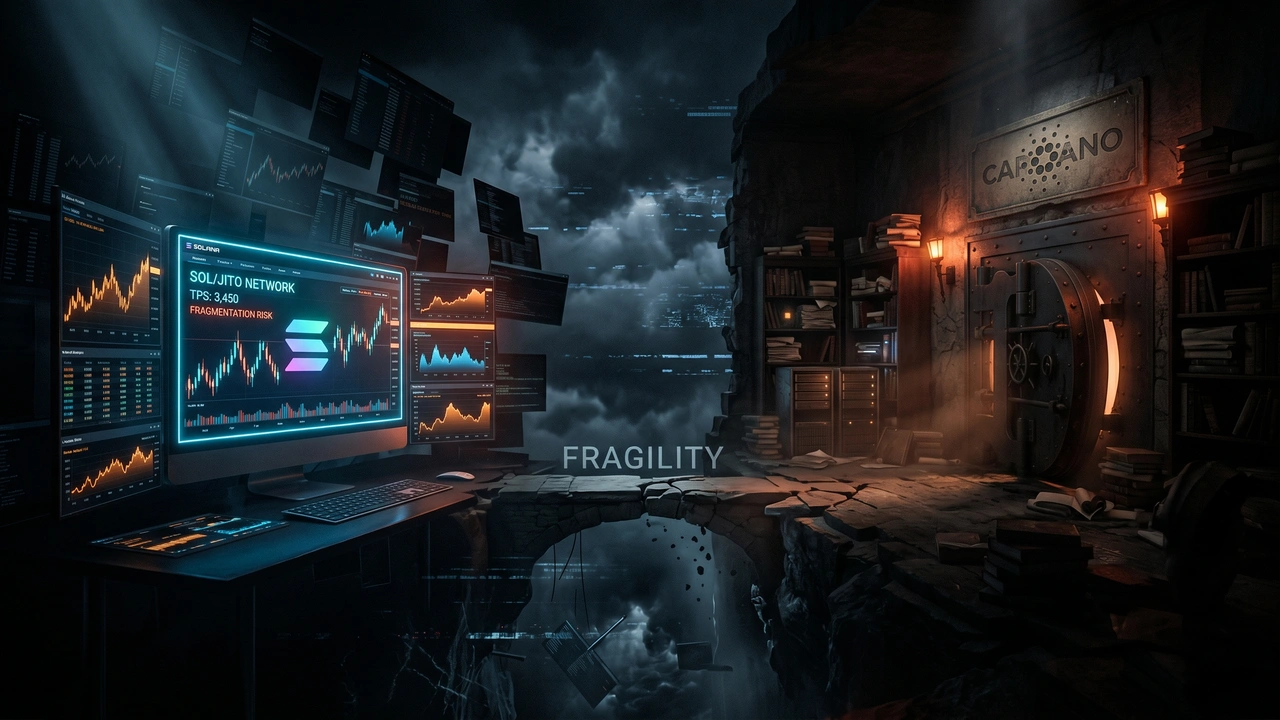
Two of crypto's most ambitious blockchain platforms are at pivotal crossroads - Jito's new professional trading terminal JTX targets Solana's tooling gap, while Cardano faces an existential governance vote that could shutter its decade-long research operation.
Key Takeaways
- Solana's infrastructure maturity is real, but the application layer remains fragmented, and Jito's JTX launch is a direct acknowledgment that professional traders have been underserved by the ecosystem's tooling.
- Cardano's governance vote is a live demonstration of decentralized decision-making carrying genuine consequences - a failed proposal could cost the network its core research operation, regardless of founder preferences.
- Hyperliquid's rise past Solana in FDV is a competitive signal that purpose-built financial chains are a credible threat to general-purpose smart contract platforms, particularly when user experience and tooling lag behind raw performance.
- ADA's short-term technical picture - with RSI near 28, price below the EMA-20, and a pattern of lower highs - reflects market anxiety around the governance vote, and a breakdown below the $0.2362 support level could meaningfully deepen the selloff.
- Both stories reinforce a core thesis: blockchain platforms that depend on sustained research funding, developer goodwill, and complex governance systems carry structural risks that simpler, more conservative protocols do not.
Platform Fragility: Solana Bets on Pro Tools While Cardano Fights for Its Research Soul
Two competing narratives are playing out across the altcoin blockchain landscape this week, and together they reveal a deeper tension that every non-Bitcoin platform must eventually confront: the gap between a network's technical ambitions and the institutional resilience needed to sustain them. On Solana, Jito is launching JTX - a professional trading terminal designed to unify what has become a chaotic patchwork of on-chain tools. On Cardano, a governance vote over 32.9 million ADA in treasury funding has morphed into an emergency referendum on whether the network can even keep its research operation alive. Both stories, read together, expose the fragility hiding beneath some of crypto's most celebrated blockchain platforms.
The Facts
Jito, the Solana-native infrastructure firm best known for its MEV-related work, is entering the application layer with JTX - positioned explicitly as a unified trading environment for professional on-chain traders [1]. The core premise is that Solana's infrastructure has matured significantly, but the application layer has failed to keep pace. According to Jito, active traders on the network currently rely on between five and eight disconnected tools - separate interfaces for charts, order execution, portfolio tracking, and capital management [1]. JTX aims to collapse that fragmentation into a single surface.
The product is not aimed at retail users or casual swappers. Jito has deliberately framed JTX as a professional-grade environment for experienced traders who demand reliability and execution quality [1]. A key feature is the inclusion of credible maker limit orders displayed directly within the charting interface - an area where Solana has historically struggled to earn trader trust [1]. Self-custody remains central: users retain control over their wallets and funds throughout. Jito presents JTX as the natural next step after four years of building infrastructure trust within the Solana ecosystem, now extending that credibility upward to the user-facing layer [1].
The backdrop for this launch, however, is one of competitive pressure. Hyperliquid, the high-performance perpetuals exchange, has reportedly surpassed Solana in fully diluted valuation (FDV) - a milestone that underscores the real threat that purpose-built financial chains pose to general-purpose platforms like Solana [1].
Meanwhile, Cardano is navigating what may be its most consequential governance moment to date. A community vote, closing June 8, is deciding whether to release 32.9 million ADA from the network treasury to fund ongoing research operations [2]. Cardano founder Charles Hoskinson has publicly urged delegates to approve the proposal. The stakes, according to those behind the motion, are severe: a failed vote could trigger the loss of key researchers and, in a worst-case scenario, lead to the closure of what the team describes as one of the most rigorous crypto-focused research groups assembled over the past decade [2]. The concern was amplified when several Japanese delegated representatives (dReps) came out against the proposal - prompting an unusually emotional public response from the research team, who described their reaction as one of "deep sorrow" [2].
On the price side, ADA has not been spared. The token was trading near $0.2379 at last check, well below its 20-period exponential moving average of approximately $0.2469, with the RSI sitting around 28 - a reading that signals short-term oversold conditions but does not, on its own, confirm a recovery [2].
Analysis & Context
What unites these two seemingly separate stories is the fundamental question of institutional durability - the capacity of a blockchain platform to sustain the infrastructure, talent, and user trust needed to remain competitive over time. Bitcoin, of course, resolved this question through radical simplicity: a fixed protocol, no foundation to fund, and no research lab to shut down. The altcoin world made a different bet - that rich smart contract platforms with professional teams and evolving governance structures would win out. This week's developments stress-test that bet.
Cardano's situation is historically significant because it represents one of the most transparent cases of on-chain governance being used to determine the survival of a core development function. The network launched its Voltaire governance era - which introduced delegated representatives and on-chain treasury management - in late 2024, giving ADA holders direct control over how treasury funds are allocated. That structure is now doing exactly what it was designed to do. The problem is that decentralized governance, by design, can vote against the wishes of founders and core teams. Hoskinson built a system where community delegates have real power, and now some of those delegates are exercising it in a direction he does not want. This is not a failure of governance - it is governance working as intended, with all its attendant risks.
For Solana and Jito, the pattern is different but equally instructive. Solana's value proposition has always leaned on raw throughput - the ability to process transactions at speeds and costs that rival centralized exchanges. But high-performance infrastructure alone does not generate a durable trading ecosystem. The emergence of Hyperliquid as a rival that reportedly now exceeds Solana in FDV is a signal that speed is increasingly a commodity. Traders are gravitating toward environments that optimize the full experience - not just execution, but workflow, trust, and interface design. JTX is Jito's answer to that challenge. Whether it succeeds will depend on whether it can actually close the usability gap that Jito itself has identified, or whether fragmentation is simply too ingrained in Solana's open, permissionless application culture to be resolved by a single product.
There is also a broader disambiguation worth making: neither of these developments carries direct implications for Bitcoin. Cardano's treasury crisis and Solana's tooling push are internal problems of smart contract platforms that have made different architectural choices - choices that Bitcoin deliberately avoided. The recurring theme of altcoin governance disputes, developer funding crises, and application-layer fragmentation are not bugs that will eventually be fixed; they are features of systems that tried to do too much with too little protocol-level clarity. Bitcoin's narrowness is not a limitation - it is the source of its institutional resilience.
Sources
- [1]btc-echo.de
- [2]btc-echo.de
AI-Assisted Content
This article was created with AI assistance. All facts are sourced from verified news outlets.