Power Is the New Gold: Bitcoin Miners Race to Own the Grid
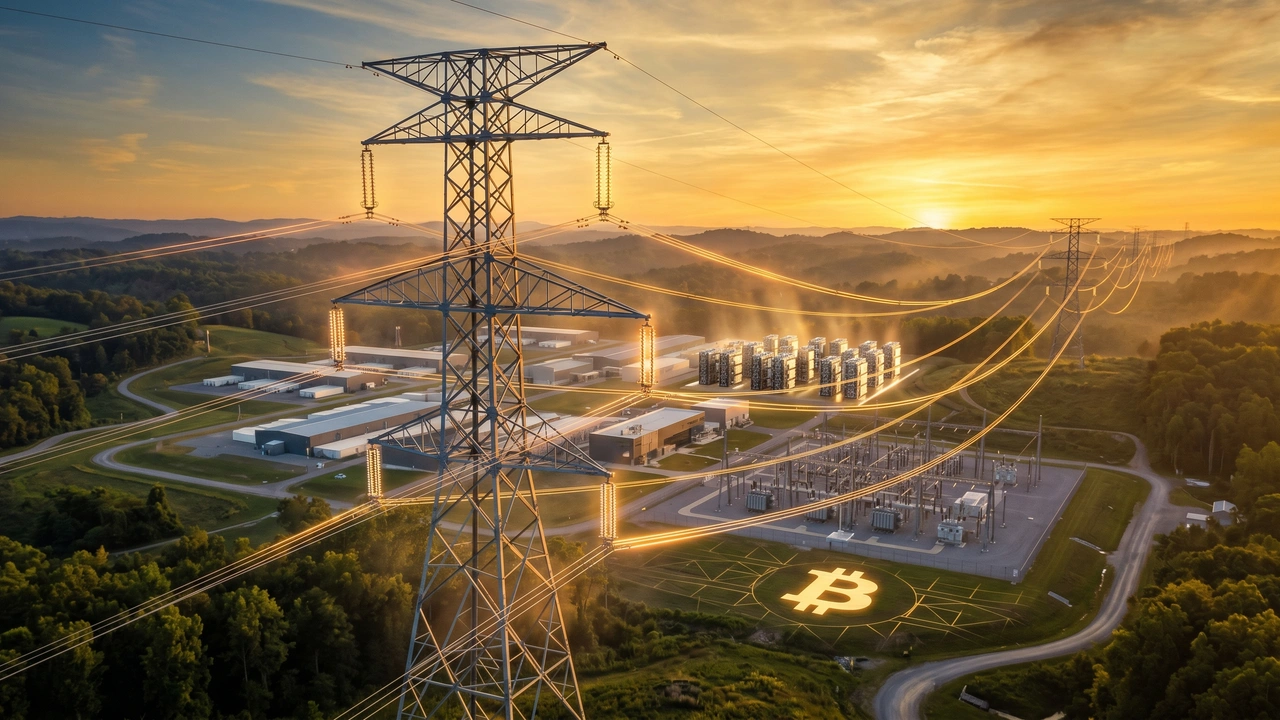
TeraWulf's acquisition of a gigawatt-scale Kentucky data center site and Abundant Mines' community recognition award reveal two distinct but converging strategies reshaping the Bitcoin mining industry - scale-driven AI pivots and trust-driven operational integrity.
Key Takeaways
- Power and transmission access have replaced hardware as the primary competitive moat in Bitcoin mining and data center infrastructure, a shift that TeraWulf's Kentucky acquisition makes concrete.
- The Google-backed financing behind TeraWulf's expansion signals that hyperscalers view power-ready land as scarce enough to underwrite debt in order to secure future capacity.
- AI compute revenue outpacing Bitcoin mining revenue at TeraWulf for the first time in Q1 marks a structural inflection, not a one-quarter anomaly, as HPC revenue grew 117% in the same period.
- Abundant Mines' community-voted recognition illustrates that client-protective features - such as downtime coverage and operational transparency - are increasingly decisive differentiators in a managed mining market historically plagued by credibility problems.
- The sector is bifurcating into institutional-scale infrastructure plays and trust-differentiated boutique operators, and both archetypes are finding viable paths forward as the industry matures.
Power Is the New Gold: Bitcoin Miners Race to Own the Grid
The Bitcoin mining sector is undergoing its most consequential identity shift since the first industrial-scale ASICs arrived. Two stories emerging from the industry this week - one about a publicly traded miner staking a billion-dollar claim on American energy infrastructure, the other about a small operator winning a community-voted award for doing things differently - together reveal a sector pulling hard in two directions at once. What unites them is a single underlying truth: in 2026, the competitive advantage in digital infrastructure is no longer the machine. It is the power behind it.
For years, mining companies competed on hashrate, chip efficiency, and electricity rates measured in fractions of a cent. That era is closing. The new battleground is transmission capacity, zoning certainty, and the kind of long-horizon infrastructure relationships that cannot be replicated overnight. How miners position themselves on that battleground will define the next decade.
The Facts
TeraWulf announced the purchase of a development site in eastern Kentucky capable of hosting over one gigawatt of AI and high-performance computing capacity [1]. The property, now branded the Muskie Data Campus, occupies roughly 285 acres within a larger industrial park in the northeastern part of the state and was acquired from Industrial Equity Partners [1]. Kentucky Power, an AEP subsidiary, is constructing a 345 kilovolt substation tied into an existing 765 kV transmission backbone specifically to serve the site [1].
Deployment is staged across two phases: an initial 500 MW tranche targeted for the second half of 2028, followed by another 500 MW by late 2030 [1]. The project represents TeraWulf's second major Kentucky footprint, complementing its 480 MW Justified Data campus in Hancock County [1]. A $3 billion financing arrangement structured through Morgan Stanley - with Google backstopping the debt - is underwriting the company's broader data center buildout strategy [1]. Markets responded sharply, with WULF shares climbing as much as 13.6% before settling around an 11% gain, pushing the stock to nearly $26 - its highest close in roughly three weeks and more than double its value from January 1 [1].
The timing reflects an internal revenue shift that has been accelerating. TeraWulf's HPC-related revenue surged 117% in its most recent quarter, and for the first time, AI compute revenue exceeded Bitcoin mining revenue [1]. The company still posted a substantial net loss of $427 million as capital expenditure climbs, a figure that reflects aggressive investment rather than operational failure [1]. CEO Paul Prager framed the competitive dynamic plainly: "The defining constraint in this market is no longer computing hardware - it is power, transmission infrastructure, and execution certainty." [1]
Meanwhile, at the Bitcoin Conference 2026, Abundant Mines received the inaugural Satos Award for Mining and Energy, an honor determined entirely by public nomination and community voting [2]. The Hood River, Oregon-based operator has grown from a single facility to six active sites, with a seventh scheduled to open in mid-2026, and expanded its workforce from 7 to 25 employees heading into this year [2]. Revenue growth has been striking - a 946% increase from 2023 to 2024, followed by a further 333% rise from 2024 to 2025 [2]. The company's proprietary Hashrate Redirect system, which reroutes capacity from its own mining fleet to cover client downtime, was cited as a differentiating feature rarely offered elsewhere in the industry [2]. CEO Beau Turner described the award as validation of a values-driven operating model built on transparency, including monthly site tours for clients [2].
Analysis & Context
The pivot by TeraWulf - and by extension the cohort of miners including Hut 8, HIVE Digital, MARA Holdings, and IREN making similar moves - follows a pattern that has precedent in other capital-intensive industries [1]. When commodity margins compress, operators who control the underlying physical infrastructure rather than just the processing layer tend to survive and consolidate. The oil services analogy is instructive: drillers who owned pipeline access fared better through price cycles than those who simply owned rigs. Bitcoin miners who secured cheap power early are now discovering that power infrastructure itself, not hashing power, is their most defensible asset. The AI demand wave has simply accelerated the realization.
The Google backstop on TeraWulf's $3 billion financing package deserves particular attention [1]. When a hyperscaler underwrites a miner's debt, it signals something more than a financial transaction - it reflects a supply-side acknowledgment that power-ready land with transmission infrastructure is genuinely scarce. Hyperscalers have been competing aggressively for exactly these assets, and a miner that secured a gigawatt-class site with zoning and energy agreements already in place has something that cannot be manufactured quickly. The 2028 delivery target for the first phase gives some indication of how long this permitting and construction cycle actually takes, which also explains why early movers command premium valuations.
The Abundant Mines story operates on a different register, but it is not unrelated. The company's rapid revenue growth - nearly a tenfold increase in a single year - occurred during a period when the broader mining industry was dealing with persistent credibility problems: opaque fee structures, undisclosed hosting risks, and custodial disputes that burned retail clients. Winning an award voted on directly by the Bitcoin community is precisely the kind of signal that distinguishes operators who treat hosting relationships as long-term partnerships from those treating them as short-term revenue extraction [2]. The Hashrate Redirect mechanism in particular addresses a structural weakness in managed mining: client downtime is typically an uninsured risk. Covering that exposure with fleet capacity is a genuine product innovation, not a marketing claim.
The deeper pattern connecting these two stories is the maturation of mining as an asset class. At the large end, miners are becoming indistinguishable from data center REITs and energy infrastructure companies. At the boutique end, operators are competing on fiduciary standards and client protection rather than raw efficiency. Both trends suggest that the cowboy era of Bitcoin mining - where execution and oversight were loosely defined and capital was cheap - is giving way to something more institutional, more accountable, and more durable. The Bitcoin halving cycle creates natural selection pressure, and the survivors tend to be those who invested in infrastructure or trust before the margin squeeze arrived.
Sources
AI-Assisted Content
This article was created with AI assistance. All facts are sourced from verified news outlets.