Privacy Coins and Sanction Evasion: When Anonymity Becomes a Liability
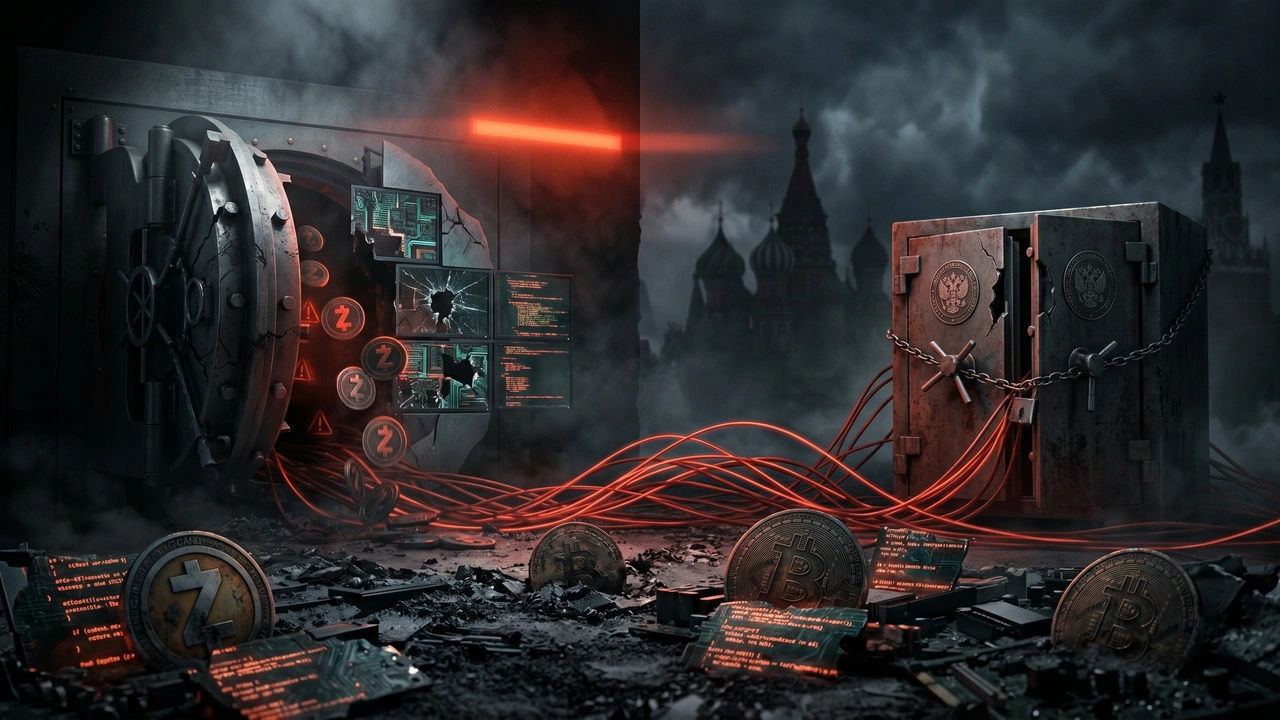
A critical vulnerability in Zcash's Orchard Pool and Russia's alleged multi-hundred-billion-dollar crypto laundering network expose the same uncomfortable truth: financial privacy, when unchecked, can corrode the very trust that gives digital money its value.
Key Takeaways
- A three-year-old cryptographic flaw in Zcash's Orchard Pool could theoretically have allowed unlimited counterfeit ZEC creation - and because the pool is private by design, exploitation during that window cannot be definitively excluded, which is the primary driver of investor panic.
- The market's 40-percent response to the Zcash disclosure reflects a trust collapse more than a technical one: patching the bug does not restore the ability to audit what may have happened while it was active.
- Russia's alleged $350 billion crypto laundering network - built on exchanges like Garantex and instruments like the A7A5 stablecoin - illustrates how state actors are exploiting the same privacy and settlement properties that make crypto attractive to legitimate users.
- Stablecoins now account for 84 percent of all illicit crypto transaction volume according to Chainalysis, making them the instrument of choice for sanction evasion - a fact that will continue to attract aggressive regulatory scrutiny.
- Privacy-preserving protocols face a mounting structural challenge: demonstrating supply integrity and regulatory compatibility without dismantling the anonymity guarantees that define their core use case.
Privacy Coins and Sanction Evasion: When Anonymity Becomes a Liability
Two stories broke this week that, on the surface, appear unconnected. One concerns a cryptographic flaw buried in a privacy coin's code for three years. The other involves a teenager placed on a Russian sanctions list for exposing what may be one of the largest state-sponsored crypto laundering operations ever documented. Together, they illuminate a fundamental tension at the heart of financial privacy technology: the same architecture designed to shield legitimate users from surveillance can become an untraceable vehicle for fraud, inflation, and geopolitical manipulation - and markets are starting to price that risk accordingly.
For Zcash, the reckoning arrived fast and hard. For Russian sanctions evaders, the walls may be closing in more slowly - but they are closing.
The Facts
Zcash suffered one of the most severe single-day collapses in its recent history, shedding more than 40 percent of its value within 24 hours to trade below $340. The trigger was a public disclosure from Shielded Labs, an independent organization operating within the Zcash ecosystem, which confirmed that a critical vulnerability had been identified inside the network's Orchard Pool - the component that handles shielded, or private, transactions [1].
The flaw was discovered on May 29 by security researcher Taylor Hornby, whom Shielded Labs had contracted in April specifically to stress-test the protocol for weaknesses. Hornby's methodology combined conventional security auditing with AI assistance, specifically Anthropic's Opus model. What he found was alarming: a logic error that allowed the system to accept inputs it should have rejected outright. Hornby went further than merely identifying the bug - he wrote a complete working exploit and validated it in a local test environment, demonstrating that the code could be leveraged to generate counterfeit ZEC without triggering any detection mechanism [1].
The vulnerability's roots stretch back to May 2022, when the Orchard protocol was first activated on Zcash's mainnet, meaning the flaw sat dormant and undetected for roughly three years. Shielded Labs has stated that exploitation during that window is considered unlikely, but it cannot be ruled out entirely - and that caveat is the crux of the crisis. Because Orchard transactions are private by design, there is no external audit trail that would definitively confirm whether fraudulent coins were minted during that period [1]. Hornby notified Zcash's development team after making the discovery, and the vulnerability was patched by June 1. Shielded Labs has outlined remediation steps, including a network upgrade intended to make the total ZEC supply more independently verifiable, along with a new shielded pool that would route Orchard coins through a supply-accounting mechanism before they can circulate further [1].
On a separate but thematically parallel front, Russia has placed 17-year-old British researcher Alexander Browder on its official sanctions list, a move reported by the state news agency Tass and attributed to the Russian Foreign Ministry. The designation followed Browder's March publication of a detailed report alleging that Russia has constructed a sophisticated crypto-based infrastructure to circumvent international sanctions [2]. The Russian government has characterized the reporting as deliberate disinformation targeting four additional journalists alongside Browder.
Browder's investigation centered on three interlocking mechanisms. The first was the Russian crypto exchange Garantex, which he alleged processed in excess of $100 billion in transaction volume, with a substantial portion linked to sanctioned entities. The second was a ruble-backed stablecoin called A7A5, which Browder claims the Kremlin deployed for cross-border settlements - at peak activity reportedly transferring around $1 billion per day through that single instrument. The overall figure Browder put on the alleged operation reaches approximately $350 billion [2]. The European Union appears to have taken the findings seriously: its 20th sanctions package, introduced in April, specifically targeted transactions involving Russian crypto service providers [2].
Blockchain analytics firm Chainalysis lent broader credence to these concerns in its annual crime report published in March. The firm found that illicit crypto activity had reached a new record high, with the composition of that activity having shifted meaningfully. Whereas previous years were dominated by hacks, scams, and ransomware, sanction evasion and state-backed networks now account for the majority of illegal volume. Stablecoins represent 84 percent of all flagged illicit transactions, with Russia, Iran, and North Korea identified as the leading state actors [2].
Analysis & Context
The Zcash episode deserves to be read as more than a technical postmortem. It represents a pattern that has recurred across cryptographic financial systems: the moment a privacy guarantee is shown to be theoretically breakable, the market reprices not just the current risk but every historical transaction conducted under that guarantee. Investors cannot verify whether the ZEC supply was silently inflated at any point over the past three years, and that epistemic gap - not the patched bug itself - is what produced the 40-percent drawdown. A transparent blockchain would allow on-chain forensics to rule out exploitation. Zcash's core value proposition prevented exactly that kind of retrospective audit.
This connects directly to the Browder story in a way that should concern anyone thinking about the long-term regulatory trajectory of privacy-preserving assets. Governments confronting documented, large-scale sanction evasion through crypto are not distinguishing carefully between legitimate privacy tools and illicit ones. The EU's April sanctions package targeting Russian crypto providers is a leading indicator: when state actors demonstrably weaponize privacy infrastructure, regulators respond with broad instruments. Privacy coins and privacy-focused protocols will increasingly face the burden of proving supply integrity and compliance compatibility - two demands that sit in structural tension with the anonymity they are designed to provide. Zcash's proposed Turnstile Accounting mechanism is a step toward that compatibility, but it may also mark the beginning of a difficult renegotiation between the privacy coin community and the regulatory environment it operates in.
Sources
- [1]btc-echo.de
- [2]btc-echo.de
AI-Assisted Content
This article was created with AI assistance. All facts are sourced from verified news outlets.