Quantum Computing and Bitcoin: Crisis or Manageable Upgrade?
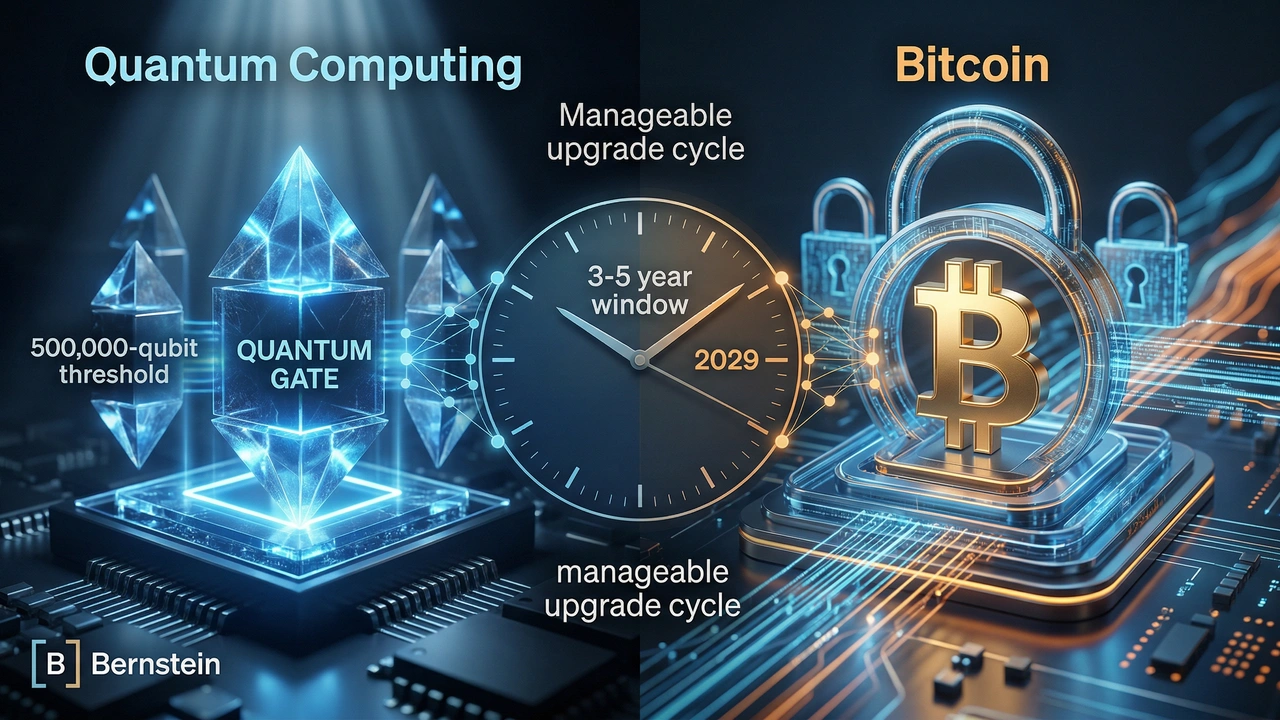
Wall Street firm Bernstein says Bitcoin has three to five years to implement post-quantum security upgrades, framing the challenge as a scheduled protocol evolution rather than an existential threat — but the clock is ticking.
Key Takeaways
- The threat is real but not imminent: Bernstein confirms quantum computing poses a genuine challenge to Bitcoin's cryptographic foundations, but estimates three to five years remain before any practical attack becomes feasible — sufficient time for an orderly transition [1][2].
- Legacy wallets are the highest-risk category: Approximately 1.7 million BTC in Satoshi-era P2PK addresses carry permanently exposed public keys, making them the most defined targets under realistic quantum attack models [2].
- SHA-256 mining is not meaningfully at risk: Bitcoin's proof-of-work consensus mechanism is not considered vulnerable to quantum attacks, meaning the network's core security model remains intact during any transition period [2].
- BIP 360 is the protocol-level response to watch: This draft proposal introducing quantum-resistant transaction formats is already in experimental implementation and represents the most concrete near-term step toward post-quantum Bitcoin [1].
- Institutional stakes are changing the upgrade dynamic: The involvement of major asset managers as Bitcoin stakeholders means the resources and incentives for supporting defensive protocol upgrades are stronger than at any previous point in Bitcoin's history [1].
Quantum Computing and Bitcoin: The Threat Is Real, But So Is the Runway
The word "quantum" has a way of triggering alarm in Bitcoin circles, conjuring images of supercomputers silently cracking wallets and draining addresses overnight. The reality, according to a new research note from Wall Street firm Bernstein, is considerably more nuanced — and considerably less cinematic. The firm's analysts argue that the quantum computing threat to Bitcoin is genuine, accelerating, and entirely manageable within a realistic preparation window. That framing deserves serious attention, because it cuts through both the hype and the dismissiveness that have characterized much of this debate.
This is not a story about Bitcoin being broken. It is a story about Bitcoin needing to evolve — as it has before, and as its architecture was always designed to allow.
The Facts
Bernstein's research team, led by analysts Gautam Chhugani, Mahika Sapra, Sanskar Chindalia, and Harsh Misra, published a note this week characterizing quantum computing as a "manageable upgrade cycle" rather than an "existential risk" to Bitcoin and the broader digital asset ecosystem [2]. The report estimates the crypto industry has roughly three to five years to implement post-quantum cryptographic standards — a window the analysts describe as sufficient given current technical and cost constraints [1].
The note arrives in the wake of fresh research from Google, which recently demonstrated that future quantum machines could potentially break the elliptic curve cryptography underpinning Bitcoin's transaction signatures using fewer physical resources than previously estimated. Google's team suggested the threshold could fall below 500,000 physical qubits — approximately 20 times fewer than prior models had projected [1]. That finding sharpened attention on a specific category of vulnerability known as "on-spend" attacks, where a transaction's public key becomes briefly visible in the mempool before confirmation, theoretically creating a narrow window for interception.
Bernstein's analysts did not dismiss Google's findings. "Recent breakthroughs seem to have accelerated the timeline, as the challenge is no longer 'a decade away' as thought earlier," the team wrote [1]. However, they were equally clear that scaling quantum hardware from tens of logical qubits to the thousands required for a real-world attack still demands unresolved breakthroughs in hardware engineering, error correction, and manufacturing — and that the associated costs could run into the tens to hundreds of billions of dollars [1].
Not all Bitcoin addresses carry the same exposure. Bernstein specifically identified pay-to-public-key (P2PK), pay-to-multisig (P2MS), and pay-to-Taproot (P2TR) address formats as among the most vulnerable to quantum-based attacks [2]. The highest-risk segment remains legacy wallets — particularly the estimated 1.7 million BTC held in early P2PK addresses, including approximately 1.1 million BTC attributed to Satoshi Nakamoto, where public keys are permanently and irreversibly exposed [2]. Newer wallet formats and practices such as avoiding address reuse significantly reduce this exposure. Critically, Bitcoin's mining mechanism, which relies on SHA-256 hashing, is not considered meaningfully vulnerable to quantum attacks [2].
On the solution side, both Google's research team and Bernstein point to 2029 as a realistic target for completing post-quantum cryptography migration. BIP 360, a draft proposal already in experimental implementation, introduces transaction formats specifically designed to reduce exposure to vulnerable cryptographic assumptions [1]. Bernstein also noted that well-capitalized institutional stakeholders — citing Strategy, BlackRock, and Fidelity — are likely to play a constructive role in reinforcing security standards as the transition unfolds [1].
Analysis & Context
Bitcoin's history is, in large part, a history of successfully navigating technical threats that once seemed insurmountable. The block size wars, the transition to SegWit, the rollout of Taproot — each represented moments where the network's decentralized governance faced real pressure and ultimately found a path forward. The quantum challenge is different in scale and technical complexity, but it fits a familiar pattern: a known threat horizon, an active developer community, and sufficient time to coordinate a response. What Bernstein's note essentially confirms is that Bitcoin sits at the beginning of that cycle, not the end.
The concentration of risk in Satoshi-era wallets is a genuinely uncomfortable dimension of this story, and one that the Bitcoin community will need to confront directly. Those 1.7 million BTC — dormant for years, with permanently exposed public keys — represent both a symbolic and a practical vulnerability. Whether those coins should be migrated by protocol-level action, flagged for special treatment, or simply accepted as a known risk is a debate the community has not fully engaged with. The quantum timeline makes that conversation more urgent. The precedent question is also thorny: any protocol mechanism that could move or freeze coins in legacy addresses touches foundational questions about Bitcoin's immutability and property rights.
For active users and investors, the near-term market implications are limited. Three to five years is a meaningful runway, and the consensus within serious technical and financial analysis communities appears to be converging around the same timeline and the same conclusion: this is an engineering problem with engineering solutions, not a reason to question Bitcoin's long-term viability. The more significant signal in Bernstein's note may be its framing of institutional players as active participants in post-quantum security — a reflection of how profoundly the network's stakeholder base has shifted. When BlackRock and Fidelity have material interests in Bitcoin's security architecture, the political economy of protocol upgrades changes substantially.
Sources
AI-Assisted Content
This article was created with AI assistance. All facts are sourced from verified news outlets.