Quantum Threats and Real Attacks: Bitcoin's Security Under the Microscope
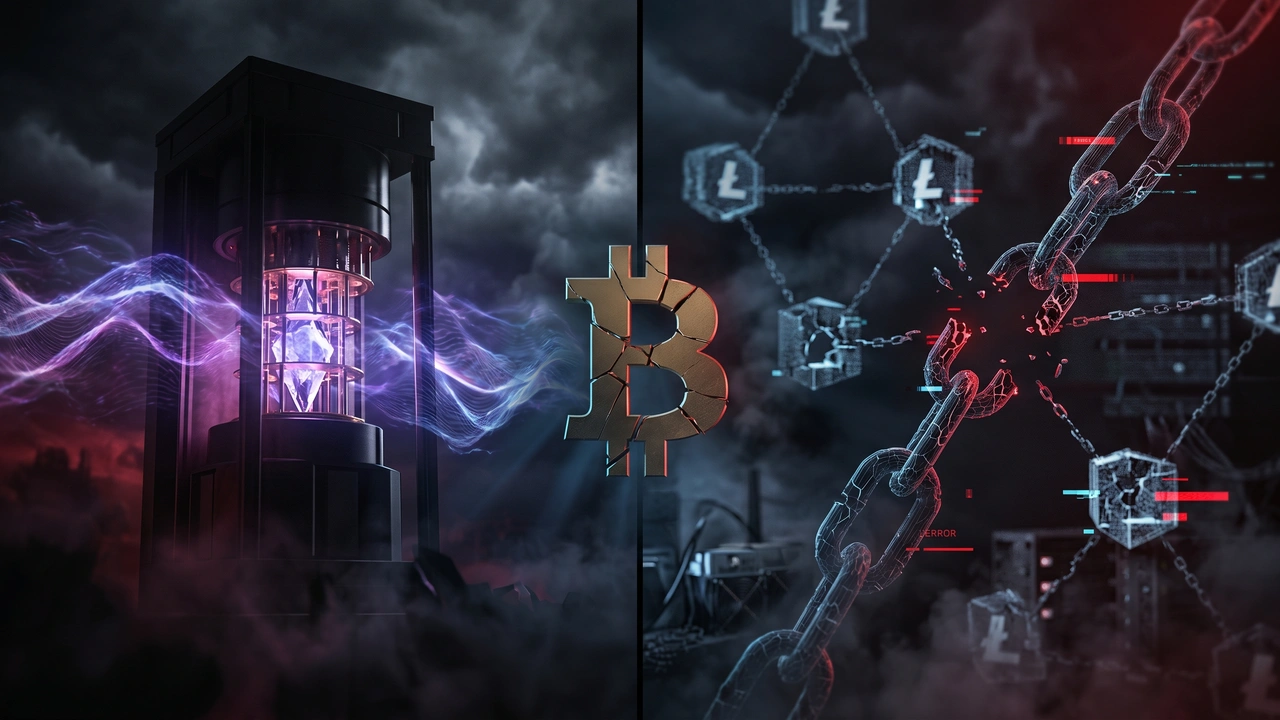
As theorists debate whether quantum computers could one day break Bitcoin's cryptography, a real-world chain reorganization attack on Litecoin's network serves as a stark reminder that blockchain security vulnerabilities are not hypothetical — they are happening now.
Key Takeaways
- Quantum computing is a long-term, manageable risk for Bitcoin, not an imminent threat. The majority of BTC sits behind hash-protected addresses, and a soft fork introducing quantum-resistant cryptography is the most credible mitigation path — one developers are already aware of and capable of executing [1].
- The real near-term danger is not quantum computers but conventional software vulnerabilities. The Litecoin chain reorganization exploited a zero-day flaw in an existing soft fork upgrade, resulting in over three hours of chain disruption and significant double-spend losses [2].
- Protocol complexity is a security liability. Litecoin's MWEB privacy layer — a well-intentioned upgrade — became the attack vector. Bitcoin's conservative, minimal-footprint design philosophy offers meaningful protection against this category of risk.
- Cross-chain infrastructure remains the ecosystem's weakest link. The double-spend attacks during the Litecoin incident targeted cross-chain protocols that accepted transactions too quickly. Platforms and users operating across bridges and multi-chain environments carry outsized security exposure [2].
- Burning vulnerable Bitcoin would be a cure worse than the disease. Confiscating coins deemed "at risk" from quantum attacks would fundamentally compromise Bitcoin's property rights guarantees — the very quality that gives the asset its value proposition [1].
When Theory Meets Reality: Blockchain Security Faces a Two-Front War
Bitcoin's security model is frequently described as impenetrable, yet two distinct but thematically connected developments this week have forced a harder look at what "secure" actually means in a rapidly evolving threat landscape. On one front, a respected institutional analyst has offered a measured reassessment of the quantum computing threat — one of the most speculated risks to Bitcoin's cryptographic foundation. On another, Litecoin's network suffered a real, coordinated, and successful attack that exploited a zero-day vulnerability, causing a chain reorganization lasting over three hours. Together, these events illustrate the spectrum of risks facing proof-of-work networks: from the slow, theoretical horizon of quantum computing to the sharp, immediate danger of undiscovered software flaws.
The timing is instructive. While much of the crypto media fixates on price action and macroeconomic catalysts, the infrastructure underpinning these networks is quietly being stress-tested — sometimes by researchers, sometimes by adversaries, and sometimes by both at once.
The Facts
Christopher Bendiksen, Head of Bitcoin Research at CoinShares, addressed the quantum computing debate directly in a recent interview, offering a notably calm but nuanced assessment [1]. He confirmed that while quantum computers could theoretically undermine some of Bitcoin's cryptographic assumptions — specifically the ability to derive a private key from a public key — the threat is far more constrained than headline-grabbing narratives suggest [1].
The critical distinction Bendiksen draws is between address types. Most Bitcoin holdings sit behind hash-based addresses, where the public key is never exposed until a transaction is signed [1]. That brief exposure window — approximately ten minutes on average before a transaction is confirmed and coins move to a new address — is the only realistic attack surface. Older Pay-to-Public-Key addresses, where the public key is permanently visible on-chain, represent the most vulnerable category, though even compromising those would require attacking thousands of individual addresses sequentially, making it a slow process rather than a sudden market catastrophe [1]. "Bitcoin can be adapted relatively easily," Bendiksen noted, pointing to a potential soft fork introducing quantum-resistant cryptography as the most plausible mitigation path [1]. He firmly rejected the idea of burning potentially vulnerable coins, calling it a confiscation of property rights that would set a dangerous precedent for the protocol [1].
On the Litecoin front, the threat was anything but theoretical. On April 25th, the Litecoin network suffered a chain reorganization attack tied to a zero-day vulnerability in its MimbleWimble Extension Block (MWEB) privacy layer [2]. Attackers manipulated outdated mining nodes into accepting invalid MWEB transactions as legitimate, allowing them to fabricate unauthorized LTC on the main chain [2]. Simultaneously, major mining pools were hit with coordinated denial-of-service attacks, compounding the disruption [2]. The reorganization spanned blocks 3,095,930 through 3,095,943, lasting more than three hours, during which double-spend attacks were executed against multiple cross-chain protocols that had already accepted transactions from now-orphaned MWEB peg-outs [2]. Aurora Labs CEO Alex Shevchenko described the operation as "highly coordinated," estimating exposure for NEAR Intents alone at approximately $600,000 [2]. The Litecoin Foundation subsequently confirmed the vulnerability has been fully patched and that valid transactions from the affected period were preserved in the canonical chain [2]. This was the first successful attack on MWEB since its activation via soft fork in May 2022 [2].
Further context: the Litecoin incident followed a separate major breach just days earlier, in which attackers compromised the LayerZero-operated cross-chain bridge of Kelp DAO, stealing approximately $292 million in rsETH — an attack LayerZero attributed to North Korea's Lazarus Group [2].
Analysis & Context
What makes this week's developments particularly significant is not any single event in isolation, but what they reveal when placed side by side. Bendiksen's quantum computing analysis is reassuring in tone, and largely correct on the technical merits — Bitcoin Core developers are aware of the long-term cryptographic challenge, and the protocol has a clear upgrade path through soft forks. Bitcoin has executed cryptographic migrations before; the transition from Pay-to-Public-Key to Pay-to-Public-Key-Hash addresses was itself a security improvement made decades ago. The network's track record of conservative, consensus-driven upgrades gives reasonable grounds for confidence that a quantum-resistant transition, if and when required, is achievable without catastrophic disruption.
However, the Litecoin attack delivers an important counterweight to complacency. Here is a network that successfully activated a soft fork — MWEB — in 2022, only for a flaw in that very upgrade to become the attack vector three years later. This is not a criticism unique to Litecoin; it is a systemic lesson. Every protocol extension is a new attack surface. The more sophisticated the feature — privacy layers, cross-chain bridges, extension blocks — the greater the potential for unforeseen interaction effects. The double-spend attacks executed through cross-chain bridges during the Litecoin reorganization are particularly telling: they demonstrate how vulnerabilities in one network can propagate financial losses across interconnected ecosystems. For Bitcoin, which has deliberately avoided the kind of complex programmability that creates these vectors, the lesson reinforces the value of conservative protocol design.
The involvement of state-level actors such as Lazarus Group in adjacent attacks also raises the geopolitical stakes of blockchain security. These are not opportunistic script kiddies — they are sophisticated, well-resourced adversaries probing for weaknesses with strategic intent. While Bitcoin's sheer hashrate and network decentralization make it a far harder target than Litecoin, the broader ecosystem in which Bitcoin operates — exchanges, bridges, wrapped token protocols — does not share the same robustness. Investors holding Bitcoin through complex cross-chain structures or on platforms with inadequate security should weigh that risk carefully.
Sources
- [1]btc-echo.de
- [2]btc-echo.de
AI-Assisted Content
This article was created with AI assistance. All facts are sourced from verified news outlets.