Regulatory Offensive Threatens Stablecoin Business and Drives Fintech Upheaval
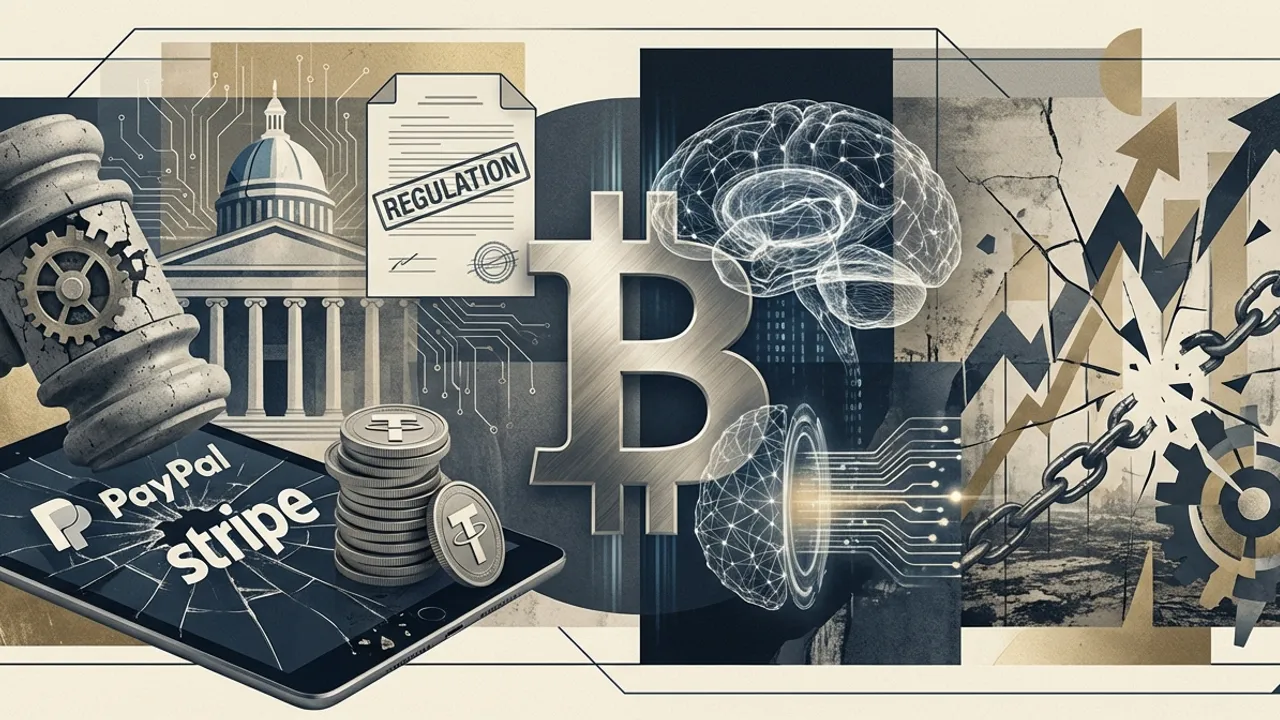
New U.S. regulations target stablecoin providers and could hit PayPal and Stripe hard, while AI-driven restructuring shakes the fintech industry. Investors hope for comprehensive crypto legislation as a catalyst for the second half of the year.
Regulatory Offensive Threatens Stablecoin Business and Drives Fintech Upheaval
The American crypto industry faces a regulatory crossroads that could have far-reaching consequences for established payment service providers, institutional investors, and the entire digital asset market. While the Office of the Comptroller of the Currency (OCC) plans drastic restrictions for stablecoin providers, a parallel AI-driven structural transformation is taking place in the fintech industry—exemplified by the radical restructuring of Jack Dorsey's Block Inc. At the same time, comprehensive market structure legislation could provide the decisive impetus for a recovery in crypto markets.
These seemingly disparate developments form a larger picture: The payments and crypto sector is undergoing a fundamental transformation in which regulatory clarity, technological innovation, and business model adjustments are setting the course for the coming years.
The Facts
The OCC plans harsh restrictions on white-label platforms, specifically targeting stablecoin-as-a-service providers. The regulations prohibit financial rewards on stablecoins, affecting companies like Paxos, Stripe's Bridge division, and Anchorage Digital Bank [1]. The OCC is considering a limitation whereby each issuer may only offer a single token brand—in return, a streamlined approval process beckons [1].
Agency head Jonathan Gould emphasized the proposal's protective mechanisms before the Senate, which are intended to significantly reduce the likelihood of deposit flight. His institution monitors any capital flight precisely and responds immediately [1]. While some market observers warn against panic and see this merely as a codification of known laws, the restrictions have drastic consequences for crypto players: Coinbase must restructure its agreement around the CRCL ticker symbol into a loyalty program without interest payments. Paxos's arrangement for issuing PayPal's PYUSD coin also faces elimination, as customers there receive four percent returns [1].
Mathew Sigel of Van Eck commented on X: "The OCC guidance merely formalizes what was already contained in GENIUS: We already knew that Coinbase would need to revise its CRCL agreement to make it more like a loyalty program rather than interest on deposits" [1]. The law takes effect eighteen months after passage or one hundred twenty days after final regulations are issued, whichever deadline comes first [1].
Parallel to this regulatory offensive, payment service provider Block Inc. is undergoing a radical restructuring: The company is reducing its global workforce by over 4,000 positions, shrinking by more than 40 percent to just under 6,000 employees [2]. CEO Jack Dorsey explicitly attributes this drastic cut not to macroeconomic difficulties, but to the imperative and rapid integration of artificial intelligence into all of the company's business processes [2].
According to Dorsey, new AI tools enable the construction of significantly flatter hierarchies and fundamentally change corporate governance. Management prefers a hard, immediate cut to gradual, trust-damaging reductions [2]. Economically, Block continues to operate on solid ground, generating gross profit of $10.4 billion in 2025 [2]. The market immediately rewarded the strategic restructuring: Block stock rose more than 23 percent in after-hours trading [2]. Despite the massive job cuts, Block is aggressively driving expansion of its Bitcoin ecosystem, activating Lightning payments for four million merchants, which will be conducted completely fee-free through 2027 [2].
Prominent crypto entrepreneur Balaji Srinivasan writes on X: "You either disrupt yourself or you get disrupted." Binance founder Changpeng Zhao adds: "The reality is: Learn to use AI optimally, or get fired" [2].
Comprehensive market structure legislation is considered a potential lifeline for battered crypto markets. JPMorgan expects rising prices in the second half of the year, provided U.S. lawmakers pass corresponding regulations by mid-year [3]. Analysts emphasize that the legislation creates regulatory clarity, ends the controversial practice of regulation by enforcement, and promotes tokenization. At the same time, it significantly facilitates market entry for institutional investors [3].
The so-called CLARITY Act already passed the House of Representatives but stalled in the Senate. Senators are currently debating intensively about closing loopholes in the Genius Act [3]. U.S. Treasury Secretary Scott Bessent suggests the law could be signed by the end of spring, after a White House deadline expires on March 1, by which negotiations between the crypto and banking industries must deliver concrete results [3].
On the prediction market Polymarket, investors estimate the probability of passage this year at around 70 percent [3]. Market observers, however, emphasize the urgency of completion before the midterm elections in the fall, as forecasts point to possible Republican vote losses, which would shift political majority conditions in favor of crypto-skeptical Democrats [3].
Analysis & Assessment
The regulatory developments reveal a fundamental conflict between traditional banking and innovative crypto business models. The OCC guidelines demonstrably aim to pull stablecoins out of the gray zone between payment instrument and interest-bearing investment product. This approach follows a proven pattern: Regulators categorize first before they regulate. For established financial companies like PayPal, however, this means the end of lucrative hybrid models that bound customers through returns.
From an investment perspective, the regulatory intervention certainly holds explosive potential for Bitcoin. The elimination of stablecoin yields forces investors to search for new return sources and potentially drives fresh capital into Bitcoin and Ether as investors reallocate idle capital [1]. This displacement effect could prove to be an unintended consequence of regulatory intervention—similar to how China's 2021 mining ban ultimately contributed to decentralization of hash rate rather than weakening Bitcoin.
Block's drastic AI-driven restructuring signals a paradigm shift in the fintech industry. The fact that the company is laying off 40 percent of its workforce despite solid profits demonstrates the disruptive power of AI automation. Industry observers view this as the first genuine AI-driven cut in the technology sector and warn that established fintechs will cede significant market share to more agile competitors without rapid transformation [2]. Noteworthy is Block's parallel commitment to the Bitcoin ecosystem: The fee-free Lightning integration for four million merchants could prove to be a strategic move that finally makes Bitcoin mainstream as a payment method.
Hopes for comprehensive market structure legislation reflect the industry's longing for regulatory clarity. Experience shows: Crypto markets react extremely sensitively to regulatory signals. Expectations of a more crypto-friendly Trump administration drove Bitcoin above $126,000 in October before the lack of legislative implementation triggered a drastic selloff [3]. The time window until the midterm elections is critical—a shift in majority conditions would significantly complicate passage and could leave the industry in regulatory uncertainty for years.
Conclusion
• OCC regulation of stablecoins ends profitable hybrid business models of established payment service providers and could paradoxically redirect capital into Bitcoin and Ether as investors seek alternative returns
• Block's AI-driven radical restructuring with 40 percent job cuts marks a turning point for the fintech industry and shows that technological disruption forces even profitable companies into drastic measures—simultaneously, Lightning integration for millions of merchants could establish Bitcoin as a payment method
• The time window for comprehensive crypto legislation is closing with the fall midterm elections—passage by mid-year could, according to JPMorgan, provide the catalyst for rising prices in the second half of the year
• The parallel developments—restrictive stablecoin rules, AI transformation, and hoped-for market structure legislation—paint an industry in fundamental upheaval where regulatory clarity and technological innovation will separate winners from losers
• For Bitcoin investors, this means: Short-term volatility due to regulatory uncertainty, but medium-term potentially positive effects through capital reallocation from stablecoins and institutional market access via clear legislation
Sources
- [1]btc-echo.de
- [2]btc-echo.de
- [3]btc-echo.de
AI-Assisted Content
This article was created with AI assistance. All facts are sourced from verified news outlets.