Retail Gets a Seat at the Institutional Table
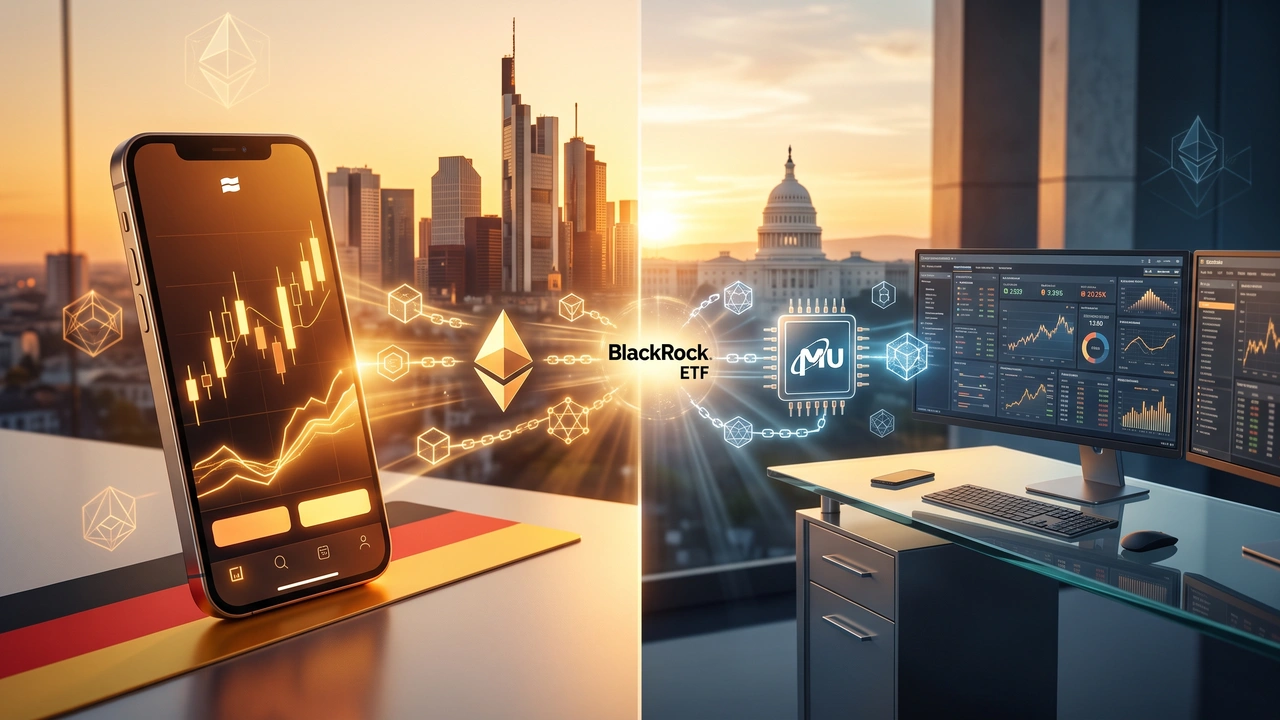
Trade Republic's sweeping platform overhaul and Ondo Finance's push to bring tokenized U.S. equities on-chain signal a convergence: the tools and assets once reserved for professional money managers are rapidly migrating toward everyday investors.
Key Takeaways
- Trade Republic's upgrade from a mobile-only broker to a multi-venue desktop trading platform places professional execution tools - including real-time best-price routing across 30 exchanges - within reach of retail investors for as little as one euro per order.
- The Ondo-Broadridge tokenization pilot demonstrates a working compliance-first model: securities remain inside regulated U.S. custody while existing as tradeable blockchain tokens, with full shareholder rights preserved.
- ONDO's token price showed muted near-term reaction, with technical analysis pointing to a likely consolidation range rather than an immediate breakout, and roughly equal probability assigned to bullish and bearish scenarios.
- The shared theme across both developments is infrastructure democratization - the systematic dismantling of the institutional advantage in market access, execution quality, and asset interoperability.
- For Bitcoin-adjacent investors, both stories reinforce the same second-order point: as on-chain finance becomes more compliant and better-tooled, the addressable market for crypto-native platforms expands materially.
Retail Gets a Seat at the Institutional Table
Two announcements landed this week that, viewed separately, look like routine product updates. Viewed together, they sketch the outline of something more significant: a structural shift in who gets access to sophisticated financial infrastructure - and on what terms. Trade Republic is tearing down the wall between mobile-first retail brokers and full-service trading desks, while Ondo Finance is demonstrating that regulated U.S. securities can live natively on a public blockchain. Both moves point in the same direction: the democratization of financial plumbing.
For anyone tracking where Bitcoin and broader crypto markets sit within this evolution, the timing matters. Platforms are not merely competing on fees anymore - they are competing on infrastructure depth, and the gap between what a hedge fund can access and what a retail investor can access is narrowing faster than most observers anticipated.
The Facts
Trade Republic, one of Germany's most widely used retail brokerages - a platform where customers can already trade equities, ETFs, and cryptocurrencies, including shares of Bitcoin treasury vehicles like Strategy and Metaplanet - has rolled out its most ambitious technical upgrade to date [1]. The centerpiece is connectivity to 30 international exchanges, spanning venues from Xetra to Nasdaq to Euronext [1]. Alongside expanded market access, the neobroker introduced a best-price routing engine that scans live quotes across all connected venues and automatically routes each order to the cheapest available execution point [1]. Standard order costs remain at one euro, while customers who prefer to designate a specific exchange themselves pay two euros per transaction [1].
Perhaps more consequential for the platform's longer-term positioning is the launch of a full web terminal aimed at active traders [1]. Until now, Trade Republic's identity was almost entirely mobile - an app-first experience optimized for simplicity. The new desktop environment flips that script, offering professional-grade charting, real-time data feeds, customizable workspaces, and a derivatives search function [1]. Co-founder Christian Hecker framed the ambition bluntly: "With over 10 million customers, we can give people access to tools and market infrastructure that until now were reserved for institutional investors, banks, and hedge funds."
On the tokenization front, Ondo Finance partnered with financial infrastructure firm Broadridge to demonstrate that mainstream U.S. securities can be issued as blockchain tokens without stepping outside existing American regulatory frameworks [2]. The pilot brought two assets on-chain via Ethereum: shares of Micron, the semiconductor manufacturer, and units of BlackRock's flagship S&P 500 index vehicle [2]. Critically, the underlying securities remain inside the regulated U.S. custody architecture throughout, with each token representing a one-to-one claim on a real-world holding [2]. Holders of these tokenized positions retain full shareholder entitlements - including voting rights at annual meetings and corporate communications delivered through Broadridge's existing investor relations infrastructure [2].
From a market perspective, ONDO's token price traded in a narrow band around $0.33 in the 24 hours surrounding the announcement, with the 14-period RSI sitting near 65 - elevated but not yet signaling an overbought condition [2]. The token found short-term footing above its 20-period exponential moving average at approximately $0.3244, though momentum appeared to be decelerating rather than accelerating [2]. A sustained close above the $0.3395 resistance level would be required to open a path toward $0.3569, while a breakdown beneath $0.3148 would shift the technical picture decisively bearish [2]. Analysts assigned roughly equal 30-percent odds to both the bullish and bearish cases, with a 40-percent base-case expectation of continued range consolidation between $0.32 and $0.335 [2].
Analysis & Context
What connects a German neobroker's desktop terminal to a tokenized Micron share sitting on Ethereum? The answer is the same competitive pressure bearing down on traditional financial gatekeepers from two directions simultaneously. Trade Republic is attacking from the retail side - taking the multi-exchange connectivity and real-time routing that prime brokers have charged institutions handsomely for, and wrapping it in a one-euro flat fee. Ondo is attacking from the asset side - arguing that securities themselves do not need to live exclusively inside legacy custody rails to remain legally compliant and operationally sound.
The Ondo-Broadridge structure is worth examining closely for what it signals about the regulatory moment. Previous tokenization attempts often stumbled on the custody question: if a token and its underlying asset diverge in treatment, who holds the legal claim? By keeping the securities inside existing U.S. depository infrastructure while mirroring them on-chain, the pilot sidesteps that ambiguity entirely. This is less a revolutionary break from the old system than a bridge - and bridges tend to carry more traffic over time than the ferry crossings they replace. If this model holds up under regulatory scrutiny, it could become the template for onboarding trillions of dollars in conventional assets onto public blockchains.
For Bitcoin specifically, the broader pattern here reinforces a theme that has been building for roughly two years: the infrastructure layer around Bitcoin and crypto is maturing faster than the asset class itself gets credit for. Every tool that makes on-chain assets easier to hold, trade, and verify - whether that is a best-price routing engine or a compliant tokenization wrapper - incrementally reduces friction for the next wave of capital entering the space.
Sources
- [1]btc-echo.de
- [2]btc-echo.de
AI-Assisted Content
This article was created with AI assistance. All facts are sourced from verified news outlets.