Riot Dominates Mining Industry – Competitors Falter in AI Race
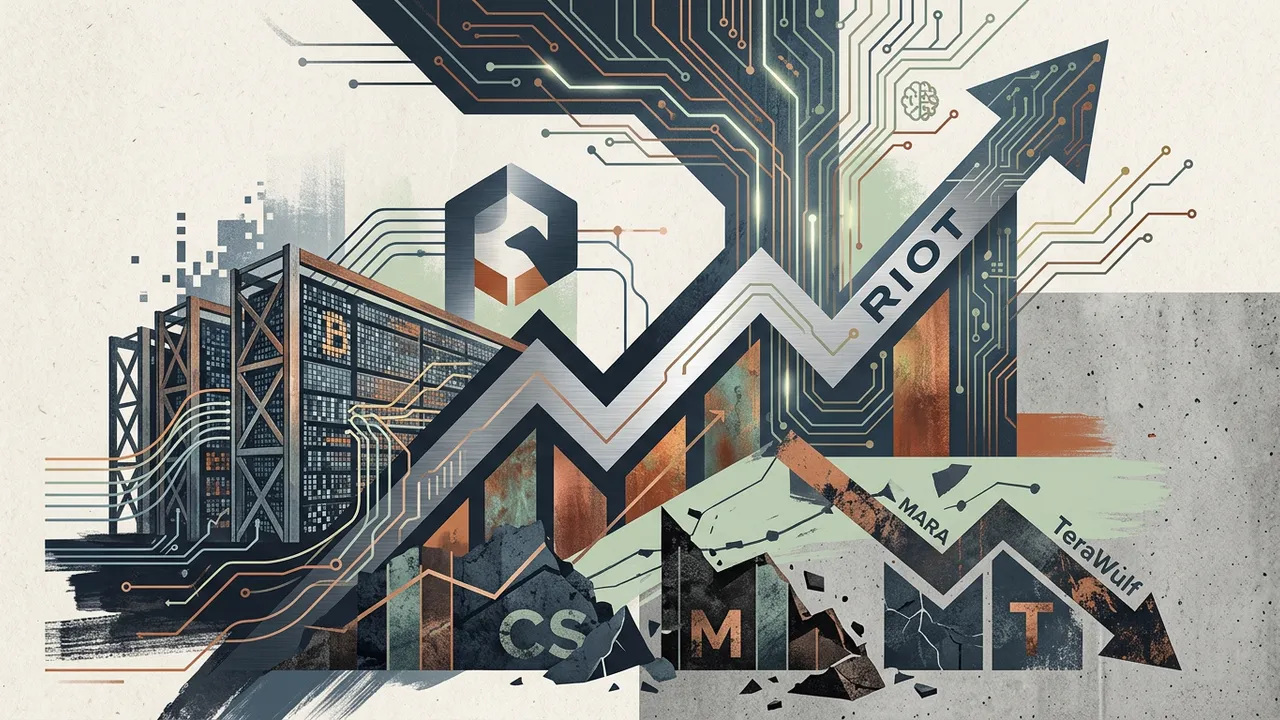
While Riot Platforms reports record revenues of $647 million, Core Scientific, MARA, and TeraWulf struggle with massive losses. The Bitcoin mining industry faces a fundamental shift toward AI infrastructure.
Riot Dominates Mining Industry as Competitors Flee to AI Infrastructure
The Bitcoin mining industry is undergoing a phase of extreme divergence in 2025: While Riot Platforms reports record results and expands its position as the dominant miner, competitors such as MARA Holdings, Core Scientific, and TeraWulf face considerable pressure. The figures reveal more than just different operational efficiency – they show an industry in fundamental transformation, where traditional Bitcoin mining is increasingly being displaced by AI and high-performance computing infrastructure.
This development raises fundamental questions: Are we witnessing a natural market consolidation where only the most efficient miners survive? Or does 2025 mark the end of pure Bitcoin mining as a viable business model for publicly traded companies?
The Facts
Riot Platforms reported record revenue of $647.4 million for 2025 – an increase of 72 percent compared to $376.7 million in the previous year [1]. The revenue jump was primarily driven by mining revenues of $576.3 million, representing an increase of $255.3 million [1][2]. The company produced 5,686 Bitcoin over the course of the year, compared to 4,828 BTC in 2024 [1][2].
However, cost structures deteriorated dramatically even at Riot: Average costs per mined Bitcoin rose from $32,216 to $49,645 – excluding depreciation [1][2]. Riot attributed this cost increase to a 47 percent rise in global network hashrate, which significantly increased mining difficulty [1][2]. This effect was partially offset by a 68 percent increase in power credits received [1]. Despite record revenues, Riot reported a net loss of $663 million due to accounting adjustments and changes in the book value of Bitcoin holdings [1][2]. Adjusted EBITDA stood at $13 million [1][2].
At year-end 2025, Riot held 18,005 Bitcoin on its balance sheet, including 3,977 BTC pledged as collateral [1]. At a Bitcoin price of $87,498 at year-end, this corresponded to a value of approximately $1.6 billion [1]. Additionally, the company had $309.8 million in liquid assets, of which $76.3 million were restricted [1].
Competitors struggled significantly more: Core Scientific reported fourth-quarter revenues of only $79.8 million – a decline of 16 percent year-over-year and well below analyst estimates of $122.08 million [1][2]. Mining revenues nearly halved to $42.2 million [1]. The company sold more than 1,900 Bitcoin in January for approximately $175 million at an average price of about $92,100 per BTC [2]. This reduced its holdings from 2,537 BTC at year-end 2025 to only around 630 BTC [2].
MARA Holdings recorded a net loss of $1.71 billion in the fourth quarter – compared to a net profit of $528 million in the previous year [1][2]. Revenues declined 6 percent to $202.3 million [1]. TeraWulf reported quarterly revenues of $35.8 million, down from $50.6 million in the previous quarter – also below expectations [1][2].
The strategic response to this development is remarkably uniform: In January, Riot signed an agreement with chip manufacturer AMD for a data center and sold Bitcoin to acquire 200 acres of land in Rockdale, Texas [1][2]. Activist investor Starboard Value argued that Riot's pivot toward artificial intelligence and high-performance computing could justify a valuation of up to $21 billion, and pushed for acceleration of this transformation [1][2]. Hive, Hut 8, TeraWulf, and Iren are also increasingly converting their mining facilities and power capacities into data centers [1][2]. Core Scientific made clear that Bitcoin mining is essentially phasing out there and is only being continued to meet minimum power purchase requirements [2]. Instead, sites are being converted into colocation data centers for AI and high-performance computing [2].
Analysis & Context
The divergent results of mining companies reveal a fundamental truth about the industry after the 2024 halving: Operational excellence and economies of scale determine survival or failure. Riot's success is not based on fortunate circumstances, but on higher operational hashrate and more efficient cost structures – despite the 47 percent increase in global network hashrate affecting all miners.
The dramatic cost increase from an average of $32,216 to $49,645 per Bitcoin at Riot illustrates the industry's central problem: Mining is becoming structurally unprofitable. At a Bitcoin price around $87,000 at year-end, margins theoretically remain, but they are shrinking dangerously. For less efficient miners like Core Scientific, whose mining revenues nearly halved, the business is already barely viable today.
The nearly synchronous pivot toward AI infrastructure is not a strategic innovation, but an economic necessity. The existing power contracts and infrastructure of mining companies are valuable – but no longer primarily for Bitcoin mining. Core Scientific's explicit statement that mining is only operated to fulfill minimum offtake obligations in power contracts is likely representative of many publicly traded miners.
Historically, this is not the first consolidation wave in the mining industry. After every halving event, inefficient miners exit the market. What is new, however, is the extent of transformation: Instead of simply shutting down operations, companies are completely pivoting to another sector. This is rational – the physical assets and power contracts retain their value – but raises questions about the long-term decentralization of the Bitcoin network. If only a few highly efficient miners like Riot can operate profitably, hashrate inevitably concentrates.
For Bitcoin investors, this development is ambivalent: On one hand, the 47 percent hashrate increase demonstrates the network's robust security. On the other hand, consolidation suggests a possible centralization tendency. The fact that the Bitcoin price remains "remarkably stable" according to sources, thanks in part to massive inflows into US spot BTC ETFs [2], suggests, however, that the market does not view mining consolidation as an existential risk.
Conclusion
• The Bitcoin mining industry is consolidating dramatically: Only highly efficient miners like Riot remain profitable, while the majority of competitors flee to AI infrastructure or suffer massive losses
• Production costs per Bitcoin have risen industry-wide to $49,645 – with a 47 percent increase in global hashrate, mining is becoming structurally unprofitable, not just cyclically
• The nearly synchronous pivot by Core Scientific, MARA, TeraWulf, and others toward AI data centers may mark the end of pure Bitcoin mining as a viable business model for most publicly traded companies
• For the Bitcoin network, this means more security in the short term through higher hashrate, but potentially more centralization among a few efficient miners like Riot in the medium term
• Investors should distinguish between pure Bitcoin miners and hybrid AI infrastructure companies when considering mining stocks – the business models are increasingly diverging
Sources
AI-Assisted Content
This article was created with AI assistance. All facts are sourced from verified news outlets.