Russia's Digital Ruble and the Architecture of State Control
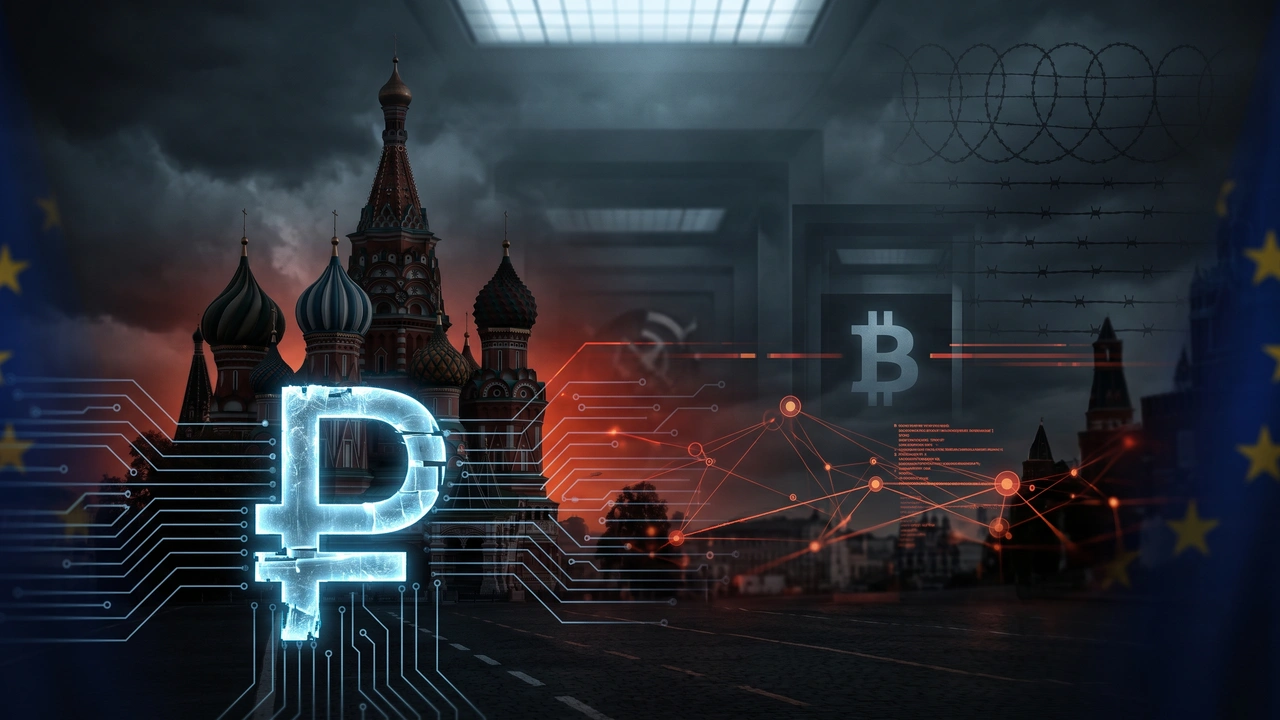
Moscow is weeks away from launching a programmable national currency, while Germany's crypto sector faces its own reckoning. Together, they reveal how state power and financial sovereignty are being redrawn in real time.
Key Takeaways
- Russia has confirmed a September 1 launch date for the digital ruble, with a transition period running to mid-2027, making it one of the most advanced CBDC deployments among major economies.
- The EU has already moved to sanction the digital ruble, signaling that Western governments view programmable state currencies as potential vectors for sanctions evasion - a new front in financial geopolitics.
- A Bitcoin mining fallback exists in Russia's strategic thinking, but real constraints - aging energy infrastructure and restricted access to modern semiconductors - limit how far that path can actually go.
- Stablecoins are being positioned as a cross-border payment complement within Russia's digital currency framework, with the state retaining tight control over their domestic role.
- The structural tension between CBDC-style state control and Bitcoin's censorship-resistant architecture is sharpening, not fading - and how that tension resolves will shape global monetary sovereignty for years ahead.
Russia's Digital Ruble and the Architecture of State Control
When a government issues a currency that can be programmed, traced, and restricted at the transaction level, it does not merely update its monetary plumbing. It acquires a surveillance instrument of historic reach. Russia is about to cross that threshold, and the implications stretch far beyond its borders - touching everything from Western sanctions policy to the fundamental argument for Bitcoin as a censorship-resistant alternative.
Two developments, separated by geography but connected by theme, illuminate how state control over money is accelerating in 2025. Russia is finalizing a central bank digital currency while debating whether Bitcoin mining could serve as a geopolitical workaround. Meanwhile, Germany's crypto industry mirrors its football team's World Cup exit: structurally adrift, short on vision, and badly in need of a rethink [1]. The surface-level comparison is almost comic. The underlying warning is not.
The Facts
Russia's central bank governor Elvira Nabiullina has confirmed a September 1 rollout date for the digital ruble, with a full national transition window extending to July 2027 [2]. The currency is designed to complement - not replace - the existing ruble, and banks along with other financial and credit institutions will be the first required to accept it. The central bank frames the project as broadly accessible, saying it is working continuously on new features to drive adoption among both private citizens and businesses [2].
The rollout has already drawn a political response from Europe. Following Russia's ongoing war against Ukraine, the EU announced restrictions targeting the digital ruble in April, explicitly designed to block Moscow from using its CBDC as a vehicle for evading the existing financial sanctions architecture [2]. The move signals that Western governments view programmable state currencies not merely as monetary innovation but as potential weapons of financial evasion - a concern that carries strategic weight as more countries develop their own CBDCs.
Stablecoins are also part of Moscow's calculus. Russian policymakers have floated the idea of using stablecoins to facilitate cross-border payments, though the central bank's current plan limits their domestic role significantly, treating them as a complement to the digital ruble rather than a competitor [2]. This distinction matters: Russia appears to be building a tiered digital currency ecosystem, state-controlled at home and more permissive abroad, where the priority is bypassing the dollar-denominated correspondent banking system.
If the digital ruble project falters, analyst Jack Jarmon has outlined a fallback scenario in which Russia leans more heavily on Bitcoin and other proof-of-work networks to route around sanctions [2]. However, Jarmon is careful to flag the structural ceiling on that strategy: Russia's energy infrastructure beyond its oil and gas sector is not equipped to absorb a dramatic scaling of Bitcoin mining operations. Western export controls have also cut off access to advanced semiconductors and hardware, leaving Moscow dependent on imports - primarily from China - for critical components [2]. That dependency is a genuine constraint, not a hypothetical one.
Against this backdrop, Germany's crypto sector is fighting a different but equally pressing crisis of legitimacy and direction [1]. The same week that German football collapsed at the World Cup, Bitcoin hit its annual low - a coincidence that BTC Echo treated as a cultural Rorschach test for an industry that has lost its sense of purpose. The parallel is uncomfortable but instructive: both institutions, one sporting and one financial, are being asked to account for a gap between their stated ambitions and their actual performance [1].
Analysis & Context
The most consequential pattern here is the emerging bifurcation of global monetary architecture. On one side, state-controlled CBDCs are advancing - Russia's digital ruble is the sharpest current example, but it sits within a broader wave that includes digital euro research, China's e-CNY rollout, and dozens of smaller national programs. On the other side, decentralized proof-of-work networks like Bitcoin continue to offer an alternative that no single government can program, freeze, or restrict at the protocol level.
The EU's preemptive sanctions against the Russian CBDC are telling. They reveal that Western governments understand CBDCs as geopolitical instruments - not just monetary ones. If a country can issue a programmable currency that routes payments outside SWIFT, outside the correspondent banking system, and outside dollar denomination, existing sanctions infrastructure starts to leak. The EU's response is essentially an acknowledgment that the rules of financial warfare are being rewritten.
Bitcoin's role in this picture is genuinely ambiguous - and that ambiguity is worth sitting with. Jarmon's scenario in which Russia turns to Bitcoin as a sanctions workaround sounds alarming to those who frame Bitcoin as purely a tool for individual financial freedom. But Bitcoin's permissionlessness is precisely what makes it resistant to weaponization by any single state actor: it cannot be programmed to serve Russian state interests any more than American ones. The infrastructure constraints Jarmon identifies - energy limits, semiconductor shortages - further cap how effectively any nation-state can co-opt proof-of-work mining at scale. Bitcoin remains, structurally, a harder tool for state capture than any CBDC will ever be.
Sources
- [1]btc-echo.de
- [2]btc-echo.de
AI-Assisted Content
This article was created with AI assistance. All facts are sourced from verified news outlets.