Scale vs. Serendipity: Bitcoin Mining's Two Faces in 2025
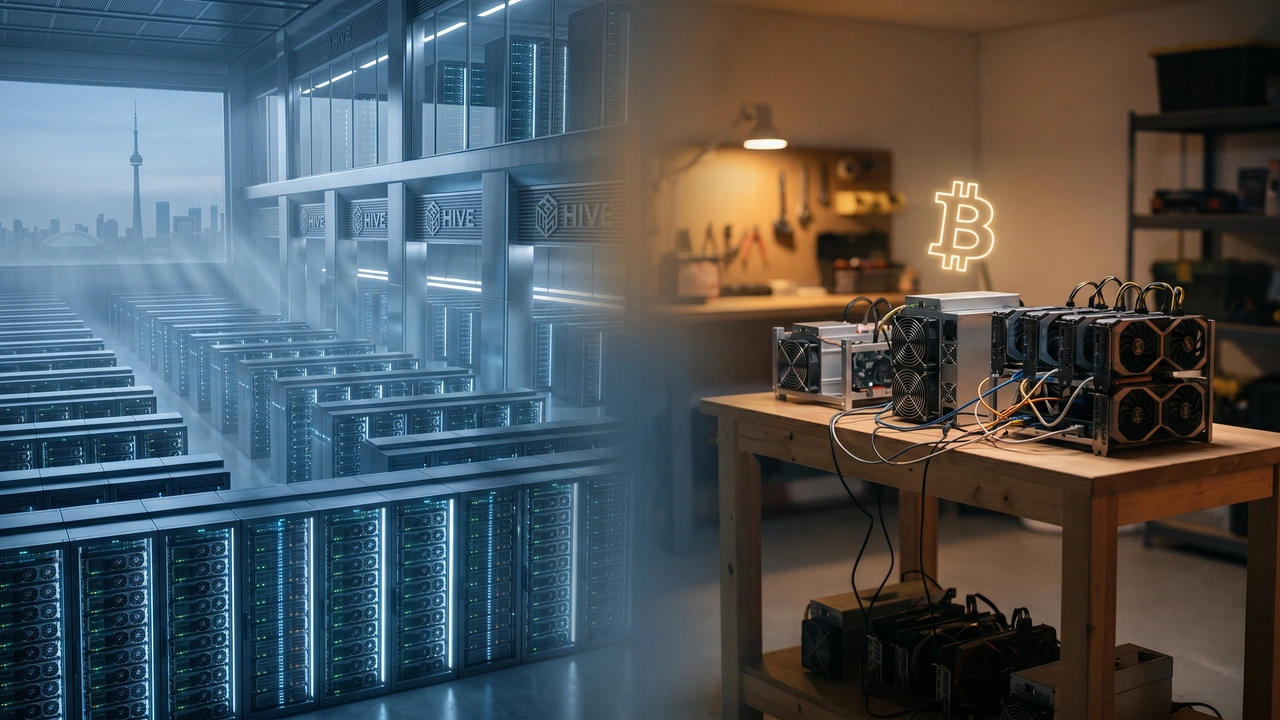
HIVE Digital Technologies posted a dramatic revenue surge while a hobbyist miner with roughly $4,000 worth of hardware beat astronomical odds to claim a $231,000 block reward - together, these stories reveal the widening chasm and unexpected opportunities inside Bitcoin's mining ecosystem.
Key Takeaways
- HIVE's revenue nearly tripled to $297.8 million, but the cost side accelerated even faster, with depreciation alone approaching three times its prior-year level - growth is real but so is the financial strain.
- The company's AI and HPC segment now generates $35 million in annualized contracted revenue, and a 320-megawatt Toronto-area data center project signals a serious long-term bet on compute diversification beyond Bitcoin mining.
- The broader public mining industry is structurally pivoting toward AI infrastructure as a revenue hedge against increasingly competitive and capital-heavy mining economics.
- A solo miner with roughly $4,000 in hardware beat approximately 600,000-to-one odds to claim a $231,000 block reward, demonstrating that Bitcoin's network remains accessible to individual participants even as institutional scale dominates.
- The widening hashrate gap between hobbyist and institutional miners means solo victories will grow rarer over time - but the permissionless design of Bitcoin ensures they remain mathematically possible for anyone willing to run the numbers.
Scale vs. Serendipity: Bitcoin Mining's Two Faces in 2025
Bitcoin mining in mid-2025 is a study in contradictions. At one end sits a publicly traded company nearly tripling its revenue while simultaneously watching costs balloon at an even faster clip. At the other end, a solo operator with a modest rack of consumer-grade hardware defied odds that would make a lottery statistician blush. Both stories broke within weeks of each other, and together they map the full spectrum of how people participate in Bitcoin's proof-of-work economy.
The connecting thread is not just mining itself - it is the question of what the activity is actually becoming. For institutions, mining is increasingly a gateway to AI infrastructure and enterprise computing contracts. For individuals, it remains a low-probability, high-romance pursuit where a single lucky block can generate life-changing returns from almost nothing. Understanding which lane you are in has never mattered more.
The Facts
HIVE Digital Technologies reported total revenue of $297.8 million for its most recent fiscal period, a figure that stands in sharp contrast to the $115.3 million the company recorded a year earlier - roughly a 158 percent jump in twelve months [1]. The overwhelming majority of that figure, $278.3 million, came from cryptocurrency mining, but the more strategically interesting number was the $19.5 million contributed by its high-performance computing segment, which nearly doubled compared to the prior year [1].
The scale of HIVE's expansion helps explain why the profit picture is more complicated than the headline revenue suggests. Depreciation charges alone hit $170.4 million - close to three times the level recorded the year before - and ranked as one of the heaviest line items on the entire income statement [1]. Operating and maintenance expenditures also climbed substantially as the company pushed deeper into both mining infrastructure and data center capacity [1]. Growth at this speed has a price, and HIVE is paying it in full.
On the computing side, HIVE's contracted annualized recurring revenue from its HPC business reached $35 million by the close of the fiscal year, driven by deployments of Nvidia GPU clusters and a growing roster of enterprise clients [1]. The company also disclosed plans for a 320-megawatt AI data center development in the Greater Toronto Area, a project that could eventually accommodate upward of 100,000 graphics processing units [1]. That scale of commitment signals that HIVE no longer sees itself purely as a Bitcoin miner - it is actively repositioning as a diversified compute infrastructure provider.
This pivot is part of a wider shift playing out across the public mining sector. As the economics of Bitcoin mining grow more capital-intensive following successive halvings and network difficulty increases, operators are hunting for alternative revenue streams that can monetize the same power infrastructure and engineering expertise [1]. AI workloads, with their insatiable appetite for GPU compute, have emerged as the most natural adjacent market.
Meanwhile, in a very different corner of the mining world, a solo operator achieved something that probability theory suggests should almost never happen. On the night of May 31, block 915,771 was claimed by a single miner running through the Braiins platform - a setup comprising just fourteen machines, two Canaan Avalon Mini 3 units and twelve Canaan Avalon Nano 3S devices, generating a combined hashrate of roughly 157 terahashes per second [2]. The entire hardware stack was valued at approximately 4,000 euros. The reward was around 3.124 BTC, worth roughly $231,000 at the time [2]. Against a network where major operators like MARA and Bitdeer routinely deploy somewhere between 40 and 80 exahashes per second, this solo miner's contribution represented approximately 0.0002 percent of total network hashrate - making the win a roughly one-in-600,000 probability event [2]. The last comparable solo success had occurred in early April [2].
Analysis & Context
HIVE's cost trajectory deserves careful attention, because it illustrates a structural tension that every scaled miner now faces. When depreciation nearly triples in a single year, it signals that the company is making enormous forward bets on hardware and infrastructure whose economic life depends on Bitcoin price levels and network conditions that cannot be guaranteed. The HPC pivot is a rational hedge - recurring contract revenue from enterprise AI clients provides a buffer that mining alone cannot offer. But it also means HIVE is effectively becoming two businesses simultaneously, each with its own capital demands, and the balance sheet must serve both.
The solo miner's win, meanwhile, is more than a feel-good anomaly. It is a periodic reminder of what Bitcoin's permissionless design actually promises. Solo mining via platforms like Braiins or CKpool is structurally similar to buying a lottery ticket with better-than-lottery odds of meaningful return - and crucially, the winner keeps the entire block reward rather than splitting it proportionally across a pool [2]. Industry observers have noted that these solo wins tend to capture public attention disproportionate to their frequency, which itself serves a function: they reinforce the narrative that Bitcoin's network remains genuinely open to participants at every scale. In a landscape increasingly dominated by institutional-grade operations, that story has real cultural and political weight for the Bitcoin community.
The juxtaposition of these two developments also points toward a longer-term question about what Bitcoin mining's industrial consolidation means for network decentralization. As public miners grow their hashrate and diversify into AI to subsidize expansion, the resource gap between institutional and hobbyist participants widens. Solo wins are becoming statistically rarer simply because the denominator - total network hashrate - keeps growing.
Sources
AI-Assisted Content
This article was created with AI assistance. All facts are sourced from verified news outlets.