Seizures, Satoshi's Coins, and Quantum Risk: Bitcoin's Two Frontiers
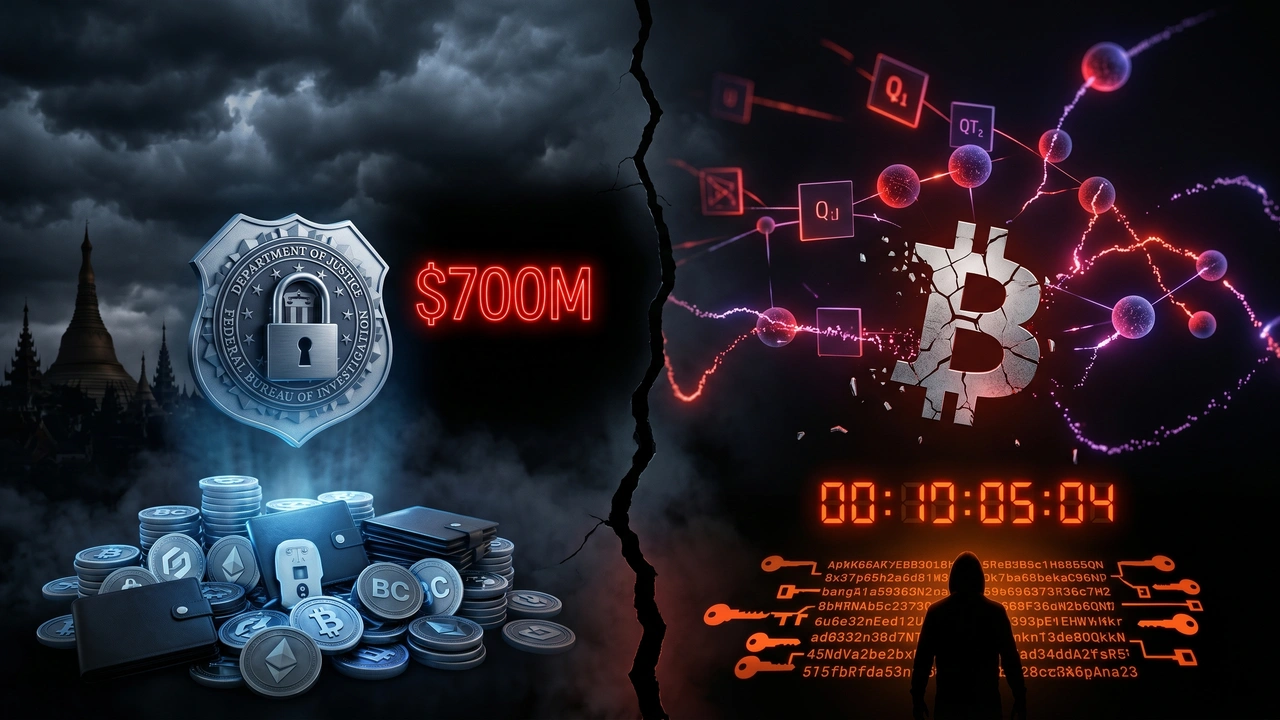
A $700 million government crypto seizure and growing alarm over quantum computing threats reveal a Bitcoin ecosystem navigating both immediate law enforcement realities and longer-term existential technical challenges.
Key Takeaways
- The $700 million DoJ seizure is not just a law enforcement milestone — under Trump's strategic reserve framework, confiscated crypto could flow into U.S. government holdings, blurring the line between crime fighting and sovereign accumulation [1].
- Quantum computing risk has been revised sharply downward in terms of the hardware required: Google now suggests fewer than 500,000 qubits may suffice to break Bitcoin's encryption, with an internal target date of 2029 — compressing the timeline the community has to act [2].
- Approximately 1.7 million BTC in legacy P2PK addresses are permanently exposed to quantum attack, including Satoshi's estimated 1.1 million BTC, which cannot be migrated — making any protocol solution incomplete by design [2].
- Institutional actors are already responding: Jefferies has cut its Bitcoin pension allocation over quantum concerns, signaling that governance inaction carries real capital consequences [2].
- Bitcoin's quantum challenge is ultimately a test of whether a decentralized protocol can achieve rapid social consensus when the stakes are existential — a question with no guaranteed answer, but one that the community must begin answering now rather than waiting for certainty that may never arrive [2].
When the State Reaches In: Bitcoin at the Intersection of Crime, Governance, and Quantum Risk
Two developments unfolding simultaneously in early 2026 illuminate something important about Bitcoin's maturation: the protocol is no longer just a technology experiment — it is infrastructure that governments seize from criminals, institutions hedge against, and developers race to future-proof. One story involves hundreds of millions of dollars in confiscated crypto assets tied to Southeast Asian fraud networks. The other involves a slow-moving governance crisis over quantum computing that, if mishandled, could threaten the integrity of Bitcoin itself. Together, they tell a single story about a network absorbing the weight of real-world consequence.
The Facts
U.S. law enforcement has secured more than $700 million in cryptocurrency assets connected to large-scale investment fraud and money laundering operations based in Southeast Asia [1]. The Department of Justice announced the action as part of its "Scam Center Strike Force," an initiative launched in November 2025, which succeeded in dismantling multiple so-called scam centers across the region [1]. Alongside the asset seizures, investigators shut down over 503 internet domains used as counterfeit crypto investment platforms and took down a Telegram channel with more than 6,000 members that was allegedly used to recruit workers into fraud operations [1].
Two Chinese nationals have been charged in connection with operating a fraud center inside the Shunda complex in Myanmar, where individuals were reportedly held against their will and forced to deceive international victims through fake crypto investment schemes [1]. In one documented instance, a single victim lost more than $3 million [1]. The FBI estimates that crypto investment fraud caused $7.2 billion in losses in 2025 alone — a 24 percent increase over the prior year — though the agency acknowledges the true figure is likely higher, since most victims never report the crime [1].
While the DoJ has stated its intention to return seized assets to victims, the legal framework established by President Trump's executive order in March of last year means that a portion of confiscated digital assets could theoretically be absorbed into U.S. government reserves [1]. That possibility has added political texture to what is otherwise a law enforcement operation.
On the technical frontier, a commentary published by Guillaume Girard of UTXO Management — a subsidiary of Nakamoto Inc. — argues that Bitcoin's quantum computing vulnerability is fundamentally a governance problem, not just an engineering one [2]. Bitcoin's security relies on elliptic curve cryptography, and a sufficiently powerful quantum computer running Shor's algorithm could theoretically derive private keys from exposed public keys, enabling large-scale theft [2]. Research published by Google's Quantum AI team in March 2026 suggested that a machine with fewer than 500,000 physical qubits — dramatically below previous estimates of 10 million — could potentially crack this encryption, with Google internally targeting post-quantum readiness by 2029 [2].
Approximately 1.7 million BTC currently reside in legacy Pay-to-Public-Key addresses where public keys are permanently visible on-chain, making them the most exposed holdings [2]. This includes an estimated 1.1 million BTC attributed to Satoshi Nakamoto — coins that cannot be migrated by any living party [2]. Bitcoin Improvement Proposal 360 (BIP-360), authored by developer Hunter Beast, introduces a new output type designed to eliminate public key exposure from standard transactions and has been merged into Bitcoin's development repository [2]. A companion proposal, BIP-361 by Jameson Lopp, outlines a three-phase migration strategy, though one phase could effectively freeze coins in wallets that fail to transition within a five-year window [2].
The institutional reaction has been notable. Jefferies removed its entire 10% Bitcoin allocation from its pension model portfolio in January 2026, with the firm's global equity strategist explicitly citing quantum risk as a long-term threat to Bitcoin's cryptographic foundation [2]. Michael Saylor has launched a Bitcoin Security Program to coordinate quantum preparedness efforts, framing it as an engineering challenge rather than a crisis [2]. Citi's cybersecurity team has placed a multi-trillion-dollar price tag on the quantum threat to the crypto market broadly [2].
Analysis & Context
The $700 million seizure is striking in scale, but it fits a well-established pattern. Governments have been seizing crypto from criminal enterprises since at least the Silk Road takedown in 2013, when the U.S. confiscated over 144,000 BTC from Ross Ulbricht's operation. What has changed is the institutional infrastructure around those seizures. The creation of a U.S. strategic Bitcoin reserve means the government is no longer just liquidating seized crypto at auction — it is potentially accumulating it as a sovereign asset. That reframes law enforcement actions as having a secondary fiscal dimension. Whether that dynamic ultimately reinforces Bitcoin's legitimacy or deepens regulatory entanglement is a question the market has not fully priced in.
The quantum threat discussion is more complex and, in some ways, more consequential. Girard's framing — that this is a governance crisis, not merely a technical one — deserves serious attention. Bitcoin has navigated contentious protocol debates before: the block size wars of 2015–2017 nearly fractured the network entirely. Those disputes involved ideological differences among a relatively cohesive community of developers, miners, and early adopters. The quantum debate adds a new variable: large institutional holders like BlackRock, who now have both the financial stake and the organizational weight to exert pressure on consensus formation in ways that retail-dominated eras never had to contend with [2]. The marginal Bitcoin buyer is no longer someone running a node in their basement — it is a sovereign wealth fund or a pension manager with fiduciary obligations. That changes the political economy of protocol governance in ways that are still being worked out.
The Satoshi coin problem sits at the uncomfortable center of this debate. Any solution that involves burning or restricting access to those coins — regardless of whether they are quantum-vulnerable — will be seen by some as a form of confiscation and a violation of Bitcoin's foundational property rights guarantees. The alternative, accepting that a quantum attacker could eventually drain those wallets in throttled batches via a mechanism like Hourglass, is a managed form of loss rather than a prevention of it [2]. Neither path is clean. Bitcoin has survived previous existential debates by finding rough consensus over time, but the quantum timeline — particularly in light of Google's revised estimates — may not afford the same luxury of patient deliberation.
Sources
AI-Assisted Content
This article was created with AI assistance. All facts are sourced from verified news outlets.