Self-Custody Grows Up: Yield Wallets and Fort Knox Key Transfers
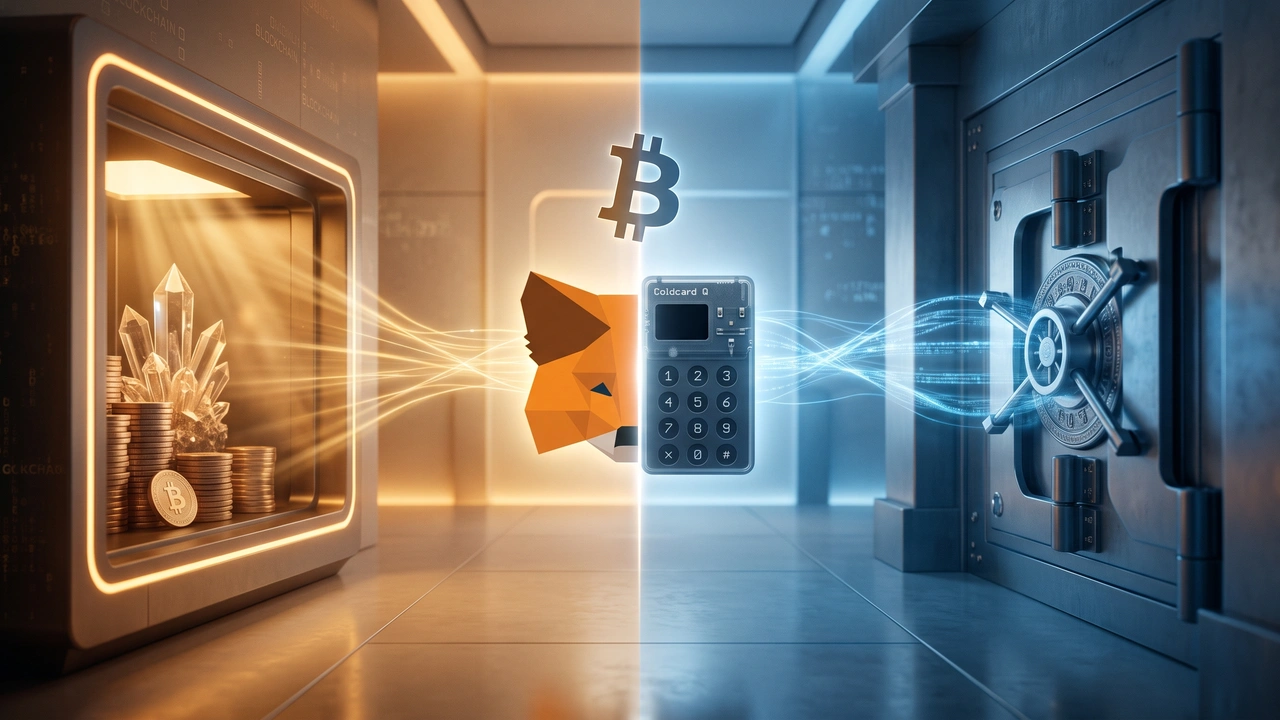
MetaMask's new yield-bearing stablecoin account and Coldcard Q's encrypted Key Teleport feature represent two converging fronts in the maturation of Bitcoin and crypto self-custody - making sovereign finance both more productive and more secure.
Key Takeaways
- MetaMask's mUSD account separates peg collateral from yield generation entirely, meaning the up-to-four-percent return is subject to DeFi market fluctuations rather than any guaranteed rate from the issuer.
- The product's absence from EU and UK markets at launch suggests unresolved regulatory exposure around yield-bearing stablecoin products - a risk factor prospective users outside those regions should monitor.
- Coldcard Q's Key Teleport replaces a technically demanding, expert-level key-transfer process with a purpose-built cryptographic protocol that an AI adversary with both authentication codes could not break.
- Both products advance self-custody by targeting its most persistent weak points: idle capital earning nothing in a wallet, and the operational paralysis that strikes when physical hardware is out of reach.
- For corporate Bitcoin treasury managers running multisig setups, Key Teleport's air-gapped, channel-split design offers a materially safer path to remote transaction signing than any currently available software alternative.
Self-Custody Grows Up: Yield Wallets and Fort Knox Key Transfers
For years, critics of self-custody argued that holding your own keys meant sacrificing both convenience and yield. This week, two product developments challenge that assumption from opposite ends of the spectrum. MetaMask is launching a dollar-denominated account that generates passive returns while you spend, and Coinkite is solving one of hardware wallet ownership's most anxiety-inducing edge cases - what happens when your keys are somewhere else and you desperately need them. Together, these developments sketch the outline of a maturing self-custody ecosystem that no longer forces users to choose between security and usability.
The stakes are higher than they might appear. As regulatory pressure tightens around centralized custodians globally, the infrastructure supporting non-custodial finance is becoming mission-critical. Whether you are a retail saver chasing yield or a corporate treasury officer managing multisig cold storage, the tooling available in 2025 looks fundamentally different from anything that existed even two years ago.
The Facts
MetaMask, the wallet product operated by Consensys, is rolling out what it calls a Money Account - a product built around its proprietary stablecoin, MetaMask USD, ticker mUSD [1]. Depositors can earn a variable annual return of up to four percent on their holdings, and the balance is spendable via a linked card [1]. The account launches globally, though residents of the European Union, the United Kingdom, and jurisdictions under international sanctions cannot access it at launch [1].
The yield mechanism is structurally separated from the stablecoin's backing. MetaMask routes deposits into on-chain vaults operated by Veda, which then distributes the capital across established DeFi lending protocols including Aave and Morpho - both generating returns from credit activity rather than from MetaMask or the stablecoin issuer directly [1]. The mUSD peg itself is maintained through US dollar cash reserves and short-duration US Treasury holdings managed by Bridge, a company affiliated with Stripe, with each token intended to hold a strict one-to-one dollar equivalence [1]. Consensys CEO Joe Lubin has noted that yield accrues from the moment funds are deposited and remains available for payments at any time [1]. Holders do not receive any portion of the yield generated by the reserve assets themselves - that income stays with the reserve manager [1].
On identity verification, MetaMask draws a deliberate line. The Money Account itself requires no KYC as a self-custody product, but anyone accessing regulated on-ramps - fiat deposits or the MetaMask Card - must complete identity checks administered by third-party providers rather than Consensys directly [1]. The product currently runs exclusively on the Monad blockchain [1].
On the hardware security front, Coinkite has introduced Key Teleport, a feature exclusive to its premium Coldcard Q device, priced at $249 [2]. The feature is designed for a scenario that every serious Bitcoiner eventually faces: needing to move key material or authorize a transaction when the physical wallet is inaccessible [2]. Before this existed, the most rigorous approach to transmitting a private key remotely involved booting a purpose-built Linux distribution called Tails OS, generating fresh PGP keypairs, and routing the encrypted payload over Tor - a process that, while technically sound, demands significant expertise and patience [2].
Key Teleport replaces that multi-step ordeal with a cryptographic protocol built directly into the Coldcard Q's hardware. Each transfer generates a single-use ephemeral keypair on the secp256k1 curve, the same elliptic curve underlying Bitcoin itself [2]. The receiver's public key is encrypted via AES-256-CTR and displayed as a BBQr code - a QR standard developed by Coinkite that handles larger data payloads than conventional QR formats [2]. The operational security design deliberately splits authentication across two separate communication channels: the QR code travels over one medium such as a video call, while an eight-digit PIN moves through a different channel such as an encrypted messaging app [2]. An attacker would need to compromise both simultaneously to intercept the key material [2]. The transferable data types include quick text messages, full seed word sets, and complete wallet backups inclusive of metadata and custom configuration [2].
Critically, both devices remain fully air-gapped throughout the process - no USB connection to a computer is required, with QR codes and NFC serving as the only data conduits, and the Coldcard Q operating on three AAA batteries [2]. NFC transmission generates a unique link hosted at keyteleport.com, replacing the need for a live video session entirely [2]. When the encrypted payload was subjected to decryption attempts by Claude Opus 4.8, Anthropic's most capable coding model, the AI was unable to recover the underlying secret even when supplied with both PIN codes, concluding that the real lock is a one-time random key residing only on the receiving device [2].
Analysis & Context
The MetaMask Money Account deserves scrutiny on its structural separation claim. DeFi yield layered on top of a fiat-backed stablecoin is not a new architecture - similar constructions have appeared before and carry compounding risk vectors. When the underlying collateral (Treasuries managed by Bridge) and the yield engine (Veda routing through Aave and Morpho) are distinct, users are simultaneously exposed to smart contract risk, counterparty risk on the custodian, and the liquidity assumptions of the lending protocols. That the peg reserve generates no yield for the holder is transparent, but it also means the four-percent figure is entirely dependent on DeFi market conditions, which can compress sharply during periods of low borrowing demand. The EU and UK exclusion at launch signals that Consensys has not yet navigated the regulatory frameworks those jurisdictions require for yield-bearing instruments - which suggests this product may face a meaningful compliance reckoning before it achieves the global reach MetaMask enjoys with its standard wallet.
The Coldcard Q's Key Teleport sits in a different risk category entirely, but the pattern it represents is equally significant. Bitcoin's multisig adoption has accelerated among corporate treasuries and high-net-worth holders over the past few years, and with it comes the operational complexity of managing geographically distributed signers. The traditional answer - fly a signing device to a co-signer or reconstruct a key from backup - is slow, expensive, and creates its own security vulnerabilities. Key Teleport offers a cryptographically rigorous shortcut that does not require the user to trust any intermediary's hardware or software stack beyond Coinkite's own open-source firmware documentation. The decision to build this exclusively into the Coldcard Q, rather than offer it as a software solution, reflects a principled bet that the threat model for high-value Bitcoin storage ultimately requires dedicated, purpose-built silicon.
Sources
AI-Assisted Content
This article was created with AI assistance. All facts are sourced from verified news outlets.