Sleeping Giants: What Bitcoin's Awakening Whales Signal for the Market
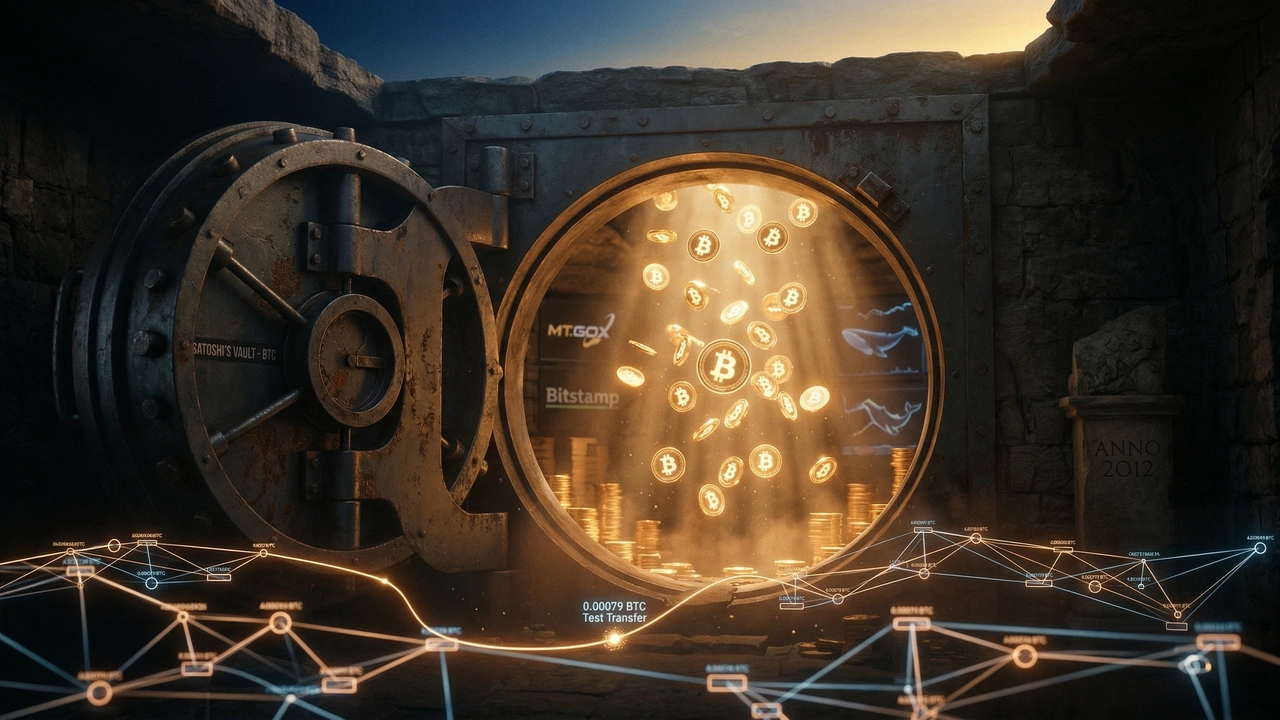
A 13-year-dormant Bitcoin wallet holding 2,100 BTC worth $147 million has stirred back to life, joining a pattern of Satoshi-era giants re-emerging — and the on-chain data is telling a story worth paying close attention to.
Key Takeaways
- A 13-year-dormant wallet holding 2,100 BTC (~$147M) has executed a small test transaction, signaling the holder may be preparing to move a far larger sum — the destination of subsequent transactions will be the critical indicator to watch [1]
- Multiple Satoshi-era wallets have re-emerged within months of each other, including a 909 BTC transfer in January and a 1,000 BTC liquidation just days before this latest event, pointing to a broader pattern rather than isolated incidents [1][2]
- CryptoQuant's Bitcoin Exchange Whale Ratio hit its highest level since July 2024 in March, suggesting institutional and large-holder activity is broadly elevated — not just confined to legacy wallets [2]
- A test transaction does NOT confirm intent to sell; many dormant wallet activations represent key recovery or storage migration rather than distribution — tracking whether coins move to exchanges or cold wallets is essential context
- The convergence of multiple early-holder awakenings with elevated whale exchange ratios historically correlates with increased market volatility; participants should monitor on-chain flows closely as this narrative develops
Sleeping Giants: What Bitcoin's Awakening Whales Signal for the Market
Somewhere in the early days of Bitcoin's existence, someone accumulated 2,100 BTC for roughly $14,000 and then, apparently, walked away. For over thirteen years, through bull runs that minted millionaires and crashes that wiped out entire funds, that wallet sat perfectly still. Now it has moved — and the Bitcoin community is watching every subsequent transaction with the intensity of a hawk circling its prey. This is not an isolated curiosity. It is part of a broader, accelerating pattern of early Bitcoin holders re-emerging from the shadows, and understanding what it means could matter enormously for anyone with skin in the Bitcoin game.
The Facts
On-chain data from BitInfoCharts confirms that the legacy Bitcoin address beginning "1NB3ZX…" received 2,100 BTC on July 5, 2012, when the price of a single Bitcoin hovered around $6.59 [1]. The total acquisition cost at the time amounted to approximately $13,800 — a sum that has since ballooned to a staggering $147 million at current prices, representing a return of more than 10,000x [1]. After sitting completely dormant for nearly fourteen years, the wallet recently executed a transaction of just 0.00079 BTC, equivalent to roughly $56 [1]. Blockchain explorer data from Mempool corroborates the movement, while analytics platform Arkham has noted that the transferred coins have not yet been moved further [2].
The minuscule size of that initial transaction is itself significant. Among long-inactive Bitcoin holders, sending a tiny "test" amount is standard operating procedure — a way to verify that the destination address is correct and that the sender still fully controls the wallet before committing a much larger sum [1]. Whale-watching services including Whale Alert and LookonChain flagged the movement almost immediately, given their close monitoring of so-called Satoshi-era addresses [1].
This event does not stand alone. Just days prior to this latest awakening, a separate wallet address dating back to 2013 liquidated 1,000 BTC worth approximately $71.6 million [2]. Earlier, in January, another Satoshi-era address that had accumulated Bitcoin in 2013 transferred its entire balance of around 909 BTC — worth roughly $85 million at the time — to a new wallet after more than thirteen years of silence, locking in a gain of approximately 13,900x on coins originally purchased for under $7 each [1].
The macro context amplifies these individual data points. According to CryptoQuant's "Bitcoin Exchange Whale Ratio" — a metric tracking the proportion of top-10 exchange deposits relative to total inflows — whale activity reached its highest level since July 2024 back in March [2]. The cumulative weight of these on-chain movements suggests that early Bitcoin holders are becoming meaningfully more active across the board, not merely in isolated cases.
Analysis & Context
The awakening of Satoshi-era wallets has historically been one of Bitcoin's most emotionally charged on-chain phenomena, and for good reason. These wallets represent Bitcoin's origin story — a time when acquiring thousands of coins required either deep technical knowledge or a level of conviction that most people simply did not possess. When they move, the market pays attention, because historically, long-dormant coins finding liquidity have occasionally preceded periods of elevated selling pressure. The logic is straightforward: holders sitting on 10,000x gains have both the means and perhaps the motive to rebalance, diversify, or exit.
However, it is critical not to conflate movement with liquidation. The test transaction pattern observed here is well-documented among early holders who may be recovering access to wallets they feared were lost — rediscovered seed phrases, old hard drives, or recalled private keys. In many of these cases, the holder has no immediate intention to sell and is simply re-establishing control. The January 2025 case, in which 909 BTC moved to a new wallet rather than an exchange, is a textbook example of a holder migrating to more secure or modern storage rather than cashing out [1]. The distinction between "moved to a new wallet" and "moved to an exchange" is the single most important data point to track in the coming days for the 2,100 BTC address currently under scrutiny.
The broader trend of rising whale activity — reflected in CryptoQuant's exchange whale ratio reaching multi-month highs — adds a layer of nuance that cannot be ignored [2]. When large holders become more active simultaneously, it often signals a market inflection point. Whether that inflection is bullish accumulation by new institutional entrants or distribution by early holders is the central question. The fact that multiple Satoshi-era wallets are stirring within the same general timeframe, combined with elevated exchange inflow ratios, suggests the market may be approaching a period of heightened volatility as long-held supply begins to price itself against today's reality. Bitcoin's market is, at its core, a continuous negotiation between conviction and liquidity — and right now, some of the most convicted holders in history are at least picking up the phone.
Sources
AI-Assisted Content
This article was created with AI assistance. All facts are sourced from verified news outlets.