Smart Money Moves to Safety: What It Means for Bitcoin
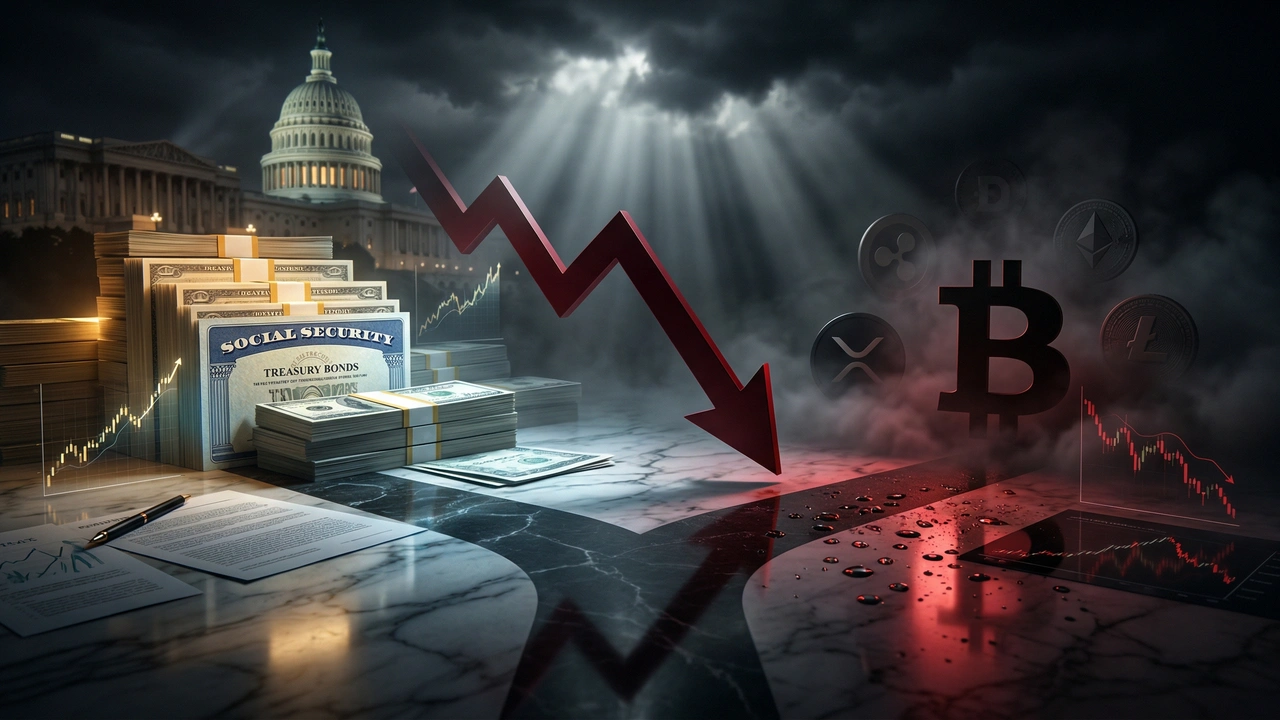
Warren Buffett's $17 billion Treasury bill purchase and Ripple co-founder Jed McCaleb's pivot from crypto to AI signal a broader institutional capital rotation away from risk assets — and Bitcoin may not be immune.
Key Takeaways
- Warren Buffett's $373 billion cash pile and latest $17 billion T-bill purchase signal deep skepticism about current equity valuations — a historically reliable warning sign that precedes broader market stress [2]
- Bitcoin's 0.47 correlation with the Nasdaq means it remains vulnerable to a risk-off equity selloff, undermining its safe-haven narrative in the short term [2]
- Jed McCaleb's redeployment of $1.6 billion in crypto profits into AGI and neuroscience research represents a broader trend of early crypto wealth migrating toward AI — a narrative competition Bitcoin must navigate [1]
- Berkshire's full exit from crypto-adjacent Nu Holdings in Q1 2025 reinforces the institutional pivot away from speculative digital asset exposure, at least among traditional value investors [2]
- Historical precedent suggests Buffett-style cash accumulation eventually transitions into aggressive deployment into undervalued assets — Bitcoin's long-term trajectory could benefit if it is viewed as a bargain asset in the next accumulation cycle
When the Smart Money Speaks, Bitcoin Investors Should Listen
Two of the most consequential capital allocation decisions of recent weeks share a common thread: sophisticated, long-horizon investors are quietly repositioning away from speculative assets. Warren Buffett is hoarding cash at historic levels while betting on the safety of US Treasuries. Meanwhile, Jed McCaleb — one of the architects of the XRP ecosystem — is redeploying billions of crypto profits into artificial intelligence research. Together, these moves paint a nuanced but sobering picture for Bitcoin investors navigating an already uncertain macro landscape.
This is not panic selling. This is deliberate, strategic capital rotation by people who have built generational wealth by reading inflection points before the crowd catches on. Understanding their reasoning — and its implications for Bitcoin — is essential for anyone with skin in the game right now.
The Facts
Berkshire Hathaway chairman Warren Buffett disclosed this week that his firm purchased approximately $17 billion in US Treasury bills at the latest auction [2]. The move is consistent with Berkshire's broader cash accumulation strategy: the company closed 2025 holding roughly $373 billion in cash and cash equivalents, up from $334.2 billion the year prior and more than double its end-of-2023 levels [2]. Buffett's message to markets was unambiguous — despite the S&P 500 falling approximately 5.75% from its January record high, he does not view equities as "substantially" cheaper and described the recent pullback as "nothing" compared to historical downturns where markets fell more than 50% [2].
Buffett's risk-off positioning has historically preceded major market dislocations. In 1998, he began trimming equity exposure and raised Berkshire's cash holdings to $13.1 billion, or roughly 23% of total assets — a figure that climbed to nearly $15 billion by mid-2000, just as the dot-com bubble began its devastating unwind [2]. Further reinforcing Berkshire's retreat from risk, the firm fully exited its position in Nu Holdings, a crypto-friendly fintech, during Q1 2025, booking approximately $250 million in profit from a stake built between 2021 and 2022 [2].
On the crypto side of the ledger, Ripple co-founder Jed McCaleb has made his own dramatic capital reallocation. Having received approximately 9 billion XRP as part of his founding allocation — a position Forbes now values at around $3.9 billion — McCaleb is channeling proceeds into his Astera Institute, with plans to invest roughly $1 billion toward artificial general intelligence (AGI) development and a further $600 million into neuroscience research [1]. His stated ambition is to measure brain activity in mice, then primates, and eventually humans, using those insights to develop novel AI architectures [1]. His verdict on his crypto chapter was pointed: "Crypto was in a certain way a big detour" — with AI always being his true destination [1].
For Bitcoin specifically, the macro backdrop compounds these signals. The 20-week rolling correlation between Bitcoin and the Nasdaq currently sits at a positive 0.47, meaning BTC continues to trade more like a technology stock than a safe-haven asset [2]. Analysts have flagged additional headwinds including quantum security concerns, war-driven inflationary pressures, and US recession probability estimates approaching 50% [2].
Analysis & Context
The parallel between Buffett's current posture and his pre-dot-com positioning is not coincidental — and it deserves serious weight. History shows that when Berkshire's cash reserves balloon to outsized proportions relative to its asset base, a market correction of meaningful scale tends to follow within 12 to 24 months. Bitcoin, which was born in the aftermath of the 2008 financial crisis as an alternative to the traditional financial system, has paradoxically spent most of the post-2020 era behaving like a leveraged tech bet. A correlation coefficient of 0.47 with the Nasdaq means that if Buffett is right about equities having further to fall, Bitcoin will likely feel that pressure acutely — particularly in the short to medium term.
McCaleb's pivot tells a subtler but equally important story. The movement of billions in crypto-derived wealth into AI is not a one-off event — it reflects a broader pattern of early crypto wealth seeking the next asymmetric opportunity. This capital migration does not spell doom for Bitcoin per se, but it does underscore a maturing dynamic: Bitcoin increasingly needs to compete for institutional mindshare against AI infrastructure, which is currently capturing the imagination of large-scale allocators in a way that crypto narratives are struggling to match. XRP's stagnation below $1.40 despite the launch of Spot ETFs [1] illustrates what happens when a narrative vacuum forms — even structurally positive catalysts fail to generate sustained momentum.
For Bitcoin bulls, the silver lining is historical precedent. Every major risk-off cycle has ultimately served as a reset that concentrated Bitcoin ownership among higher-conviction holders and cleared out leveraged speculation. If Buffett's cash deployment timeline mirrors 1998–2000, a redeployment phase — where Berkshire and similar institutions move from cash into bargain-priced assets — could eventually include Bitcoin-adjacent or Bitcoin-native exposure, particularly as the ETF infrastructure now makes such allocation far more accessible than it was in prior cycles. The question is not whether Bitcoin survives this rotation, but whether investors can tolerate the turbulence that may precede the next accumulation phase.
Sources
AI-Assisted Content
This article was created with AI assistance. All facts are sourced from verified news outlets.