Solana Ecosystem at a Crossroads: SOL and JTO Face Key Tests
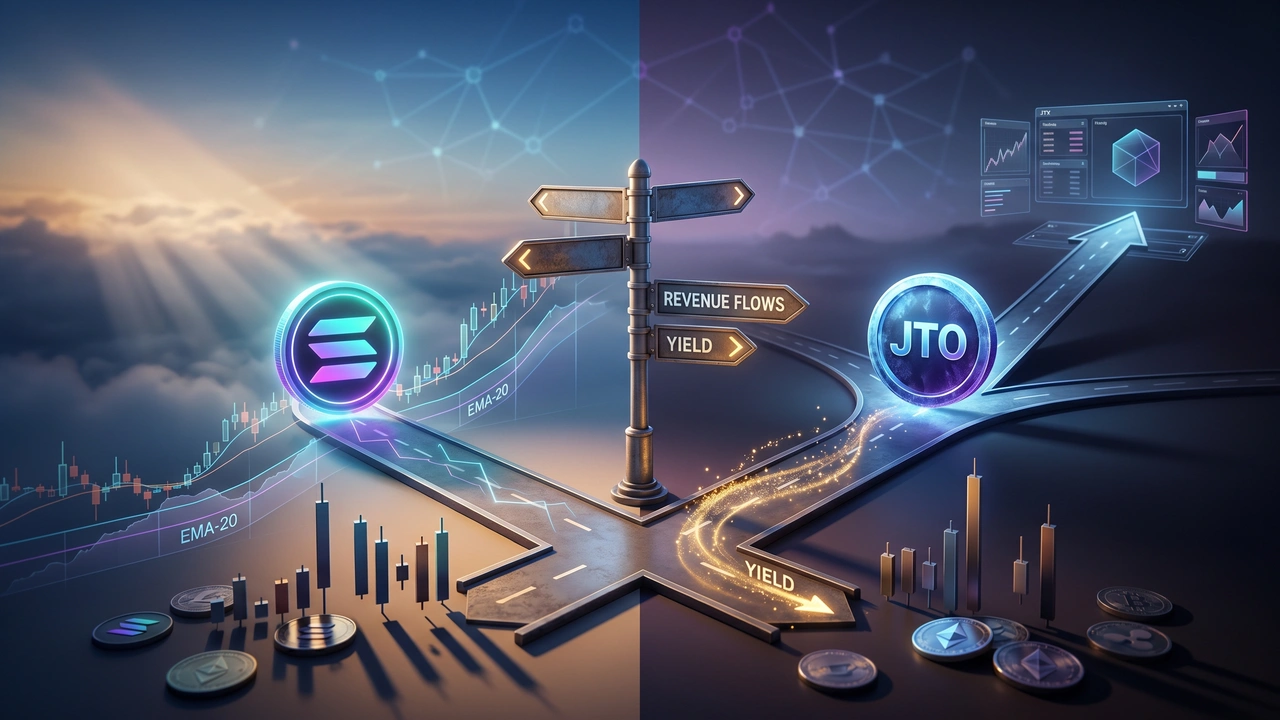
After a partial recovery, Solana and its governance token JTO are both navigating critical technical levels - while a major structural shift in Jito's revenue model could redefine how the ecosystem's value flows to token holders.
Key Takeaways
- SOL recovered approximately 13 percent from its early-month low but now faces a critical test at the EMA-20, which must hold to sustain the bullish case.
- Jito's upcoming JTX platform introduces an 80 percent fee-to-buyback mechanism that gives JTO its first direct economic link to protocol revenues - a structural upgrade to the token's investment thesis.
- JTO trades technically neutral-to-bullish above its EMA-20 near $0.7144, but a close below $0.7172 would shift sentiment bearish and open the door to deeper losses.
- The RSI near 64.9 and softening MACD histogram suggest buying momentum is present but losing steam, warranting caution about chasing the recent move higher.
- The real value of the JTX revenue model hinges on actual trading volume adoption - without it, the buyback program lacks the firepower to offset ongoing token emissions.
Solana Ecosystem at a Crossroads: SOL and JTO Face Key Tests
The Solana ecosystem is sending mixed signals right now. Its native token has clawed back a meaningful portion of early-month losses, yet remains perched at a technical inflection point where bulls must demonstrate real conviction. Meanwhile, Jito - one of Solana's most prominent liquid staking protocols - is rolling out a revenue-sharing framework that could fundamentally alter the investment case for its governance token, JTO. Together, these two developments tell a story about an ecosystem straining to mature: one part chart mechanics, one part tokenomics evolution.
What makes this moment instructive is the tension between short-term price fragility and longer-term structural improvement. The technicals demand attention right now, but the narrative around Jito's upcoming trading platform could shift the medium-term calculus considerably for investors tracking the Solana ecosystem broadly.
The Facts
SOL staged a notable comeback over the past week, adding roughly 13 percent after a sell-off that hit early in the month [1]. That recovery, while encouraging on the surface, has run into a familiar wall: the 20-period exponential moving average, a widely tracked momentum indicator. Bulls must defend this line to keep the recovery thesis alive; losing it would invite renewed selling pressure and meaningfully darken the short-term outlook [1]. Macro headwinds compound the technical risk - a more restrictive central bank posture, should it materialize, could amplify downward pressure across risk assets including crypto [1].
On the JTO front, the token's recent price action was initially sparked by a staking campaign from the exchange Bitget [2]. But the development drawing far greater attention is the scheduled launch of JTX, a unified on-chain trading interface planned for July 2026 [2]. Jito describes JTX as an integrated hub where charting, order execution, portfolio management, and capital allocation converge in a single environment. Spot trading would be available at launch, with perpetual futures and prediction markets joining the platform at a later stage [2].
The structural innovation that has investors talking is the fee arrangement attached to JTX. According to the project, 80 percent of all trading fees generated through the platform will be directed toward open-market buybacks of JTO [2]. This is a significant departure from how JTO has functioned historically - the token has never before had a direct mechanical link to protocol revenue. Whether those buybacks will ultimately offset the ongoing dilution from token emissions remains an open question, but the directional intent is clear [2].
Price-wise, JTO has been volatile in the immediate term. Within a recent 12-to-24-hour window, the token swung between a low of $0.7444 and a high of $0.8278 before settling around $0.7501 - a drop of approximately 11 percent from the prior day's close near $0.8441 [2]. Market capitalization sat at roughly $362 million, providing a frame of reference for the token's liquidity profile [2]. Despite the intraday weakness, JTO continues to hold above its EMA-20, currently near $0.7144, which keeps the immediate technical structure in neutral-to-slightly-bullish territory [2].
Momentum indicators present a nuanced picture. The 14-period RSI reads near 64.9 - high enough to confirm residual buying interest, but not yet in overbought territory [2]. The MACD histogram, however, is softening, pointing to a deceleration in short-term upward momentum [2]. Bollinger Band width has expanded to around $0.4346, reflecting the elevated volatility regime the token currently inhabits [2]. A clean daily close above the $0.8082 resistance level would open a path toward targets in the $0.88-to-$1.50 range, while a breakdown under $0.7172 would shift the bias bearish and bring the $0.60-to-$0.65 zone into play [2].
Analysis & Context
The JTX revenue model deserves particular scrutiny because it represents a maturing pattern within the broader DeFi landscape - one where governance tokens graduate from pure vote-holding instruments to something closer to cash-flow-linked assets. This shift mirrors a transformation Bitcoin observers have watched play out in various forms across crypto cycles: when a token gains genuine economic utility tied to real platform activity, its correlation to speculative sentiment weakens and its floor becomes more defensible.
That said, the 80 percent buyback commitment only creates durable value if JTX actually generates meaningful trading volume. Jito is entering a competitive on-chain trading space where established aggregators and DEX interfaces already command significant liquidity and user loyalty. The announcement catalyzes optimism, but the fundamental test is whether traders migrate to JTX in sufficient numbers to make the buyback engine consequential. History in DeFi suggests that tokenomics improvements without product-market fit tend to front-load the price response and then fade - making execution the variable that separates a structural bull case from a short-lived narrative pop.
For SOL itself, the EMA-20 defense is not just a technical footnote - it reflects whether the broader Solana ecosystem retains the momentum that carried it through earlier recovery phases. A hawkish macro turn from central banks would hit the entire risk asset complex, but high-beta tokens like SOL tend to experience outsized drawdowns in that environment. The confluence of a fragile technical setup and macro uncertainty means the bulls carry the burden of proof in the near term.
Sources
- [1]btc-echo.de
- [2]btc-echo.de
AI-Assisted Content
This article was created with AI assistance. All facts are sourced from verified news outlets.