SpaceX IPO: History Made, Crypto Left Scrambling
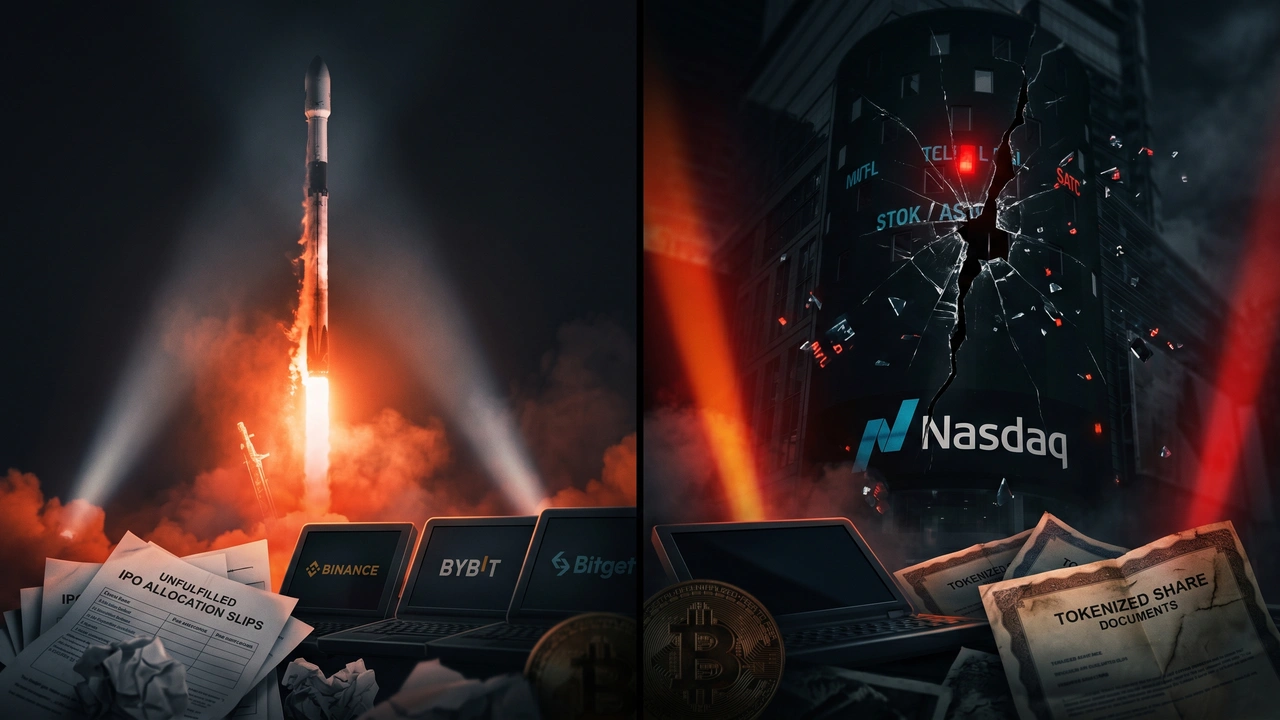
SpaceX's record-breaking Nasdaq debut reshaped the global asset landscape overnight - and exposed deep structural cracks in how crypto platforms promise retail investors access to landmark IPOs.
Key Takeaways
- SpaceX's $2.1 trillion post-IPO valuation made it the largest debut in market history - a milestone that briefly lifted risk appetite across equities and crypto alike.
- Three of the largest crypto exchanges failed to deliver on explicit promises of SpaceX IPO access, exposing a critical gap between product marketing and operational execution in tokenized asset offerings.
- Crypto investors must distinguish between pre-IPO perpetual futures (pure speculation on valuation), tokenized share products (closer to equity but lacking full ownership rights), and actual shares held at a regulated broker - they are not interchangeable.
- Bitcoin's 4.5% weekly recovery appears driven less by SpaceX sentiment and more by a potential U.S.-Iran ceasefire agreement, a geopolitical shift with broader macro implications for risk assets.
- The episode reinforces that the infrastructure for tokenized real-world assets, despite its promise, remains too fragile to reliably serve retail investors during high-demand market events.
SpaceX IPO: History Made, Crypto Left Scrambling
The largest initial public offering in stock market history landed on Friday, and it sent ripples far beyond Wall Street. SpaceX's Nasdaq debut didn't just mint a new financial record - it forced a reckoning across the crypto industry, where major exchanges had promised their users a seat at the table, then quietly handed them an empty chair. At the same time, Bitcoin found an unlikely tailwind in the aftermath, though the real catalyst may have had less to do with rockets than with geopolitics.
For anyone watching the intersection of digital assets and traditional finance, this week crystallized something important: the infrastructure bridging crypto and equity markets remains immature, and the gap between what platforms promise and what they can actually deliver is wider than most retail investors realize.
The Facts
SpaceX priced its shares at $135 apiece ahead of the Nasdaq listing under the ticker SPCX, and the market's verdict was swift and emphatic. By the close of its first trading day, the stock had climbed nearly 24%, settling around $166.84 per share according to Tradingview data [2]. That opening-day surge pushed the company's total market capitalization from a $1.77 trillion IPO valuation to approximately $2.1 trillion when trading ended, according to CompaniesMarketCap figures [1]. That puts Elon Musk's aerospace firm among the seven most valuable companies on earth and inside the top ten most valuable assets globally - an extraordinary positioning for a company that was private until this week [1].
For retail crypto investors, the story took a far less celebratory turn. Binance, Bybit, and Bitget had each told their users in advance that they could participate in the SpaceX IPO through tokenized share products known as xStocks [1]. The demand proved unmanageable. Bybit disclosed to its users that xStocks had been unable to secure the underlying assets, meaning Bybit itself received zero allocation and customers who had registered their interest walked away with nothing [1]. Bitget cited what it called unforeseen market conditions as the reason it could not procure or distribute the SPCXx shares it had committed to offering [1]. Binance acknowledged the same outcome and apologized, attributing the failure to circumstances outside the platform's control [1]. All three exchanges pledged full compensation to affected users; Binance went a step further by announcing a $1 million airdrop of its proprietary SpaceX token, SPCXB, to be distributed by June 18 to everyone who participated in the campaign [1].
The episode also illuminated how fragmented and misunderstood the crypto-native SpaceX product landscape actually was going into the IPO. Across the industry, platforms had been offering at least two fundamentally different instruments under the SpaceX banner for weeks [3]. Pre-IPO perpetual futures - available on Hyperliquid, Coinbase International, Binance, Bitget, and Aster - are derivatives that let traders speculate on valuation expectations without conveying any ownership in the company, no shareholder rights, no dividends, and no claim to actual equity [3]. A separate category, tokenized shares, was offered by Kraken through its IPO Access program via xStocks and by Bybit through its new IPO Express feature - SpaceX was the first listing on both [3]. Tokenized products sit closer to real equity in concept, but they still differ materially from buying the stock outright through a conventional broker, with ownership rights and voting power typically absent [3]. Only MEXC's RealStocks offering, which routes orders through a broker partner, came close to traditional equity access within the crypto ecosystem [3].
Despite the chaos on the product side, Bitcoin absorbed the positive sentiment from the SpaceX listing and closed the week on firmer footing. BTC added roughly 1.3% in the 24 hours around the IPO and ended what had been a particularly rough week with a net gain of approximately 4.5%, trading near $63,800 [2]. U.S. spot Bitcoin ETFs broke a five-session losing streak on Friday, pulling in around $85 million in net inflows [2]. Analysts, however, pointed to a more powerful driver than SpaceX euphoria. President Trump reportedly called off a planned military strike against Iran at the last moment, citing progress in negotiations [2]. Pakistan's president Shebaz Sharif, acting as a mediator in the conflict, suggested that a resolution was closer than it had ever been [2]. Iran's foreign minister Abbas Araghchi confirmed via state television that a draft deal was on the table, covering a ceasefire across multiple fronts, the lifting of U.S. sanctions, and the reopening of the Strait of Hormuz, though he cautioned that the text was not yet finalized [2]. Prediction markets on Polymarket moved sharply in response to those headlines [2].
Analysis & Context
The tokenization failure at Binance, Bybit, and Bitget is not merely an operational embarrassment - it is a signal about structural readiness. The crypto industry has spent considerable energy positioning tokenized real-world assets as a transformative product category, one that democratizes access to assets previously gated behind institutional relationships and geography. What Friday exposed is that the supply chain for sourcing underlying assets at scale, particularly for a high-demand IPO where institutional allocations are already oversubscribed, is nowhere near robust enough to back those promises. When demand overwhelms infrastructure, retail users pay the price.
This matters for Bitcoin specifically because one of the medium-term bull cases for BTC involves the broader legitimization of digital asset infrastructure - tokenized equities, on-chain capital markets, and regulated crypto products drawing new pools of capital into the ecosystem. Every high-profile execution failure chips away at that narrative. Sophisticated institutional money watches these incidents closely, and trust is cumulative.
The geopolitical angle around Iran deserves equal weight in any honest market reading. The correlation between risk assets and Middle East tension has been consistent and measurable across this cycle - Bitcoin tends to compress when conflict probability rises and expand when it retreats. The reported draft peace framework involving the Strait of Hormuz is particularly significant given its role in global energy shipping. A genuine de-escalation there would reduce a systemic risk premium that has been quietly embedded in commodity and risk-asset prices for months. If that framework holds, Bitcoin's Friday move may mark the beginning of a more sustained recovery rather than a brief bounce.
Sources
- [1]btc-echo.de
- [2]btc-echo.de
- [3]btc-echo.de
AI-Assisted Content
This article was created with AI assistance. All facts are sourced from verified news outlets.