Taiwan's Bitcoin Dilemma: Geopolitical Insurance or Premature Bet?
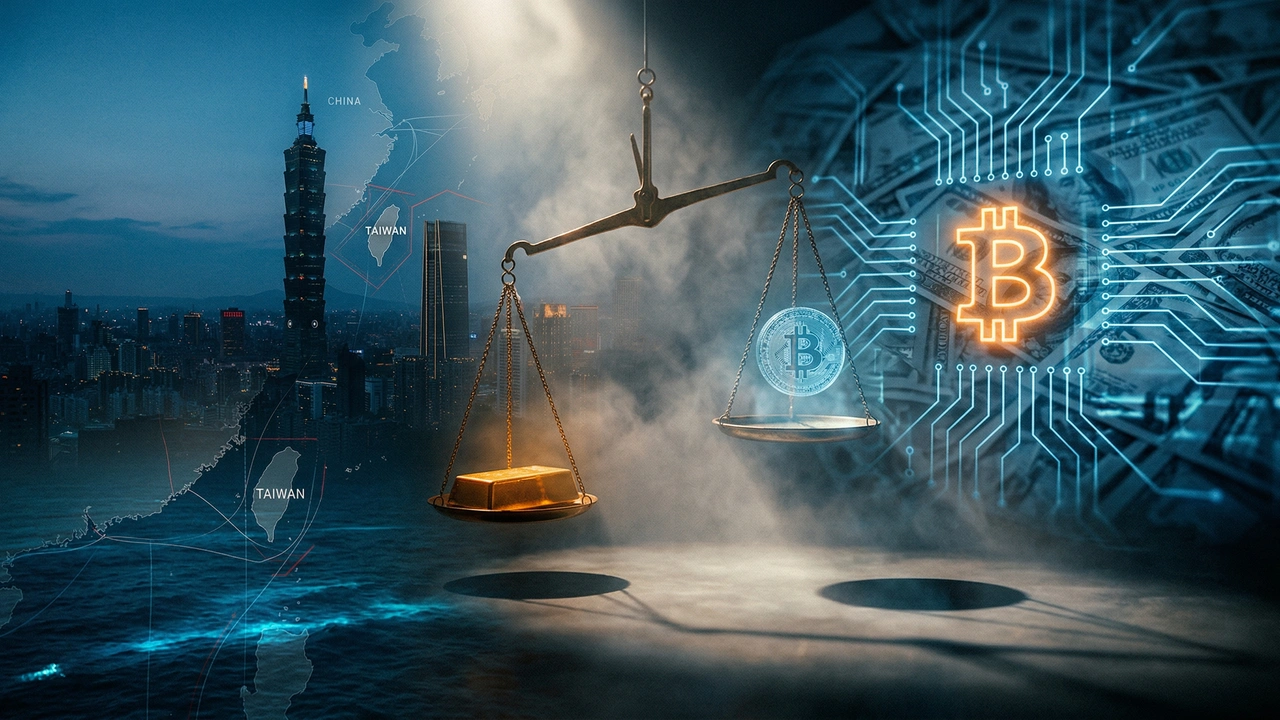
The Bitcoin Policy Institute argues Taiwan's heavy USD dependency and unique military vulnerability make Bitcoin not just a financial hedge, but a potential lifeline in a crisis scenario — yet Taipei's central bank remains unconvinced.
Key Takeaways
- Taiwan's unique geopolitical exposure to potential PRC military action makes the Bitcoin reserve argument qualitatively different from other nations — this is about crisis-accessible liquidity, not just portfolio diversification.
- The CBC's formal rejection of a Bitcoin reserve in December 2024 cited volatility, liquidity, and custody concerns, but critics argue these are solvable institutional challenges rather than fundamental barriers [1].
- Taiwan already holds 210 BTC through its Ministry of Justice — a small but symbolically significant foothold that could serve as the foundation for a deliberate strategic reserve policy [1][2].
- Taiwan's 80%+ USD reserve concentration represents a structural vulnerability that Bitcoin, alongside gold, could partially hedge against dollar debasement risks driven by US fiscal expansion [1].
- The broader nation-state Bitcoin reserve debate is accelerating globally, and Taiwan's decision — whether to act or remain passive — will likely look very different in hindsight depending on how its geopolitical situation evolves over the next decade.
When Geography Meets Monetary Policy: Taiwan's Case for Bitcoin Reserves
In most countries, the debate over holding Bitcoin as a national reserve asset is primarily a financial conversation — about inflation hedges, portfolio diversification, and signaling modernity. For Taiwan, the argument carries a dimension that no other prospective Bitcoin reserve nation faces with the same urgency: the very real possibility that its conventional reserves could become inaccessible overnight. That reframing — from financial instrument to geopolitical lifeline — is what makes the Taiwan Bitcoin debate one of the most compelling and consequential in the nation-state reserve narrative unfolding globally.
As more governments quietly study the concept of strategic Bitcoin holdings, Taiwan represents a unique stress test for the entire thesis. If Bitcoin's censorship-resistance and borderless accessibility mean anything at the sovereign level, this is precisely the scenario where that value proposition is most legible — and most consequential.
The Facts
The Bitcoin Policy Institute (BPI), a Washington-based think tank, has published a research report arguing that Taiwan should reconsider its rejection of Bitcoin as a reserve asset [1]. The report's author, BPI research fellow Jacob Langenkamp, builds his case around two interconnected vulnerabilities: Taiwan's extraordinary exposure to the US dollar and the island's precarious geopolitical position vis-à-vis mainland China.
On the dollar dependency front, Langenkamp notes that at least 80% of Taiwan's central bank reserves are denominated in USD-linked assets, with the majority of its trade also conducted in dollars [1]. This concentration leaves Taiwan acutely exposed to any deterioration in US fiscal health. The report identifies growing American debt levels, Federal Reserve monetary expansion, a potential AI-sector market correction, and declining semiconductor revenues as compounding factors that could accelerate dollar debasement over the medium term [1].
The geopolitical argument is starker still. Langenkamp contends that in the event of a People's Republic of China (PRC) blockade or military invasion, gold reserves would become physically stranded or subject to seizure, while USD reserves could face international restrictions [1]. Bitcoin, operating on a decentralised network requiring no physical transport infrastructure or institutional intermediary, would remain fully spendable under such conditions. As Langenkamp put it: "Bitcoin provides geopolitical resilience: in a PRC blockade or invasion, gold is stranded or seized and USD reserves face potential restrictions, but Bitcoin remains fully accessible without physical transport" [1].
Taiwan's central bank, the CBC, had previously reviewed the concept of a national Bitcoin reserve but formally rejected it in December, citing Bitcoin's price volatility, liquidity constraints, and custody complexity, reaffirming the US dollar as its preferred reserve standard [1]. Despite this, the CBC indicated it would continue experimenting with digital assets in a controlled sandbox environment [1]. Notably, Taiwan is not without Bitcoin exposure entirely — approximately 210 BTC, valued at roughly $14 million, are held by the country's Ministry of Justice, confiscated during criminal investigations [1][2]. Langenkamp suggests these existing holdings could serve as the seed of a more deliberate strategic position [2].
The BPI report acknowledges the CBC's concerns as legitimate, but argues they are addressable through institutional custody expertise and that both volatility and liquidity issues will diminish as nation-state adoption broadens [1].
Analysis & Context
The Taiwan case crystallises something the broader nation-state Bitcoin debate often skirts around: the difference between Bitcoin as a speculative reserve enhancement and Bitcoin as a genuine tool of monetary sovereignty. Every other reserve asset — dollars, euros, gold, SDRs — is ultimately dependent on either a physical supply chain or a network of institutional counterparties that can be pressured, sanctioned, or physically blocked. Bitcoin's architecture was designed, deliberately, to eliminate those dependencies. For most countries, that feature is a theoretical benefit. For Taiwan, it maps directly onto an acknowledged existential risk.
Historically, the precedent for assets serving as crisis-proof reserves is thin and often disappointing. Gold, long considered the ultimate safe haven, proved difficult to access during wartime. The UK famously shipped its gold reserves to Canada during World War II to prevent Nazi seizure. In a modern blockade scenario, similar vulnerabilities apply — you cannot move physical gold through a naval cordon. Frozen USD reserves are equally precedented: witness the freezing of Afghan, Russian, and Venezuelan central bank assets in recent years. Bitcoin's seizure resistance is not merely theoretical; it has been tested repeatedly at the individual level and, increasingly, the institutional level. The question for Taiwan's policymakers is whether they are willing to extrapolate those properties to the sovereign scale.
The CBC's rejection, while understandable from a traditional risk-management standpoint, may reflect an institutional framework ill-suited to evaluating a novel asset class against non-traditional threat vectors. Central banks are structurally conservative — that is by design. But the BPI report's strongest point may be that Taiwan's risk calculus is simply not comparable to that of Switzerland or Norway. When your most pressing reserve concern is not currency fluctuation but potential physical isolation from the global financial system, the volatility that makes Bitcoin uncomfortable in Basel looks considerably more manageable in Taipei. If even a modest allocation — say, 1-3% of reserves — were directed toward Bitcoin, the asymmetric upside in a crisis scenario could far outweigh the mark-to-market volatility costs in peacetime.
Sources
AI-Assisted Content
This article was created with AI assistance. All facts are sourced from verified news outlets.