Tehran Airstrikes Trigger 700% Crypto Exodus as Iran Crisis Tests Bitcoin's Safe-Haven Thesis
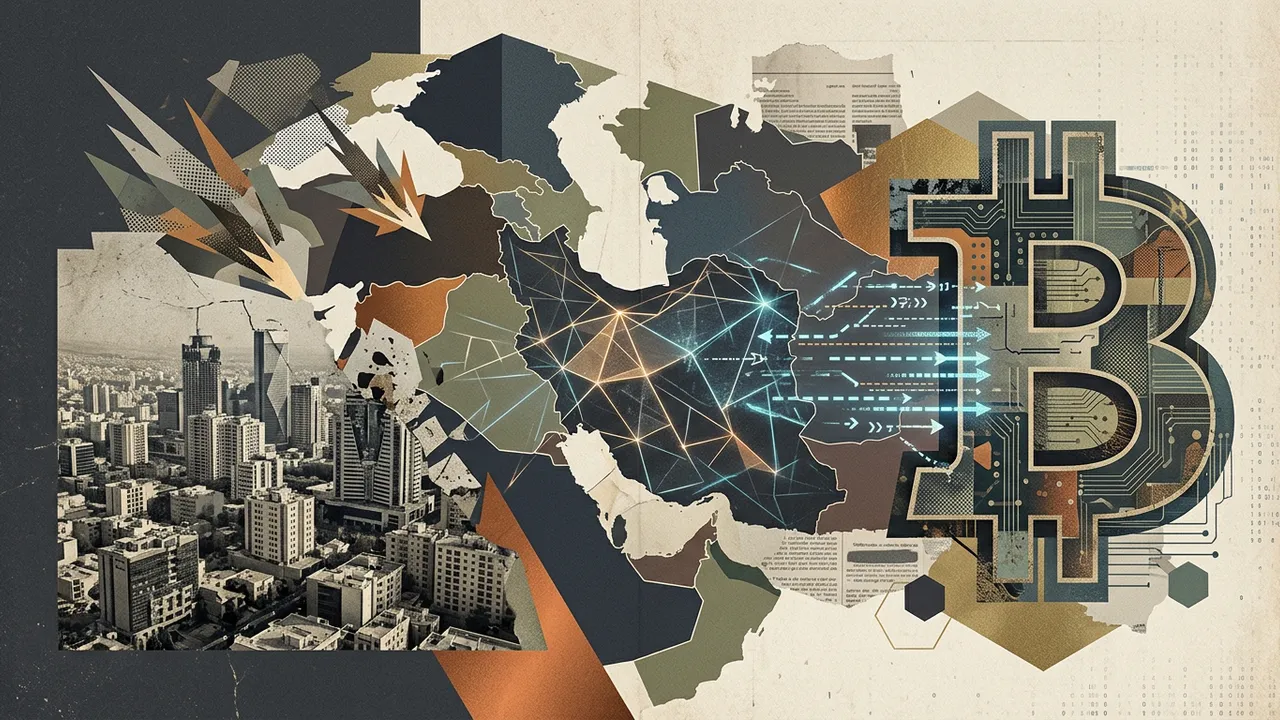
As U.S.-Israeli strikes hit Tehran, Iranians flooded crypto exchanges to move capital out, demonstrating Bitcoin's utility during geopolitical collapse while markets debate whether it's digital safe haven or risk-on tech asset.
Key Takeaways
• Iran's 700% crypto outflow surge during airstrikes demonstrates Bitcoin's functional role as crisis infrastructure, not just speculative asset, with 11 million users accessing financial escape routes when traditional systems failed
• Bitcoin's initial 5% drop followed by recovery to near $70,000 reflects market confusion about whether to treat it as risk-off safe haven or risk-on tech asset—a duality that will likely persist during geopolitical crises
• Sophisticated traders stacking $1.9 billion in put options while simultaneously increasing open interest signals expectations for continued volatility but maintained long-term exposure, suggesting institutional confidence despite short-term uncertainty
• The broader economic context—potential $100 oil, gold at $5,300, and 20% of global oil supply threatened—creates macroeconomic conditions that historically correlate with alternative asset outperformance over medium-term horizons
• Bitcoin's proven utility under maximum state pressure makes it increasingly relevant as geopolitical instability intensifies, but this same characteristic ensures continued tension with sanctions enforcement and regulatory scrutiny
Bitcoin's Dual Identity Faces Real-World Test as Iranian Capital Flees Through Crypto Channels
When missiles struck Tehran on Saturday morning, the response wasn't just military—it was financial. Within minutes, cryptocurrency outflows from Iran's largest exchange surged 700%, revealing a stark reality about Bitcoin's evolving role in global crises. As bombs fell and traditional banking infrastructure became unreliable, millions of Iranians turned to crypto not as speculation, but as survival infrastructure. The episode crystallizes a fundamental question the Bitcoin community has debated for over a decade: Is this truly digital gold that performs during chaos, or merely another risk asset that dumps when markets panic?
The answer, it turns out, may be both—and that duality could define Bitcoin's next phase as geopolitical instability becomes the norm rather than the exception.
The Facts
The U.S.-Israeli strikes—codenamed Operation Roaring Lion and Epic Fury—hit Tehran at 9:45 a.m. local time on Saturday, targeting nuclear facilities, missile sites, and residential areas including the Pasteur district where Supreme Leader Ayatollah Ali Khamenei resided. Iran confirmed Khamenei's death hours later [1].
As news broke, blockchain analytics firm Elliptic recorded a 700% surge in crypto outflows from Nobitex, Iran's largest cryptocurrency exchange, which processed $7.2 billion in transactions in 2025 and serves over 11 million users [1]. The spike represented capital flight executed in real time, with Iranians racing to move money out through crypto channels that bypass the country's sanctioned banking system. Elliptic's tracing showed funds flowing to overseas exchanges that have historically received significant Iranian inflows [1].
"The outflows potentially represent capital flight from Iran that bypasses the traditional banking system," said Dr. Tom Robinson, Elliptic's co-founder [1].
This wasn't Nobitex's first crisis-driven surge. Elliptic flagged similar spikes on January 9 during anti-regime protests and a government-imposed internet blackout, and again when fresh U.S. sanctions were announced. Each time, crypto served as the escape mechanism [1].
Meanwhile, Bitcoin's price volatility reflected market confusion about how to interpret the crisis. The asset plunged from approximately $67,000 to below $64,000—shedding nearly 5% in minutes—as news broke [1]. Total crypto market capitalization dropped $128 billion as forced liquidations cascaded across exchanges. Then came a sharp reversal: speculation that regime decapitation might shorten the conflict briefly pushed Bitcoin above $68,000 before fizzling as Iranian retaliation escalated [1].
By Sunday afternoon, Bitcoin had settled around $65,300, and at time of reporting was approaching $70,000 [1]. "The positive performance of the crypto market today can be explained primarily by a significantly more restrained reaction than anticipated," Thomas Probst, a research analyst at Kaiko, noted, adding that when U.S. equities opened slightly positive on Monday, it reinforced the upward bias [1].
However, options markets told a more cautious story: $1.9 billion in Bitcoin put options stacked at the $60,000 strike price on Deribit indicated sophisticated traders were hedging for worse outcomes [1].
The conflict's broader economic ripples extended to traditional markets. Iran's Islamic Revolutionary Guard Corps announced no vessels would cross the Strait of Hormuz—through which 20% of the world's daily oil supply passes—sending oil futures surging. Goldman Sachs projected oil could hit $100 per barrel if the conflict persists [1].
Meanwhile, gold surged to $5,300, up 1.3% from the previous week, with intraday highs above $5,400 [2]. Bestselling author Robert Kiyosaki, famous for "Rich Dad Poor Dad," predicted that "silver and Bitcoin will take off" following gold's rally, though he acknowledged concerns that "thousands could die in another oil war if this holy war spreads to European and U.S. cities through radical Islamist terror cells" [2].
Analysis & Context
The Iranian exodus reveals Bitcoin's most compelling and controversial characteristic: it works exactly as designed during state collapse, regardless of whether observers find that morally comfortable. For 11 million Iranians, Nobitex wasn't a speculative trading platform—it was financial infrastructure that functioned when everything else failed.
This utility-during-crisis thesis conflicts with Bitcoin's short-term price behavior, which initially looked like classic risk-off selling. The 5% dump when missiles launched fits the "Bitcoin trades like tech stocks" narrative. Yet the subsequent recovery—and critically, the continued function of crypto rails for Iranian capital flight even as bombs fell—suggests something more nuanced is emerging.
Timot Lamarre, director of market research at Unchained, captured this tension: "Much like we saw during the banking crisis of 2023, when the market runs to bitcoin in chaos, it gives a glimpse into more people understanding bitcoin's value in a chaotic world full of counterparty risk" [1]. The 2023 banking crisis saw Bitcoin rally as regional banks collapsed, defying traditional risk correlations.
Historically, Bitcoin has performed this dual function during geopolitical stress: short-term correlation with risk assets as traders de-leverage, followed by medium-term outperformance as the utility case becomes undeniable. During Russia's invasion of Ukraine in 2022, Bitcoin initially dropped 10% before recovering and becoming a primary humanitarian funding channel. Lebanese citizens used crypto to preserve wealth during their banking collapse. Each crisis adds empirical evidence that Bitcoin infrastructure continues functioning when traditional systems fail.
The options market positioning—$1.9 billion in downside protection at $60,000—suggests institutional players expect continued volatility but are maintaining exposure rather than exiting entirely. Open interest climbing on February 28 indicates traders were adding positions, not de-risking, suggesting markets had already priced in geopolitical developments [1].
For Bitcoin's long-term trajectory, the Iran crisis represents a critical test case. If crypto can facilitate $7.2 billion in annual transaction volume under maximum sanctions pressure while providing a functional exit for millions during active bombardment, the utility case becomes harder to dismiss as libertarian fantasy. The challenge remains that this same utility makes Bitcoin a flashpoint in financial warfare between Western sanctions regimes and adversary states—a tension that will intensify, not resolve.
Sources
AI-Assisted Content
This article was created with AI assistance. All facts are sourced from verified news outlets.