The Dollar's Trojan Horse: Stablecoins, Debt, and Bitcoin's Role
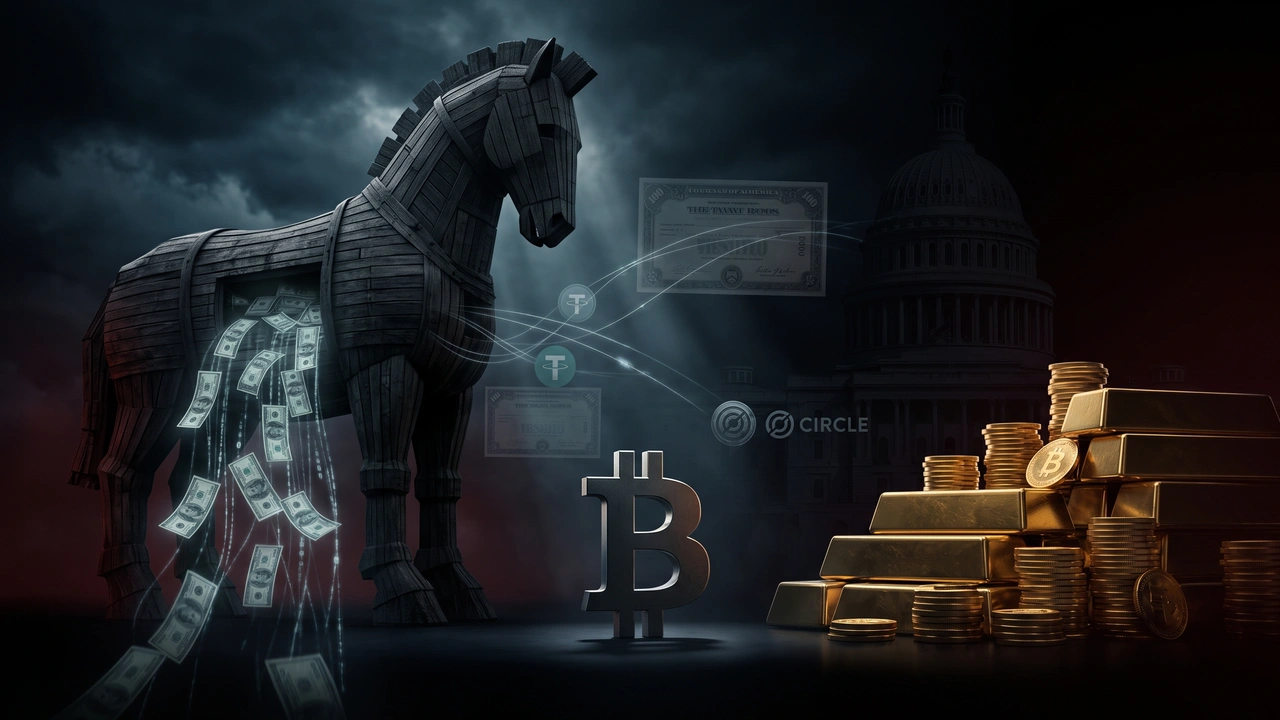
As Robert Kiyosaki admits short-term miscalls while doubling down on hard assets, a parallel revelation is reshaping the crypto landscape: stablecoins may have quietly become the most effective distribution mechanism for U.S. government debt ever devised.
Key Takeaways
- Kiyosaki's gold concession is a reminder that even well-reasoned macro theses play out over years, not weeks - his five-year $35,000 gold target and his Bitcoin conviction both remain unchanged despite near-term price weakness.
- Stablecoins, now required by U.S. law to hold Treasuries as reserves, function as an indirect and rapidly scaling demand source for American sovereign debt - turning crypto adoption into a fiscal policy tool.
- The retreat of foreign central banks from U.S. Treasury holdings, now outpaced by gold in global reserves for the first time, makes stablecoin-driven demand structurally more important to Washington than most market commentary acknowledges.
- Bitcoin's architecture - no issuer, no reserve mandate, no government paper on the balance sheet - makes it genuinely distinct from stablecoins, reinforcing rather than contradicting the hard-asset thesis Kiyosaki and others advance.
- Investors holding stablecoins for autonomy or capital preservation should understand that the regulatory framework makes them indirect creditors of the U.S. government, regardless of their intentions.
The Dollar's Trojan Horse: Stablecoins, Debt, and Bitcoin's Role
Two developments landed this week that, read separately, seem unrelated. Robert Kiyosaki publicly conceded a forecasting error on gold. Cory Klippsten, CEO of Swan Bitcoin, laid out a provocative case for why stablecoins are less a challenge to the dollar system than its most powerful new appendage. Together, these stories illuminate something important about where Bitcoin sits in the broader monetary landscape - and why the distinction between hard assets and dollar-denominated digital instruments has never mattered more.
The through-line is trust - or rather, its gradual erosion. Whether you are talking about a bestselling author admitting markets humbled him, or a Bitcoin executive arguing that crypto's most popular products secretly prop up American sovereign debt, the underlying question is the same: what actually protects wealth when the machinery of fiat finance starts to strain?
The Facts
Kiyosaki took to X to acknowledge that his near-term read on gold had been wrong [1]. The metal has continued sliding, he noted, but he framed the setback not as a repudiation of his thesis, but as an ordinary feature of how markets work - they rise and they fall. His core conviction remains intact: over approximately five years, he believes gold could reach $35,000 [1]. For Kiyosaki, the practical lesson is that entry price determines most of an investor's eventual return, which means weakness phases represent opportunity rather than defeat [1].
His broader investment framework has long centered on a deep skepticism toward fiat currencies and the institutions that manage them [1]. Hard assets - precious metals, real estate, and increasingly Bitcoin - are his preferred hedges against what he describes as a broken monetary system [1]. Kiyosaki treats gold and Bitcoin as belonging to the same category: scarce instruments that could appreciate as confidence in central banks deteriorates over time [1]. Weeks before his gold admission, he had also made headlines by warning that a major financial crash could arrive sometime this year or next [1].
Meanwhile, Klippsten offered a structural argument about stablecoins that cuts against the grain of how much of the crypto industry portrays them [2]. Under the GENIUS Act, which took effect in 2025, dollar-pegged stablecoins must hold their reserves predominantly in actual dollars and short-duration U.S. Treasury securities [2]. The mechanical consequence is straightforward: every new stablecoin issued translates directly into incremental demand for those Treasuries. Klippsten's argument is that this turns major issuers like Tether and Circle into indirect financiers of U.S. government borrowing - a function originally dominated by foreign central banks [2].
The timing of Klippsten's thesis is significant because the traditional buyer base for American debt is visibly shifting. Several sovereign nations have trimmed their Treasury holdings over recent years, while central banks globally have been steadily accumulating gold [2]. A European Central Bank report from June 2026 found that gold now represents 27 percent of worldwide currency reserves, putting it ahead of U.S. Treasuries for the first time at 22 percent [2]. As state-level demand becomes less reliable, Klippsten argues, any new source of structural buying carries outsized strategic weight - and stablecoins are now positioned to fill precisely that gap [2].
The irony Klippsten highlights is sharp. Stablecoins are routinely marketed as tools for financial autonomy - ways to escape currency controls, access dollar liquidity in markets with weak local currencies, and move money without institutional gatekeepers [2]. Yet the regulatory framework governing their reserves ensures that the more adoption grows, the more their issuers become buyers of the very government paper that underpins the system many users thought they were sidestepping [2]. Millions of people holding digital dollars are, in practical terms, acting as creditors to the United States without necessarily recognizing that role [2].
Analysis & Context
The Klippsten thesis deserves to be read alongside the long arc of dollar hegemony, not just as a crypto-specific observation. Washington has historically relied on a combination of geopolitical leverage and genuine economic utility to ensure foreign appetite for its debt. As that dynamic shifts - partly due to trade tensions, partly due to the weaponization of dollar-clearing systems as a sanctions tool - the U.S. has a structural incentive to cultivate alternative buyer pools. Stablecoins, by routing retail and commercial demand for dollar instruments through a crypto-native wrapper, accomplish something that would have required years of policy negotiation through conventional channels. The GENIUS Act begins to look less like crypto regulation and more like sovereign debt strategy.
For Bitcoin specifically, the stablecoin picture clarifies rather than complicates the thesis. Bitcoin carries no reserve requirement, no issuer obligation, and no mandatory exposure to any government's balance sheet. Where stablecoins offer dollar stability while covertly extending the reach of dollar-denominated liabilities, Bitcoin offers a genuinely orthogonal position. Kiyosaki's framing - that BTC and gold occupy the same drawer as scarce, system-independent assets - holds up precisely because Bitcoin, unlike a USDT or USDC, cannot be conscripted into financing anybody's deficit. The current price weakness in both gold and Bitcoin does not alter that structural characteristic. What it does is test whether holders understand the difference between short-term volatility and the long-term thesis they signed up for.
Sources
- [1]btc-echo.de
- [2]btc-echo.de
AI-Assisted Content
This article was created with AI assistance. All facts are sourced from verified news outlets.