The Great Mining Exodus: What It Really Means for Bitcoin
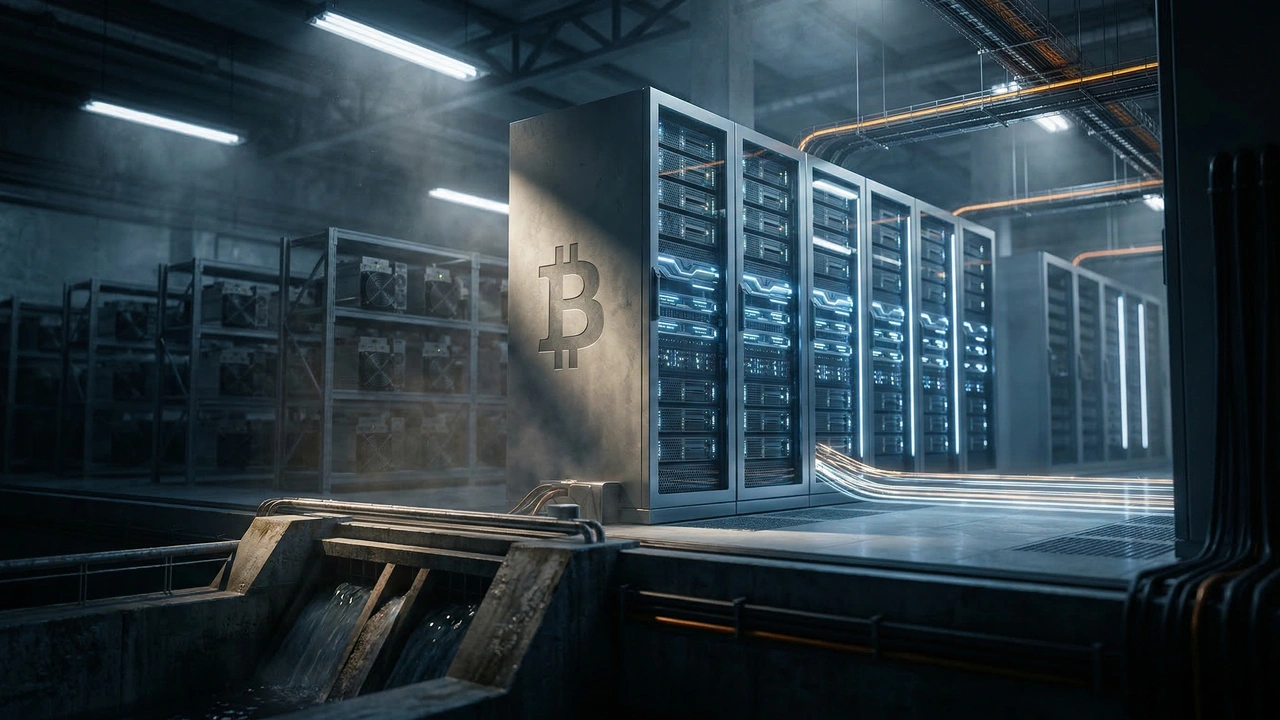
As major miners pivot toward AI infrastructure and nation-states quietly restructure their Bitcoin strategies, a fundamental question emerges: is the mining industry's transformation a threat to Bitcoin's security — or simply the next phase of its maturation?
Key Takeaways
- Bitcoin's network security remains intact: The hash rate near 1,000 EH/s — close to all-time highs — demonstrates that the AI pivot by some miners has not meaningfully compromised Bitcoin's resistance to attack [1].
- The AI transition is financially logical but structurally complex: AI/HPC contracts generate up to 3-4x the revenue per megawatt compared to Bitcoin mining, but capex requirements are also 5-10x higher, meaning the pivot is not a guaranteed path to improved margins [1].
- Bitcoin's difficulty adjustment is the ultimate safety valve: Historical precedent consistently shows that when large miners exit, conditions improve for remaining and incoming participants — the protocol is self-correcting by design [1].
- Bhutan's Bitcoin strategy shift is ambiguous, not necessarily alarming: The absence of mining inflows on known wallets may reflect seasonal energy constraints, a strategic AI pivot, or simply the use of new, untracked wallet addresses — not necessarily an abandonment of Bitcoin [2].
- The next halving will be the real stress test: With block rewards set to halve again in approximately two years, only miners with access to near-zero-cost surplus energy will operate profitably at scale — positioning Bitcoin mining increasingly as an anchor buyer of otherwise wasted renewable energy [1].
The Mining Industry Is Reinventing Itself — and Bitcoin Is More Resilient Than the Panic Suggests
The Bitcoin mining industry is undergoing its most significant structural transformation since the early days of GPU farming in spare bedrooms. Across the board — from publicly listed mining corporations to sovereign-state operations — players are recalibrating their strategies, selling Bitcoin reserves, and in some cases pivoting entirely toward artificial intelligence infrastructure. The alarm bells are ringing loudly in certain corners of the Bitcoin community. But a closer look at the fundamentals reveals a more nuanced and arguably healthier picture than the doomsayers are painting.
Two developments, unfolding simultaneously, tell this story with striking clarity. On one hand, major industrial miners are abandoning or scaling back traditional proof-of-work operations in favor of high-performance computing (HPC) and AI data centers. On the other, the Kingdom of Bhutan — one of the world's most intriguing sovereign Bitcoin miners — appears to have dramatically reduced or potentially halted its mining activity entirely, while aggressively liquidating its Bitcoin reserves. Together, these shifts represent a structural inflection point for the industry.
The Facts
The economics of Bitcoin mining have deteriorated sharply for many operators. High operational costs, thin margins, and intensifying competition have made profitability increasingly difficult to sustain. According to Alexandre Schmidt of crypto asset manager CoinShares, Bitcoin mining currently generates approximately $300,000 to $400,000 per megawatt annually under current market conditions [1]. By contrast, AI and HPC infrastructure contracts can yield up to $1.4 million per megawatt over the same period — a revenue multiple of three to four times [1]. That disparity is proving impossible for many operators to ignore.
The financial appeal of the pivot, however, comes with its own set of challenges. Schmidt notes that capital expenditure requirements for AI data centers are five to ten times higher per megawatt than for traditional Bitcoin mining operations [1]. This cost burden has driven some miners to liquidate long-held Bitcoin reserves to finance the transition — a dramatic departure from the "never sell" treasury strategies many publicly embraced during the bull market.
Meanwhile, on the sovereign side, Bhutan's state investment vehicle Druk Holding and Investments (DHI) has transferred approximately 970 BTC — worth roughly $72 million — within a 48-hour window, reducing the country's identifiable Bitcoin holdings to approximately 4,453 BTC [2]. This is a steep decline from the more than 13,000 BTC the kingdom had accumulated through hydropower-driven mining as recently as October 2024 [2]. Perhaps more telling: on-chain data analyzed by Arkham Intelligence shows that DHI's known wallets have received no significant mining rewards for over a year, with inflows from mining pool Foundry ceasing entirely after November 15, 2024, and Ant Pool transfers stopping by February 8, 2025 [2].
Bhutan has offered no official explanation. Analysts at Arkham have raised the direct question of whether the country has ceased mining operations altogether [2]. Possible explanations range from seasonal energy constraints — Bhutan's hydropower output fluctuates dramatically, with roughly 68% of annual production concentrated in just four summer months — to a strategic pivot toward AI data center infrastructure, which Bhutan formally announced as a national priority in October 2025 [2]. There is also a less dramatic possibility: Bhutan may still be mining but routing rewards to previously unknown wallet addresses, a plausible scenario given that its mining operations were secret for years before being revealed through bankruptcy proceedings involving Celsius and BlockFi [2].
Despite these shifts, Bitcoin's network security metrics remain robust. André Dragosch of Bitwise told BTC-ECHO that the Bitcoin hash rate continues to hover near all-time highs at approximately 1,000 EH/s, even accounting for miners who have diversified away from the network [1]. At that level, the cost of executing a 51% attack remains economically prohibitive for any realistic adversary.
Analysis & Context
The mining industry's pivot toward AI is not without historical precedent in spirit, even if the destination is new. Bitcoin mining companies have always been forced to evolve or die — from the ASIC arms race of 2013 to the post-2018 bear market consolidation that wiped out thousands of small operators and concentrated the industry in the hands of well-capitalized firms. What is different this time is the availability of a genuinely attractive alternative use case for the same core infrastructure asset: cheap, abundant power.
Schmidt's observation about Bitcoin mining's self-correcting mechanism deserves more attention than it typically receives [1]. The protocol's difficulty adjustment algorithm is one of Satoshi's most elegant design choices. When miners exit, difficulty drops, profitability improves for those who remain, and new entrants are attracted back in. This cycle has played out repeatedly across Bitcoin's fifteen-year history — after the 2018 crash, after China's mining ban in 2021, and after each halving event. The current AI pivot is a demand-side disruption rather than a price-driven one, but the underlying incentive structure responds the same way. The next halving, expected in approximately two years, will reduce the block subsidy from 3.125 BTC to 1.5625 BTC, further concentrating mining among operators with access to what Schmidt describes as "near-free" electricity — surplus renewable energy that would otherwise go to waste [1].
Bhutan's situation is particularly instructive because it illustrates how Bitcoin mining functions as a uniquely flexible economic tool for energy-rich but capital-constrained economies. The kingdom built a meaningful sovereign reserve precisely because hydropower generates surplus electricity that had no other monetizable outlet. If Bhutan is indeed transitioning that surplus capacity toward AI infrastructure, it is following the same economic logic — not abandoning Bitcoin, but following the returns. The critical question is whether its energy build-out plan, targeting 20,000 MW by 2040, will generate sufficient surplus to sustain both use cases simultaneously [2]. Given the seasonal dynamics of Himalayan hydropower, that seems plausible.
For Bitcoin's long-term security model, the more important trend is the continued democratization of mining through the accessibility of stranded and surplus energy globally. As large industrial players redirect capital toward AI, the marginal cost advantage shifts toward smaller, geographically distributed operators with direct access to cheap power — exactly the decentralization outcome Bitcoin's design intended to incentivize.
Sources
AI-Assisted Content
This article was created with AI assistance. All facts are sourced from verified news outlets.