Tokenization Goes Public: Two Listings Signal a Structural Shift
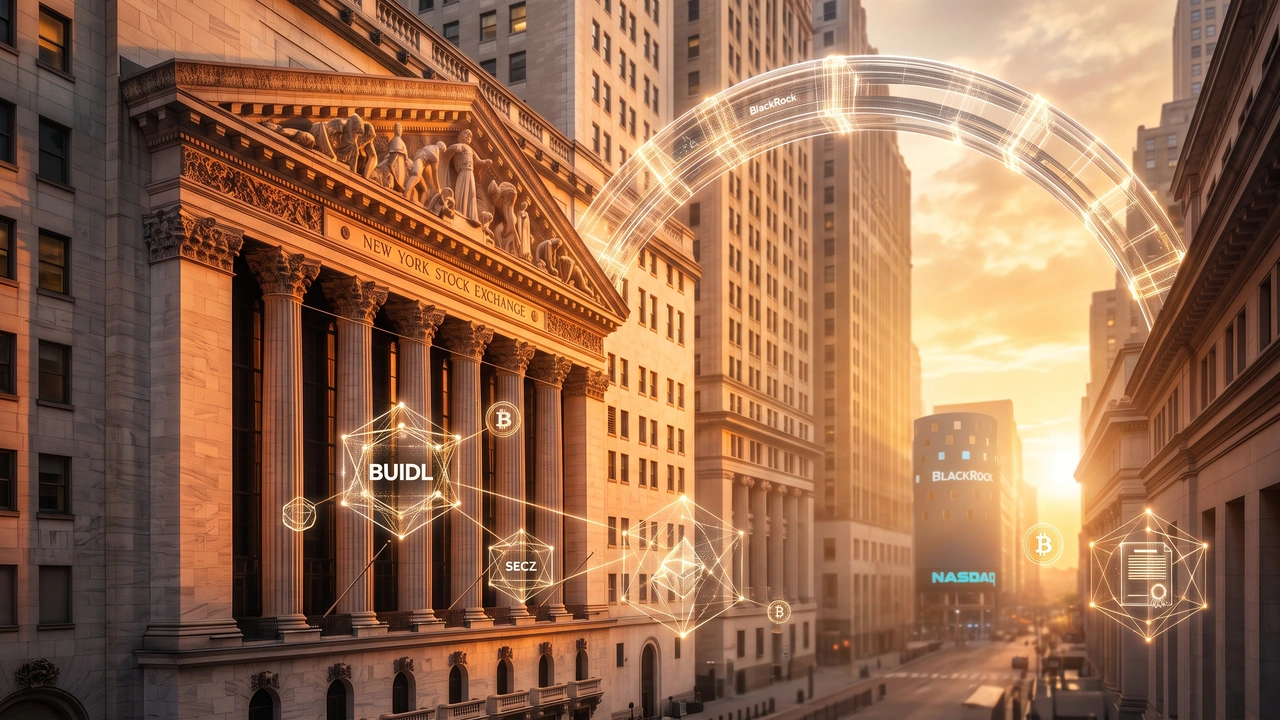
Securitize's NYSE debut and Ionic Digital's Nasdaq filing mark a turning point where blockchain infrastructure stops pitching itself to crypto believers and starts answering to public markets.
Key Takeaways
- Securitize's NYSE listing via SPAC merger delivers roughly $400 million in new capital and puts one of the leading real-world asset infrastructure firms - manager of BlackRock's $3 billion-plus BUIDL fund - directly into the hands of public market investors.
- SECZ offers equity exposure to the tokenization theme without requiring investors to hold individual RWA tokens or crypto assets, but SPAC listings carry well-documented post-merger volatility that should temper near-term expectations.
- Ionic Digital's Nasdaq filing is a liquidity event, not a fundraising exercise - its primary function is giving former Celsius creditors a tradeable market for shares they received through bankruptcy proceedings.
- Ionic's Ward County AI pivot has already reshuffled its revenue mix, with infrastructure leasing generating nearly six times more revenue than Bitcoin mining in Q1 2026, reflecting how quickly former mining assets can be redeployed.
- Together, both listings suggest that digital infrastructure - whether tokenization rails or repurposed compute facilities - is now mature enough to withstand public market scrutiny, and how these stocks trade will serve as a real-world referendum on whether the industry's growth story justifies its valuations.
Tokenization Goes Public: Two Listings Signal a Structural Shift
For years, the tokenization of real-world assets existed largely as a promise - a compelling slide deck argument that traditional finance would one day migrate to blockchain rails. That argument is now being stress-tested in the most unforgiving arena available: the public equity markets. Within weeks of each other, two digital infrastructure companies have moved to list on major U.S. exchanges, and together they sketch the outline of an industry graduating from proof-of-concept to publicly accountable business.
The significance runs deeper than two ticker symbols. What Securitize and Ionic Digital represent are different bets on the same underlying wager - that digitized infrastructure, whether for tokenized treasuries or AI compute, is worth building at scale and funding transparently. How markets price each company will tell the industry something that no white paper ever could.
The Facts
Securitize, one of the most prominent names in real-world asset infrastructure, is headed to the New York Stock Exchange under the ticker SECZ, with trading anticipated to begin on July 2, 2026 [1]. The listing is the product of a merger with Cantor Equity Partners II, a special purpose acquisition company whose shareholders voted to approve the deal. Completion of the transaction is expected on July 1 [1].
The SPAC vehicle brings approximately $400 million in fresh financing to Securitize, including a private investment in public equity component worth $225 million [1]. Notably, fewer than 30 percent of the SPAC's original shareholders exercised their right to redeem shares, meaning the bulk of that capital stays with the company rather than being returned to investors - a stronger vote of confidence than many SPAC transactions produce [1]. CEO Carlos Domingo has described the NYSE move as evidence that tokenization is entering the mainstream, and that public capital markets will provide the company with greater credibility and visibility for its next growth phase [1].
Securitize's existing client roster underscores why that credibility argument carries weight. The firm administers BlackRock's tokenized money market fund, known as BUIDL, which has grown to a value exceeding $3 billion [1]. Additional institutional partners include Apollo, KKR, Hamilton Lane, and VanEck - a lineup that represents trillions of dollars in combined assets under management and signals that Securitize is not operating at the experimental fringes of finance [1]. The broader RWA sector the company inhabits is seeing accelerating migration of conventional assets - government bonds, money market products, private credit instruments - onto blockchain infrastructure [1].
The second listing tells a different story of reinvention. Ionic Digital, a Bitcoin miner with a direct lineage to the collapsed Celsius Network, has filed with the U.S. Securities and Exchange Commission for a direct Nasdaq listing under the proposed ticker IOND [2]. Unlike a traditional IPO or SPAC merger, the listing will not raise new capital. Its purpose is narrower: establishing a liquid public market for existing shareholders, a group that includes former Celsius creditors who received Ionic equity through the lender's bankruptcy restructuring [2].
Ionic was incorporated in 2024 specifically to absorb Celsius Mining's assets out of bankruptcy proceedings, but by 2025 management had begun pivoting the company away from pure Bitcoin mining toward artificial intelligence and high-performance computing infrastructure [2]. The centerpiece of that pivot is a 234-megawatt facility in Ward County, Texas - originally constructed for mining - which Ionic leased to AI infrastructure provider Nscale in October 2025 under a 126-month agreement [2]. That contract represents contracted revenue of nearly $2 billion, with a potential expansion to roughly $2.6 billion if Ionic secures additional capacity and necessary approvals [2].
The financial results are already reflecting the strategic turn. In the first quarter of 2026, Ionic recorded $44 million in revenue from digital infrastructure leasing, while its Bitcoin mining revenue collapsed by 82 percent year-over-year to just $7.4 million as mining equipment was wound down at Ward County [2]. Ionic separately closed a $400 million private equity placement, with CEO Andy Stewart indicating those proceeds would fund continued development of the company's digital infrastructure assets [2].
Analysis & Context
What connects these two very different companies is a pattern the traditional technology industry knows well: the moment infrastructure businesses stop relying exclusively on private capital and begin subjecting themselves to quarterly earnings cycles and retail investor sentiment. That transition rarely goes smoothly in the short term. SPAC-linked listings carry a particular history of post-merger volatility - the first weeks of trading often bear little relationship to the underlying business quality, as early holders lock in gains and price discovery starts from scratch. Securitize investors should brace for that turbulence regardless of how strong the BUIDL partnership looks on paper [1].
The more important long-run question is whether either company can defend its margin structure as competition intensifies. Securitize operates in a space that will almost certainly attract new entrants as RWA tokenization scales - technology incumbents, traditional custodians, and upstart protocols are all circling the same opportunity. A publicly listed Securitize will now have to articulate a durable competitive advantage every 90 days, not just when pitching the next institutional partnership. That discipline is healthy for the industry even if it is uncomfortable for the company.
For Ionic, the SPAC-free direct listing route is telling. It signals that management is not primarily trying to raise money right now - the $400 million private placement already covered that need - but rather to give Celsius creditors an exit path and establish a price benchmark before broader institutional capital decides what a converted Bitcoin mining site running AI workloads is actually worth. That valuation exercise will be watched closely by every other miner considering a similar pivot.
Sources
AI-Assisted Content
This article was created with AI assistance. All facts are sourced from verified news outlets.