Tokenized Payments: From BIS Blueprints to Bitcoin at the Strait
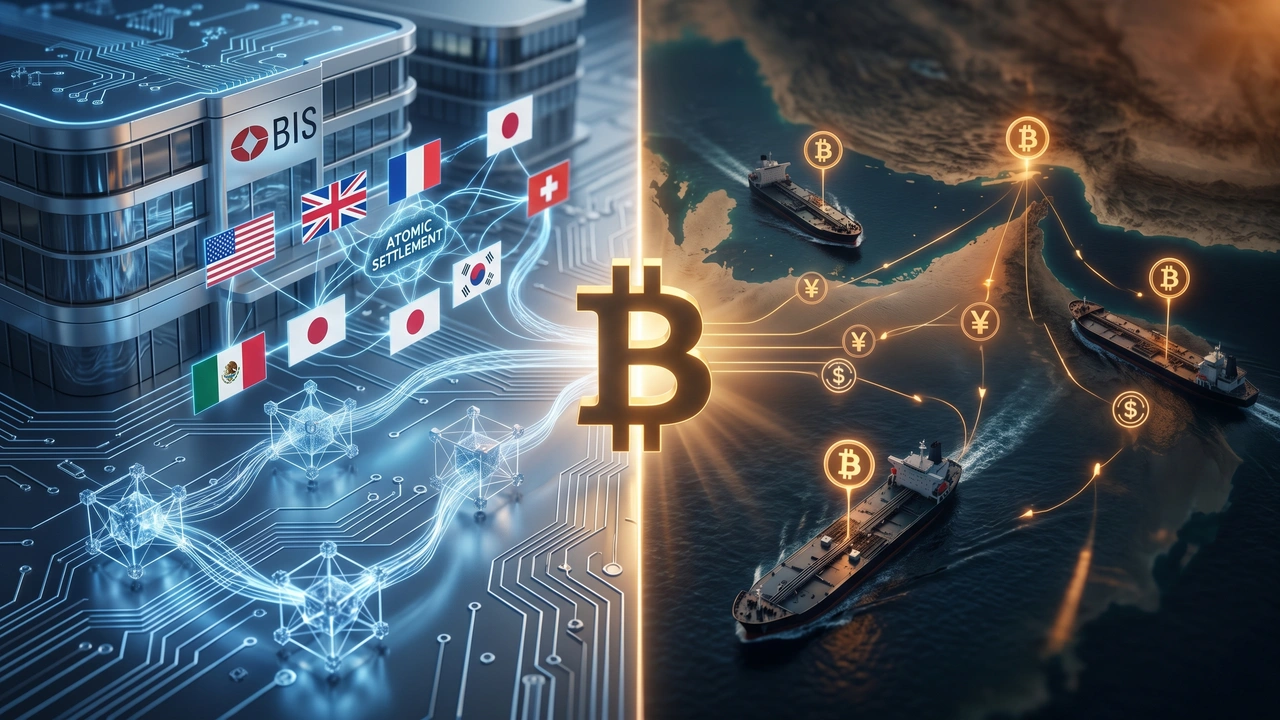
Two parallel developments reveal how tokenized payment infrastructure is being built simultaneously from the top down by central banks and from the bottom up by sanctioned states - with Bitcoin sitting at the intersection of both trends.
Key Takeaways
- The BIS's Project Agorá has demonstrated that atomic, multi-currency cross-border settlement is technically feasible, with seven major central banks and over 40 private institutions already participating - representing a serious institutional commitment to replacing correspondent banking infrastructure.
- Privacy-preserving compliance tools are a deliberate design priority for the BIS platform, meaning the new system is being engineered to make sanctions enforcement more precise, not less - a direct counterweight to crypto-based workarounds.
- Iran's reported use of Bitcoin and stablecoins for oil shipping illustrates that demand for censorship-resistant settlement is real and growing, but stablecoins proved vulnerable to rapid US enforcement action, underscoring Bitcoin's structural differentiation as the only option that cannot be frozen.
- The parallel development of a tightly controlled official tokenized system and a permissionless Bitcoin network is sharpening the geopolitical divide between those inside the regulated financial perimeter and those outside it - a divide that may define global monetary architecture for the coming decade.
- Investors and analysts should watch the pace of Project Agorá's live testing phase closely: a successful rollout would validate tokenized settlement at the sovereign level, potentially accelerating both institutional adoption of blockchain infrastructure and demand for Bitcoin as the neutral alternative for excluded parties.
Tokenized Payments: From BIS Blueprints to Bitcoin at the Strait
The global financial system is undergoing a quiet but consequential rewiring. On one side, the most powerful central banking institution in the world is engineering a multilateral platform designed to make cross-border settlements faster, programmable, and atomic. On the other, a heavily sanctioned oil exporter has reportedly turned to Bitcoin and stablecoins to keep crude shipments moving. These developments are not unrelated curiosities - they represent two competing visions for how tokenized money will flow in the decade ahead, and Bitcoin sits at the center of both narratives.
What connects a Bank for International Settlements prototype and Iranian oil logistics is a single underlying question: who controls the rails of international value transfer, and on what terms? The answers emerging in 2025 and beyond suggest that the old architecture of correspondent banking is being dismantled from multiple directions at once.
The Facts
Project Agorá, a joint initiative coordinated by the BIS alongside the Institute of International Finance, has published results showing that so-called atomic settlement across multiple currencies is technically achievable on a shared tokenized platform [1]. In an atomic settlement, a transaction either completes in its entirety or is rolled back entirely - eliminating the settlement risk that plagues today's multi-step, multi-timezone correspondent banking chains. The BIS describes this as a meaningful reduction in operational friction for international transactions [1].
The project brings together the central banks of the United States, United Kingdom, France, Japan, South Korea, Mexico, and Switzerland, alongside more than 40 private financial institutions. Canada is expected to join the consortium in a subsequent phase [1]. The architecture being tested is deliberately multi-layered: national central banks retain sovereign control over their own monetary infrastructure, while a shared interoperability layer enables cross-border coordination. The BIS has flagged additional capabilities under consideration, including programmable payment logic, around-the-clock system availability, and integrated tools for combating financial crime [1].
Privacy and compliance were tested in tandem. According to the BIS report, the prototype demonstrated that sensitive transactional data can be shielded without undermining regulators' ability to enforce legal requirements - a tension that has historically made central bankers skeptical of distributed ledger technology [1]. The next stage involves live tests using real monetary value across selected currency pairs, with a broader role envisioned for private sector participants. The BIS simultaneously cautioned against reliance on public blockchain infrastructure, signaling a preference for permissioned, institution-controlled environments [1].
Meanwhile, a very different tokenized payment story has been unfolding around Iran. Iranian state media reported in May 2025 that the government was exploring a maritime insurance framework for oil tankers navigating the Strait of Hormuz, with premiums payable in Bitcoin [2]. By April 2026, Iranian authorities had reportedly moved further, accepting shipping tolls in a combination of Bitcoin, yuan, and dollar-pegged stablecoins [2]. The arrangement reflects an attempt to route around the dollar-denominated correspondent banking system that sanctions enforcement depends upon.
The limits of that strategy became visible almost immediately. US authorities subsequently froze approximately $344 million in stablecoins they linked to the Iranian government and its Revolutionary Guard [2]. Tether's USDt, despite that enforcement action, reportedly remains the dominant settlement token in Iranian oil shipping fees, according to Sam Lyman of the Bitcoin Policy Institute [2].
Analysis & Context
The juxtaposition here is more than ironic. The BIS - the institution often described as the central bank of central banks - is building exactly the kind of programmable, controllable payment infrastructure that makes selective enforcement of sanctions more precise and more powerful. Project Agorá's emphasis on privacy-preserving compliance tools is not incidental. It is the core value proposition for sovereign participants: a system where regulators can see what they need to see, and freeze what they need to freeze, while the machinery runs invisibly beneath global commerce [1].
Iran's pivot to Bitcoin and stablecoins represents the counterpressure. For decades, the dollar's dominance in commodity trade rested on the absence of a credible alternative settlement layer. Bitcoin and stablecoins have not yet dislodged that dominance, but they have introduced optionality for actors willing to accept the associated risks. The rapid US enforcement response - freezing hundreds of millions in stablecoins within months of Iran's reported adoption - demonstrates both that stablecoins remain vulnerable to the same jurisdictional pressure as traditional finance, and that the enforcement machinery can now operate at blockchain speed [2]. This is precisely why Lyman's observation matters: USDt continues to dominate despite the demonstrated ability of US officials to act against it, suggesting that for counterparties on the receiving end of Iranian payments, the convenience outweighs the perceived risk.
Historically, new payment infrastructure has followed a pattern of parallel development - official systems built for compliance and efficiency, shadow systems built for access and censorship resistance - before one eventually absorbs or marginalizes the other. The Eurodollar market of the mid-twentieth century is an instructive analogy: offshore dollar liquidity flourished in the gaps between regulatory jurisdictions, eventually growing large enough that regulators had to accommodate rather than suppress it. Bitcoin occupies a structurally similar position today. It is permissionless, bearer-settled, and immune to the kind of asset freeze that neutralized hundreds of millions in Iranian stablecoin holdings. That property is precisely what makes it attractive to sanctioned actors and precisely what makes central banking institutions like the BIS prefer their own controlled rails.
The forward implication is significant for Bitcoin's role in the monetary system. If Project Agorá succeeds, the BIS framework will offer major economies a fast, programmable, atomic settlement network that dramatically reduces the friction advantage currently enjoyed by crypto rails - at least for participants inside the system. Nations or actors excluded from that framework, by choice or by sanction, will have nowhere compliant to turn. That structural exclusion is Bitcoin's most durable value proposition in the geopolitical payment space. The more powerful and efficient the official system becomes, the sharper the line between those who can access it and those who cannot - and the more irreplaceable a truly neutral settlement layer becomes for the latter group.
Sources
AI-Assisted Content
This article was created with AI assistance. All facts are sourced from verified news outlets.