Tornado Cash Retrial: The Battle to Define Where Code Ends and Crime Begins
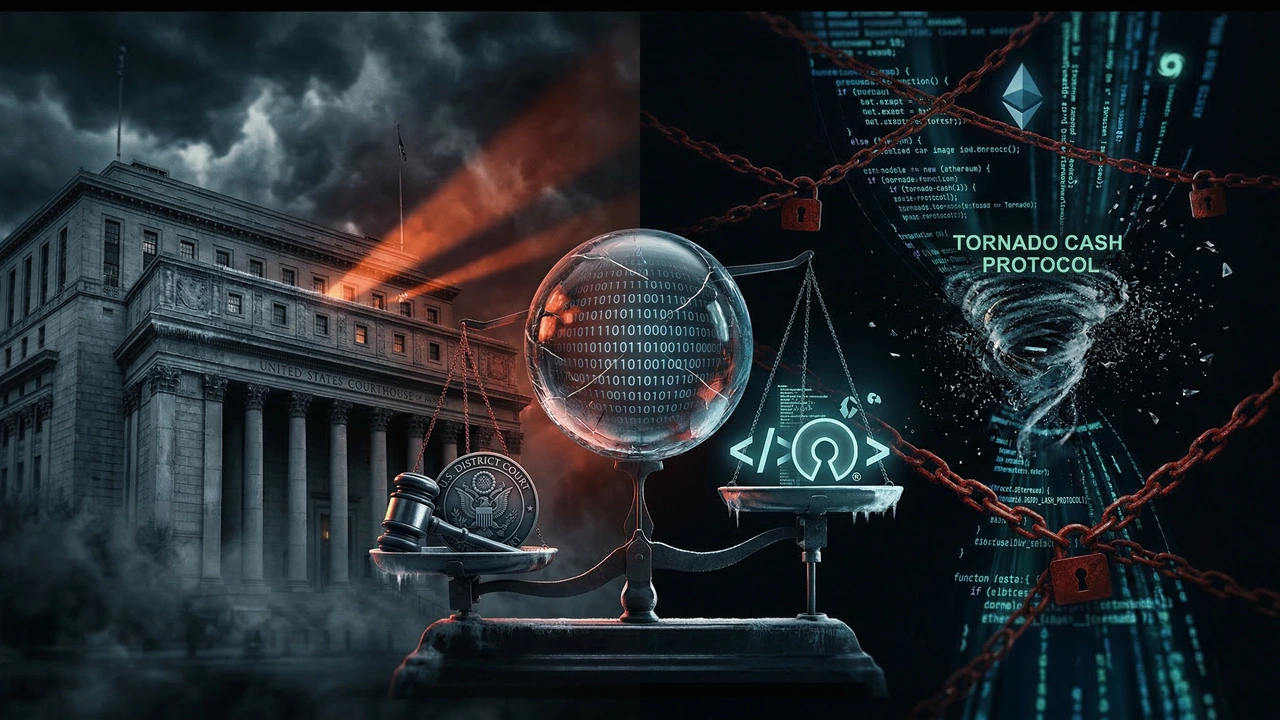
Federal prosecutors are pushing for a second trial against Tornado Cash developer Roman Storm on the two most serious charges — a move that exposes a deepening contradiction at the heart of U.S. crypto policy.
Key Takeaways
- Federal prosecutors are seeking a retrial of Roman Storm specifically on the two deadlocked charges — money laundering and sanctions violations — which together carry a potential 40-year prison sentence, making this far from a routine legal follow-up.
- The retrial request creates a direct and visible contradiction with the DOJ's own internal memo discouraging prosecution of developers for user conduct, as well as Treasury's acknowledgment that crypto mixers have legitimate uses — a tension the defense will almost certainly exploit.
- The first jury's deadlock on the most serious charges is itself a meaningful signal: twelve citizens reviewed four weeks of evidence and could not unanimously agree that writing and deploying open-source code constitutes criminal conspiracy.
- The case is setting a precedent that will affect every privacy-focused developer in the cryptocurrency space — including those building on Bitcoin — and its resolution will either protect or chill open-source innovation in the U.S. for years to come.
- Storm's public call for legal defense donations and the community's visible solidarity suggest this case has crystallized into a cause célèbre for the crypto space, with outcomes that will resonate well beyond the courtroom.
The Government Wants Another Bite at the Apple — But the Legal Ground Has Shifted
The U.S. Department of Justice is not finished with Roman Storm. Despite a jury of twelve Americans declining to convict the Tornado Cash developer on the two most serious charges against him, federal prosecutors in Manhattan have filed a request for a retrial — and the implications extend far beyond one developer's fate. What is unfolding in the Southern District of New York is arguably the most consequential legal test of whether writing open-source code can constitute a federal crime.
The timing of this push is particularly striking. It arrives against a backdrop of a measurably softening federal stance on crypto privacy tools, creating a tension that Storm's supporters argue makes the retrial not just legally dubious, but politically contradictory.
The Facts
Roman Storm's first trial concluded in August with a split verdict. A Manhattan jury convicted him on one count — conspiracy to operate an unlicensed money-transmitting business — but deadlocked on the two remaining and far more serious charges: conspiracy to commit money laundering and conspiracy to violate sanctions [1]. Those unresolved counts carry a combined maximum sentence of up to 40 years in federal prison, making them the true stakes of this legal battle [1].
Prosecutors filed a letter with Judge Katherine Polk Failla requesting that a retrial be scheduled for early to mid-October, estimating the new proceedings would last approximately three weeks [1]. Storm's legal team, however, has already indicated that October is unavailable for them, with any potential trial date pushed toward the end of the year at the earliest [2]. Whether Judge Failla grants the retrial request at all remains an open question [2].
Storm, who remains free on bail, responded to the news with a pointed statement on X: "A jury of 12 Americans heard four weeks of evidence and deadlocked — no verdict on money laundering, no verdict on sanctions violations. The government's response? Try again to make writing code a crime" [1]. He also issued a call for public donations to fund his legal defense, drawing an outpouring of solidarity from within the crypto community [2].
The case centers on Tornado Cash, a privacy protocol Storm helped build in 2019 that operates via autonomous smart contracts on the Ethereum network — not through a centralized operator [1]. Prosecutors allege the protocol facilitated more than $1 billion in illicit transactions, including funds linked to the North Korean Lazarus Group hacking collective [1]. Storm's defense counters that developers cannot bear criminal liability for how decentralized, immutable software is used once deployed.
Crucially, the retrial request comes at a moment of notable policy contradiction. Deputy Attorney General Todd Blanche issued a memo stating that the Justice Department "is not a digital assets regulator" and cautioning prosecutors against targeting developers for the actions of their users [1]. Separately, the U.S. Treasury Department, in a March 2026 report to Congress under the GENIUS Act, explicitly acknowledged that crypto mixers can serve legitimate purposes — including protecting consumer spending habits, business payments, charitable donations, and personal wealth information [1][2]. Storm himself noted the bitter irony that this prosecution is intensifying even after Treasury removed Tornado Cash from its sanctions list over a year ago [2].
Analysis & Context
The Tornado Cash case represents the sharp edge of a broader regulatory identity crisis within the U.S. government. On one hand, the executive branch is signaling through policy memos and Treasury reports that it understands the legitimate use cases for privacy tools and does not wish to regulate crypto through criminal prosecution. On the other hand, the Justice Department is pressing for a second trial on the very charges a jury already refused to unanimously support. This is not just a legal inconsistency — it is a contradiction that will define the operating environment for every open-source developer building on public blockchains.
Historically, this debate echoes earlier battles over encryption software in the 1990s, when the U.S. government attempted to classify strong cryptography as a munition and prosecuted Phil Zimmermann, the creator of PGP, for exporting it. That effort ultimately failed, and the courts and Congress eventually recognized that code is speech and that developers cannot be held responsible for every downstream use of their tools. The Tornado Cash case may well become the crypto era's equivalent of that battle — with similarly lasting implications for what can and cannot be built in the United States. The deadlock in Storm's first trial suggests that at least some jurors were already wrestling with the fundamental question of whether intent and authorship alone are sufficient for criminal liability when the underlying tool has clear legitimate utility.
For the broader Bitcoin and crypto ecosystem, the outcome here matters enormously. Bitcoin's own value proposition includes financial privacy and censorship resistance. Tools and protocols that enhance on-chain privacy — whether mixers, CoinJoin implementations, or Layer 2 solutions with privacy features — all exist in the same legal gray zone that Tornado Cash now occupies. A successful retrial conviction would embolden prosecutors to pursue similar cases against other developers. A dismissal or acquittal would establish a protective precedent that code, even code misused by bad actors, does not automatically make its author a criminal co-conspirator.
Sources
AI-Assisted Content
This article was created with AI assistance. All facts are sourced from verified news outlets.