Two Crypto Milestones That Reveal Regulation's Dual Face
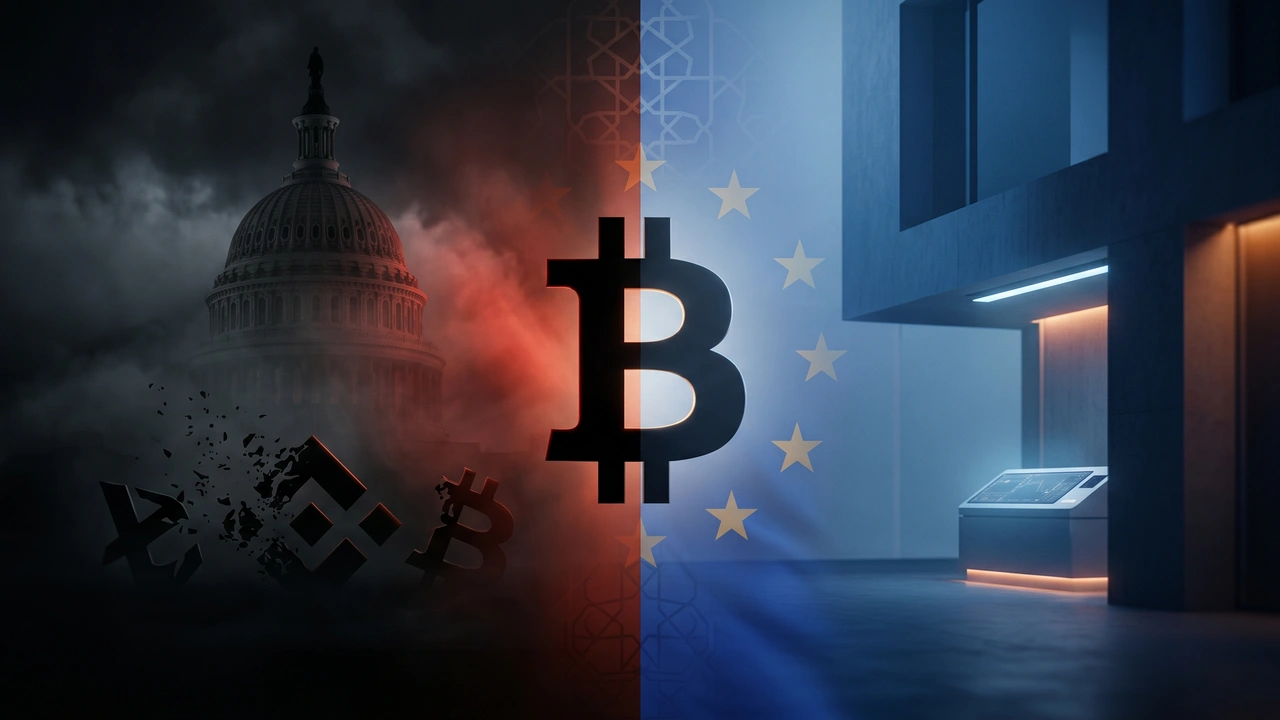
Washington designated Iran's four largest crypto exchanges - seizing nearly $500 million in digital assets - while Europe's MiCA framework quietly handed its first institutional trading license to RULEMATCH. Together, the moves signal that global crypto regulation has entered a new, bifurcated era.
Key Takeaways
- The simultaneous U.S. blacklisting of four Iranian exchanges and the EU's MiCA licensing of RULEMATCH illustrate that crypto regulation has moved from theoretical debate into active, bifurcated enforcement - coercion on one front, legitimization on the other.
- OFAC's decision to designate Nobitex leadership individually, not just the exchange itself, marks a strategic escalation - personal SDN listings create liability for global counterparties and cannot be circumvented by simply relaunching under a new brand.
- Nobitex's dominance - handling more than half of all Iranian crypto inflows in 2025 - confirms that sanctioned economies have deeply embedded digital assets as a financial workaround, making exchange-level enforcement a top-tier geopolitical tool.
- RULEMATCH's bank-only, MiCA-licensed model signals that the next wave of institutional crypto adoption in Europe will be built on compliance infrastructure first, with the Nasdaq-sourced matching engine lending credibility to its institutional pitch.
- For Bitcoin specifically, both developments reduce ambiguity: assets linked to sanctioned actors face accelerating seizure risk, while regulated institutional venues provide an increasingly clear legal pathway for serious capital to enter the market.
Two Crypto Milestones That Reveal Regulation's Dual Face
On the same week that Washington weaponized crypto regulation against Tehran, a Liechtenstein regulator issued a quiet but consequential license to a Swiss-born institutional exchange in the European Economic Area. These events unfold on opposite ends of the regulatory spectrum - one a hammer, one a handshake - yet both signal the same fundamental shift: governments have stopped treating crypto as a fringe technology and started treating it as a financial infrastructure they must either police or harness.
The divergence matters for Bitcoin specifically. When regulators act with surgical precision - whether blacklisting regime-linked platforms or green-lighting institutional venues - they validate the asset class while simultaneously shrinking the grey zones it has historically occupied. That is not a comfortable place for everyone. But it is where we are.
The Facts
The U.S. Treasury's OFAC division on Tuesday placed four Iranian digital asset platforms - Nobitex, Wallex, Bitpin, and Ramzinex - on its Specially Designated Nationals list, effectively barring all American persons and entities from conducting business with them. [1] Nobitex, the largest of the four and the dominant exchange in the Iranian market, routed more than half of all crypto capital flowing into the country during 2025. [1] Wallex ranked second, handling roughly 12% of those same flows and allegedly processing transactions tied to Iran's Islamic Revolutionary Guard Corps. [1]
The action extended beyond platform-level designations. OFAC simultaneously named Nobitex CEO Seyed Ali Khoee, chairman Amir Hossein Rad, and several co-founders as sanctioned individuals. [1] The inclusion of Hossein Rad is notably specific: according to web sources, he was instrumental in rebuilding Nobitex's operations after a $90 million hack struck the exchange in June 2025. Treasury Secretary Scott Bessent framed the move as part of a sustained maximum-pressure campaign, stating that "while Iran's economy is in free fall, the regime has chosen to co-opt digital asset technologies for its own corrupt agenda." [1] His department pointed to frozen and blocked assets totalling nearly $500 million in cryptocurrency as evidence the campaign is generating results. [1]
Bitpin, which accounted for roughly 10% of Iranian digital asset inflows, drew scrutiny for ties between its investor base and known sanctions-evasion networks. Ramzinex, a Tehran-founded exchange established in 2018, had cleared over $2.45 billion in lifetime transactions before the designation. Together, the four platforms represent a near-comprehensive sweep of Iran's active crypto market infrastructure, and Treasury invoked both counterterrorism authority and Iran-specific financial sector executive orders to justify the action.
On the other side of the ledger, Liechtenstein's Financial Market Authority awarded RULEMATCH Europe a MiCA-compliant operating license, clearing the company to run a crypto trading venue across the European Economic Area. [2] Crucially, RULEMATCH is not targeting retail investors - the platform is designed exclusively for banks, securities firms, and regulated financial institutions seeking institutional-grade crypto execution. [2] The company routes orders through a request-for-quote mechanism in which multiple competing liquidity providers submit bids, and its matching infrastructure is built on technology originally developed by Nasdaq. [2] The license also covers custody and transfer services for digital assets, rounding out a full-service offering aimed squarely at compliance-conscious institutional players. [2]
CEO David Riegelnig made clear that the platform's value proposition sits entirely within the MiCA framework - specifically designed for institutions that want to run crypto operations under a recognized European legal structure rather than in a regulatory grey area. [2] RULEMATCH now joins the growing roster of firms that have secured formal MiCA authorizations since the regulation's full implementation, a list that remains relatively short but is expanding as the compliance runway clarifies. [2]
Analysis & Context
The OFAC action against Iranian exchanges follows a template established against Russia-linked platforms in prior years - most notably the 2022 sanctions against the Garantex exchange, which was later physically disrupted in a joint law enforcement operation in 2025. What distinguishes the Iran sweep is the deliberate targeting of company leadership alongside the platforms themselves. Sanctioning executives personally - freezing their assets and exposing their global counterparties to secondary sanctions risk - creates deterrent pressure that outlasts any individual platform. An exchange can technically rebrand or reconstitute; a named individual cannot erase their SDN designation. Tether's April 2025 decision to freeze $344.2 million in stablecoins attributed to the Central Bank of Iran demonstrates how these designations cascade: once OFAC designates, stablecoin issuers and custodians face their own liability if they fail to act.
The RULEMATCH approval, meanwhile, illustrates the constructive face of the same regulatory impulse. MiCA is performing its intended function: providing a single, passportable license across 30-plus EEA jurisdictions that makes institutional crypto participation legally defensible. For Bitcoin and digital assets broadly, the arrival of Nasdaq-technology-backed, bank-only venues under full regulatory cover represents a structural deepening of the market - the kind that historically reduces volatility over the long term by broadening the participant base beyond retail speculation. The friction between Washington's enforcement posture and Brussels' regulatory architecture is not a contradiction. It is the same underlying logic operating on different targets: those who misuse the infrastructure face elimination, while those who formalize it gain access.
Sources
- [1]btc-echo.de
- [2]btc-echo.de
AI-Assisted Content
This article was created with AI assistance. All facts are sourced from verified news outlets.