U.S. Crypto Regulation at a Crossroads: Fed Leadership and the Clarity Act
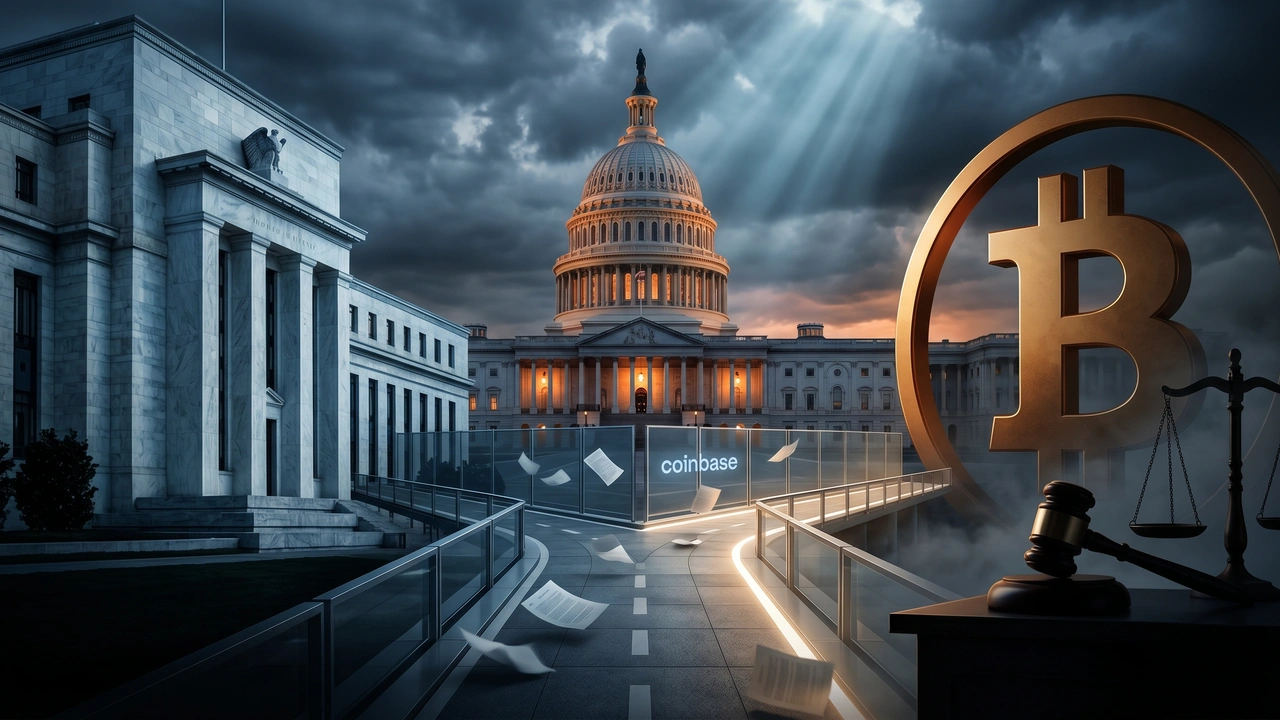
Two parallel developments in Washington — the clearing of Jerome Powell's path to succession and the stalling of the landmark Clarity Act — are reshaping the regulatory landscape for Bitcoin and the broader crypto industry at a critical moment.
Key Takeaways
- The DOJ dropping its Powell probe clears Kevin Warsh for Fed confirmation, but his hawkish inflation stance could delay the rate cuts that have historically driven Bitcoin price rallies — investors should not assume monetary easing is imminent.
- The Clarity Act's survival now depends on a narrow May window; failure to reach a stablecoin yield compromise before summer recess could kill the bill entirely or produce a radically different version under a potentially Democratic-controlled Congress after midterms.
- The stablecoin rewards dispute is a direct battle between Wall Street incumbents and crypto challengers for control of digital dollar infrastructure — the outcome will shape the competitive landscape for stablecoin issuers for years.
- Political entanglement between Fed leadership, crypto legislation, and competing congressional priorities illustrates how Bitcoin's regulatory environment remains deeply vulnerable to Washington's dysfunction, reinforcing the case for jurisdictional diversification in the industry.
- Bitcoin's long-term thesis as a neutral, apolitical monetary asset is paradoxically strengthened every time U.S. institutional credibility is seen to waver — whether through attacks on Fed independence or regulatory stagnation on crypto frameworks.
America's Crypto Future Hangs on Two Washington Power Struggles
Rarely does the fate of Bitcoin's regulatory environment hinge so visibly on raw political mechanics. Yet right now, two separate but deeply interconnected battles in Washington are quietly determining whether the United States will deliver on its promise to become the world's premier crypto hub — or squander a historic legislative window. The closure of the DOJ's probe into Fed Chair Jerome Powell and the increasingly uncertain trajectory of the Clarity Act are not isolated stories. Together, they form a single, high-stakes narrative about regulatory clarity, institutional credibility, and the future of sound monetary policy in the age of digital assets.
For Bitcoin investors and crypto businesses alike, the next few weeks may prove more consequential than any price chart.
The Facts
On Friday, the Department of Justice officially closed its criminal investigation into Federal Reserve Chair Jerome Powell, with U.S. Attorney Jeanine Pirro announcing the matter would be transferred to the Fed's own inspector general for an internal review [1]. The probe had centered on alleged cost overruns during a $2.5 billion renovation of the Fed's Washington headquarters — a case that a federal judge had already effectively gutted in March after a government prosecutor admitted the evidence was "essentially zero" and the legal justification "thin and unsubstantiated" [1]. Powell himself had publicly characterized the investigation as a politically motivated attack on the central bank's independence [1].
The closure removes the primary obstacle to the Senate confirmation of Kevin Warsh as Powell's successor. Senator Thom Tillis, a Republican on the Senate Banking Committee who had labeled the probe "bogus," had pledged to block Warsh's confirmation hearings until the investigation ended [1]. With that condition now met, congressional leadership is pushing for a swift committee vote and floor confirmation before Powell's term expires on May 15 [1]. Warsh, a 56-year-old former Fed governor and Stanford professor, appeared before the Senate Banking Committee earlier this week and explicitly promised independence from White House pressure on rate decisions [1].
Simultaneously, the Clarity Act — the landmark U.S. legislation designed to finally establish a coherent regulatory framework for digital assets — is facing its most serious threat of collapse [2]. The bill has been stalled in the Senate for months, with the central sticking point being whether stablecoin issuers should be permitted to offer yield or rewards to holders. A recent compromise proposal would have banned traditional interest-bearing returns on stablecoins while permitting "user-based rewards" tied to transactions or loyalty programs — a distinction that the crypto industry roundly rejected [2]. Coinbase's Chief Legal Officer Paul Grewal was blunt: "You cannot be for the Clarity Act while being against rewards" [2].
The reporting deadline has now slipped into May at the request of Senate rapporteur Tom Tillis — ironically the same senator whose Powell-probe stance had already entangled crypto legislation with Fed politics [2]. Industry voices have been sharp in their criticism of the banking lobby's influence over the compromise proposal. Daniel Seifert, who oversees Coinbase's European operations, argued at the Paris Blockchain Week that removing rewards would harm not just the industry but its users directly — particularly underbanked Americans who rely on crypto income [2]. According to an FDIC report, approximately 5.6 million U.S. households had no bank account in 2023, with 14.2% classified as underserved by financial services [2].
If no deal is reached before the summer recess — when congressional attention shifts to midterm election campaigning — the Clarity Act's future will likely depend on post-election majority dynamics. Current polling shows Democrats ahead, and a Democratic-controlled Congress would almost certainly produce a fundamentally different version of the legislation [2].
Analysis & Context
The convergence of these two developments reveals a structural fragility in America's crypto policy ambitions. The Trump administration came into office with an explicit mandate to make the U.S. a global crypto leader, and for a period, the legislative pipeline looked genuinely promising. But Washington's perennial tendency to let political grievances contaminate policy is now threatening to derail years of industry lobbying and legal groundwork.
The Kevin Warsh angle deserves particular scrutiny from a Bitcoin perspective. Markets have been pricing in a rate-cut cycle for much of 2025, and Bitcoin's trading range of $70,000–$92,000 this year reflects that monetary policy uncertainty [1]. Historically, Bitcoin has benefited from loose monetary conditions — lower rates reduce the opportunity cost of holding non-yielding assets and erode confidence in fiat currency purchasing power. Warsh, however, has been explicit in his criticism of the Fed's post-pandemic response, calling it "the biggest policy error in 40 or 50 years" [1]. A more hawkish Fed chair could meaningfully delay the liquidity expansion that many Bitcoin bulls have been anticipating. That said, a credibly independent Fed — even a hawkish one — arguably reinforces the long-term narrative for Bitcoin as an alternative monetary system. When the DOJ first launched its Powell probe in January, Bitcoin surged toward $92,000 precisely because institutional investors read political interference with the Fed as a threat to dollar credibility [1]. Counterintuitively, a stronger institutional Fed may reduce short-term Bitcoin tailwinds while strengthening its long-term value proposition.
On the Clarity Act, the stablecoin yield dispute is not merely a technical regulatory debate — it is a proxy war between traditional finance and the crypto industry over who controls the future of digital money. The banking sector's resistance to yield-bearing stablecoins is transparently self-interested: permitting crypto firms to offer returns on dollar-pegged instruments would directly threaten bank deposit franchises. The fact that a JPMorgan-aligned proposal appears to have shaped the Senate compromise text [2] suggests that lobbying dynamics, not consumer protection logic, are driving the legislation. The legislative clock is now the most urgent variable. If Congress fails to pass meaningful crypto regulation before midterm campaigning absorbs political bandwidth, the U.S. risks ceding its regulatory leadership position to jurisdictions — the EU with MiCA, the UAE, Singapore — that have already moved decisively.
Sources
AI-Assisted Content
This article was created with AI assistance. All facts are sourced from verified news outlets.