US Regulatory Momentum Builds as Bitcoin Eyes Political Tailwinds
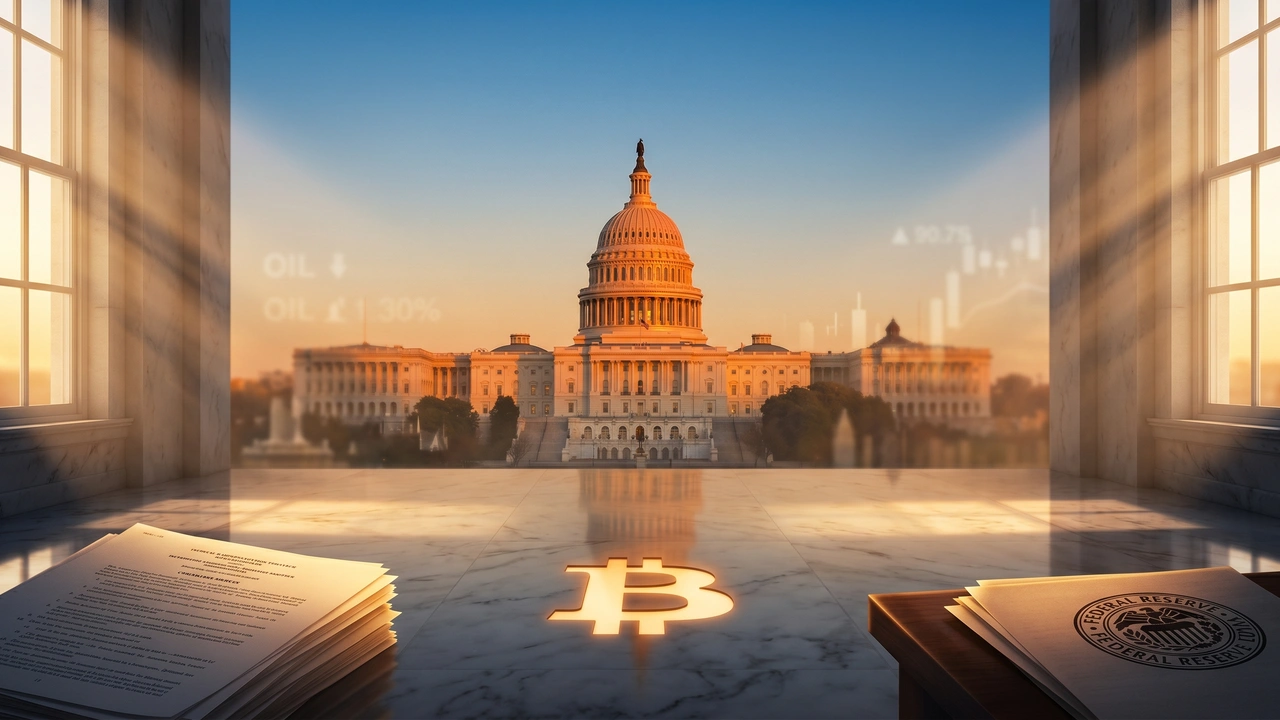
From landmark crypto legislation in the Senate to the pardoning of Binance's founder, Washington's posture toward Bitcoin and digital assets is shifting in ways that could define the next market cycle.
Key Takeaways
- The CLARITY Act markup in the Senate Banking Committee this week is arguably the most consequential near-term regulatory event for Bitcoin and digital assets, with analysts calling it a potential inflection point for institutional participation [2]
- Kevin Warsh's expected confirmation as Federal Reserve chair may remove a layer of policy uncertainty from markets, with analysts framing it as a net positive for risk assets including Bitcoin [2]
- Bitcoin has risen nearly 30% since the US-Iran conflict began in late February, outperforming both equities and gold - reinforcing its emerging role as a geopolitical hedge [2]
- CZ's unproven allegations about competitor lobbying against his pardon highlight how political influence and regulatory outcomes in crypto are increasingly intertwined with competitive corporate interests [1]
- Binance's return to the US market following its $4.3 billion settlement and Zhao's pardon signals that the Trump administration is actively reshaping who has access to American crypto markets - a dynamic with major long-term competitive implications [1]
Washington Is Rewriting the Rules - and Bitcoin Is Watching Closely
A confluence of political and regulatory developments in the United States is reshaping the landscape for Bitcoin and the broader digital asset industry. From high-stakes Senate votes on crypto legislation to the geopolitical backdrop of a US-Iran conflict rattling traditional markets, Bitcoin finds itself at the center of a rapidly evolving story - one where regulatory clarity and political maneuvering may matter just as much as on-chain fundamentals.
The signals coming out of Washington are hard to ignore. Two major catalysts are converging this week in the Senate, and industry veterans are already calling one of them the most consequential piece of crypto legislation in years. Meanwhile, the pardoning of Binance founder Changpeng Zhao by President Donald Trump has reignited debate about the political dimensions of crypto regulation - and who truly benefits when the rules of the game change.
The Facts
Bitcoin's near-term price trajectory could receive a significant boost from two distinct events unfolding in the US Senate this week, according to Markus Thielen, CEO of 10x Research [2]. The first is a Senate confirmation vote on Kevin Warsh as the new chair of the Federal Reserve, and the second is the Senate Banking Committee's scheduled markup of the CLARITY Act on Thursday [2].
Thielen described the CLARITY Act as the "most significant piece of crypto legislation in years," arguing that it represents a potential "turning point for regulatory certainty across digital assets" [2]. The logic is straightforward: clearer rules reduce the friction that has historically kept large institutional players on the sidelines of the Bitcoin market. Regarding the Warsh confirmation, Thielen acknowledged that the nominee is considered more hawkish on inflation than current Fed Chair Jerome Powell, but argued that his confirmation would eliminate an "uncertainty overhang" that has weighed on risk assets [2]. In his view, "both events lean bullish for Bitcoin: regulatory clarity reduces institutional friction, and a smooth Fed leadership transition avoids the policy uncertainty that typically pressures risk assets" [2].
This regulatory momentum is playing out against a turbulent geopolitical backdrop. The ongoing US-Iran conflict - triggered by a US airstrike on February 28 that killed Iran's Supreme Leader - has caused sustained disruption in global financial markets over the past ten weeks [2]. Oil prices have climbed to $98.7 per barrel, up 4.6% following Trump's latest comments rejecting Iran's counteroffer for a ceasefire [2]. Despite this turmoil, Bitcoin has risen 29.7% since the conflict began, outperforming both the S&P 500 and gold during the same period [2].
On a separate but thematically connected front, Binance founder Changpeng "CZ" Zhao has made explosive claims about the political battle that surrounded his presidential pardon. In an interview with the Crypto Banter podcast, Zhao alleged that rival US-based crypto exchanges lobbied against his pardon, motivated by a desire to keep Binance out of the American market [1]. "The other crypto exchanges in the US did not want me to be pardoned," Zhao stated, though he acknowledged he had no concrete evidence, only strong conviction that such efforts took place [1]. Trump pardoned Zhao in October 2025, and Binance resumed US operations in February 2025 after having largely exited the market following a $4.3 billion settlement with US authorities in late 2023 over money laundering and sanctions violations [1]. Zhao himself served a four-month prison sentence in 2024 [1]. Despite his return to public life, Zhao has ruled out reclaiming the CEO role, with Richard Teng and co-founder Yi He now sharing leadership of the exchange [1].
Analysis & Context
What makes this moment historically significant is the degree to which Bitcoin's regulatory environment is being shaped by forces that extend well beyond the asset itself. The CLARITY Act, if it advances meaningfully through committee, would represent the most serious legislative attempt to define the jurisdictional boundary between securities and commodities in the digital asset space - a question that has plagued the industry since the SEC began aggressive enforcement actions under the previous administration. Markets tend to price in regulatory certainty well before it fully arrives, which means even the credible possibility of the CLARITY Act passing could act as a sustained institutional on-ramp. We have seen this pattern before: the months leading up to the approval of US spot Bitcoin ETFs in early 2024 saw sustained price appreciation driven almost entirely by the anticipation of legitimacy rather than the event itself.
The Zhao allegations add a more unsettling dimension to this regulatory narrative. If true - and Zhao himself concedes he lacks hard proof - they suggest that some of the most vocal advocates for "good" crypto regulation in Washington may simultaneously be working to kneecap their competitors through political channels. This is not surprising from a competitive dynamics standpoint, but it is a reminder that regulatory clarity and regulatory capture are not mutually exclusive outcomes. The industry's loudest calls for a level playing field can sometimes mask efforts to tilt that field in a specific direction. Bitcoin, as a decentralized and permissionless protocol with no corporate lobbying arm, sits apart from this kind of maneuvering - but it is not immune to its consequences.
The macro picture reinforces Bitcoin's evolving narrative as a geopolitical hedge. The fact that Bitcoin has outpaced gold during an active military conflict involving the world's largest economy is a data point that institutional allocators will not easily dismiss. It adds empirical weight to a thesis that has long been theoretical: that Bitcoin can function as a non-sovereign store of value even during acute geopolitical stress. If the CLARITY Act clears committee and Warsh's confirmation proceeds without incident, the combination of regulatory progress and macro resilience could provide the foundation for sustained price discovery at levels above recent highs.
Sources
AI-Assisted Content
This article was created with AI assistance. All facts are sourced from verified news outlets.