From Pizza Receipts to Pocket Hardware: Bitcoin's Physical Legacy
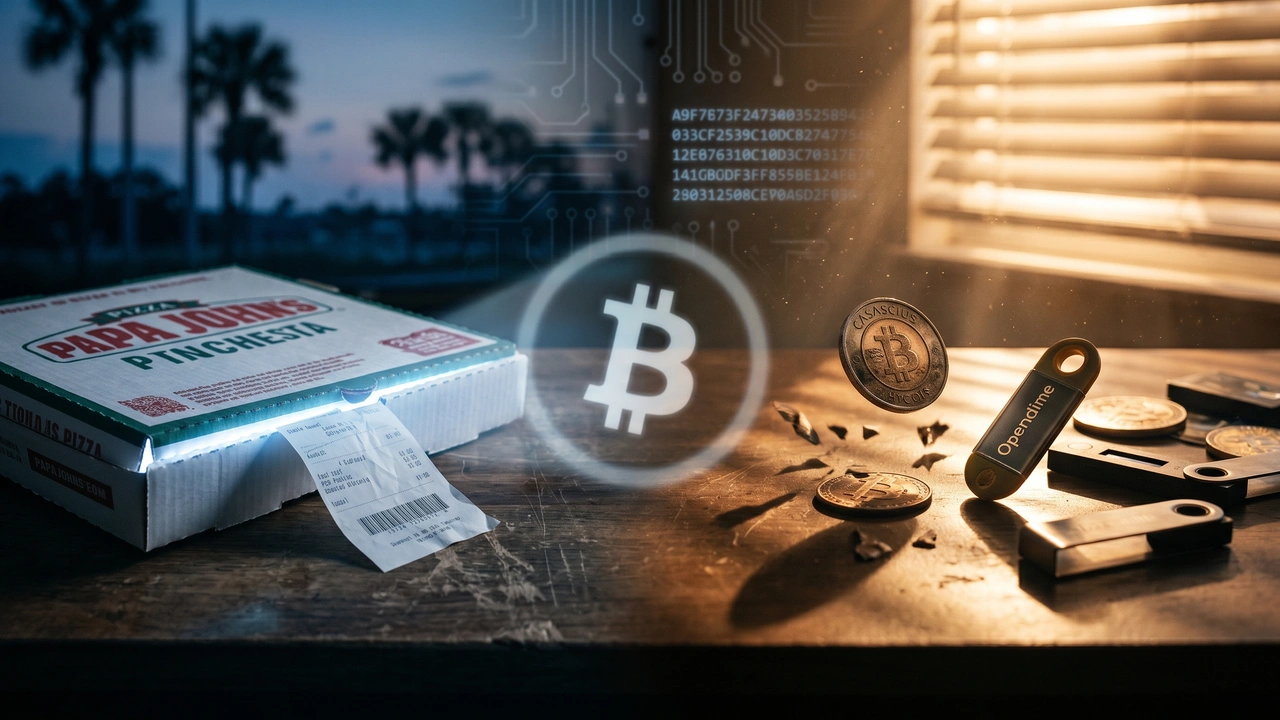
Bitcoin's greatest cultural milestones - from the $777 million pizza order to the decades-long quest for touchable coins - reveal a technology perpetually wrestling with its own intangibility. Together, they tell a single story about how humans are still learning to hold something that was never meant to be held.
Key Takeaways
- Bitcoin Pizza Day is more than nostalgia - the annual revaluation of Hanyecz's 10,000 BTC to current spot price has become one of the cleanest, manipulation-free benchmarks in global finance, currently reading $777.87 million after a macro-driven 30% drawdown from last year's record.
- The history of physical Bitcoin hardware - from Casascius coins through Opendime to Tapsigner - is a systematic attempt to reduce trust requirements at each step, mirroring Bitcoin's own philosophy of minimizing reliance on centralized parties.
- Regulatory pressure (FinCEN vs. Caldwell in 2013) set the template for every subsequent collision between Bitcoin bearer-asset innovation and financial compliance frameworks, a dynamic still very much unresolved.
- The fundamental barrier to cash-like physical Bitcoin is not engineering but economics: the cheapest cryptographic chips capable of secp256k1 operations still cost several dollars each, making sub-dollar denominations economically inviable without a structural change in chip manufacturing.
- The Q1 2026 drawdown and ETF outflows represent macro shock absorption, not structural failure - the partial Q2 recovery suggests Bitcoin's price floor is gravitating higher even as short-term volatility remains tied to geopolitical and trade policy shocks.
From Pizza Receipts to Pocket Hardware: Bitcoin's Physical Legacy
Bitcoin's defining paradox is that its most powerful features - permissionless transfer, cryptographic self-custody, borderless settlement - are entirely invisible to the human hand. You cannot fold a satoshi into your wallet or leave one on a counter as a tip. Yet the history of Bitcoin is, in no small part, a history of people desperately trying to make it feel real. Two recent deep-dives into that history - one tracing the arc of physical Bitcoin artifacts, the other revisiting the 16th anniversary of the world's first commercial BTC transaction - converge on a single, uncomfortable truth: Bitcoin's cultural milestones are inseparable from its physicality problem.
The Facts
On May 22, 2010, a Florida programmer named Laszlo Hanyecz changed monetary history by posting a simple offer on the BitcoinTalk forum: 10,000 BTC to anyone who would order him two large pizzas. The coins were worth roughly $41 at the time. Four days after the post, a 19-year-old forum user named Jeremy Sturdivant accepted, placed the order at a Papa John's, and collected the coins via manual transfer, giving Bitcoin its first-ever exchange rate against a physical consumer good [2]. The transaction is commemorated each May 22 as Bitcoin Pizza Day - the moment a cryptographic experiment became, technically, a medium of exchange.
At this year's Pizza Day anniversary, the 10,000 BTC price tag has been revalued at approximately $777.87 million, with Bitcoin trading near $77,300 - down nearly 30% from the record $1.106 billion valuation recorded on May 22, 2025, when Bitcoin hit an all-time high of $110,568 [2]. The decline tracks a turbulent macro backdrop: an October 2025 all-time high of $126,000 was followed by President Donald Trump's announcement of 100% tariffs on Chinese imports and export controls on key U.S. software, triggering a single-session wipeout of nearly $200 billion in total crypto market cap and approximately $19 billion in liquidated leveraged positions [2].
The physical side of Bitcoin's history began not with pizzas but with coins - specifically the Casascius coins, minted as early as September 2011 at a bitcoin price below $8, by developer Mike Caldwell [1]. Caldwell generated private keys on an air-gapped machine, printed them, and sealed them beneath tamper-evident honeycomb stickers on premium metal coins [1]. Buyers trusted Caldwell not to retain copies of those keys - and by all accounts, that trust was justified. His reputation remains strong to this day, and the collector premiums on surviving coins reflect it. The project ran until November 2013, when FinCEN informed Caldwell that minting physical bitcoins made him a money transmitter subject to heavy compliance requirements [1].
What followed was a decade-long engineering relay race. RavenBit tried to decentralize the minting problem by shipping blank coins with tamper-proof stickers and letting users generate their own keys - a clever idea that, in practice, replaced one trusted party with thousands of untrusted ones using potentially malware-ridden office printers [1]. Coinkite responded with the Opendime, a USB device containing a secure chip that generates and stores Bitcoin keys internally, making the private key physically inaccessible until the user punctures the device [1]. The Satochip card took that concept further into a credit-card form factor with NFC capability, lowering the cost floor to around 13 euros [1]. Most recently, Coinkite's own Tapsigner brings a full Bitcoin signing environment - secp256k1 cryptography and all - into a tap-to-pay card format at roughly $20, designed not just as a bearer asset but as a refillable spending wallet [1].
Analysis & Context
The Pizza Day anniversary and the history of physical Bitcoin are more than cultural footnotes - they are two faces of the same fundamental challenge: how do you make an abstract, cryptographically-secured ledger entry feel like money to ordinary people? Hanyecz's transaction in 2010 provided the psychological proof of concept: if a human being would accept BTC for a pizza, then BTC had real-world value. The physical coin experiments of the following decade attacked the same problem from the hardware side - if you could hand someone a coin or card with real bitcoin inside it, the abstraction problem might dissolve entirely.
Historically, this mirrors a well-worn pattern in monetary evolution. Gold itself is abstract in large quantities; paper currency, gold certificates, and eventually banknotes were all attempts to make an unwieldy abstract store of value portable and transactable. The Casascius coin era maps remarkably closely onto the early history of private banknote issuers in 19th-century America - small, trusted operators who issued bearer instruments, built reputations, and eventually encountered a federal regulator who decided the space needed standardization. The FinCEN intervention against Caldwell in 2013 was Bitcoin's first encounter with that regulatory dynamic, and it foreshadowed every subsequent clash between crypto innovation and financial compliance infrastructure [1].
The pattern of innovation in physical Bitcoin also reveals something important about trust hierarchies. Each successive attempt has tried to push trust further down the stack - from a single trusted mint (Casascius), to a distributed but unverified network of individual minters (RavenBit), to a trusted chip manufacturer whose open-source firmware can be audited (Opendime, Tapsigner). This mirrors the broader arc of Bitcoin itself: a system designed to minimize reliance on any single trusted party. The remaining unsolved problem - that any physical bearer asset ultimately requires an internet connection to verify the on-chain balance it claims to represent - is not a design flaw but an honest acknowledgment that Bitcoin is, at its core, a digital protocol. There is no way to make it fully analog without also making it fully trusted, which defeats the purpose [1].
The macro context of this year's Pizza Day valuation also deserves unpacking. The $328 million drop from 2025's anniversary high to this year's figure is not Bitcoin failing - it is Bitcoin behaving exactly as a high-beta global asset would under the sharpest U.S. trade policy shock in decades [2]. The Q1 2026 drawdown of 23.2%, the third-worst opening quarter on record, and the $4.5 billion bleed from spot Bitcoin ETFs in the first eight weeks of the year, reflect genuine macro fear - not structural Bitcoin weakness [2]. The partial Q2 recovery of roughly 14% suggests the market absorbed the shock more quickly than the headline numbers implied. The deeper cultural point is that this annual revaluation of Hanyecz's pizza trade has quietly become the most honest benchmark in all of finance: a fixed quantity of Bitcoin priced at current spot, with no futures distortion, no index weighting, and no narrative management.
Sources
AI-Assisted Content
This article was created with AI assistance. All facts are sourced from verified news outlets.