Warsh's Hawkish Debut Puts Bitcoin's Fixed Supply in Sharp Relief
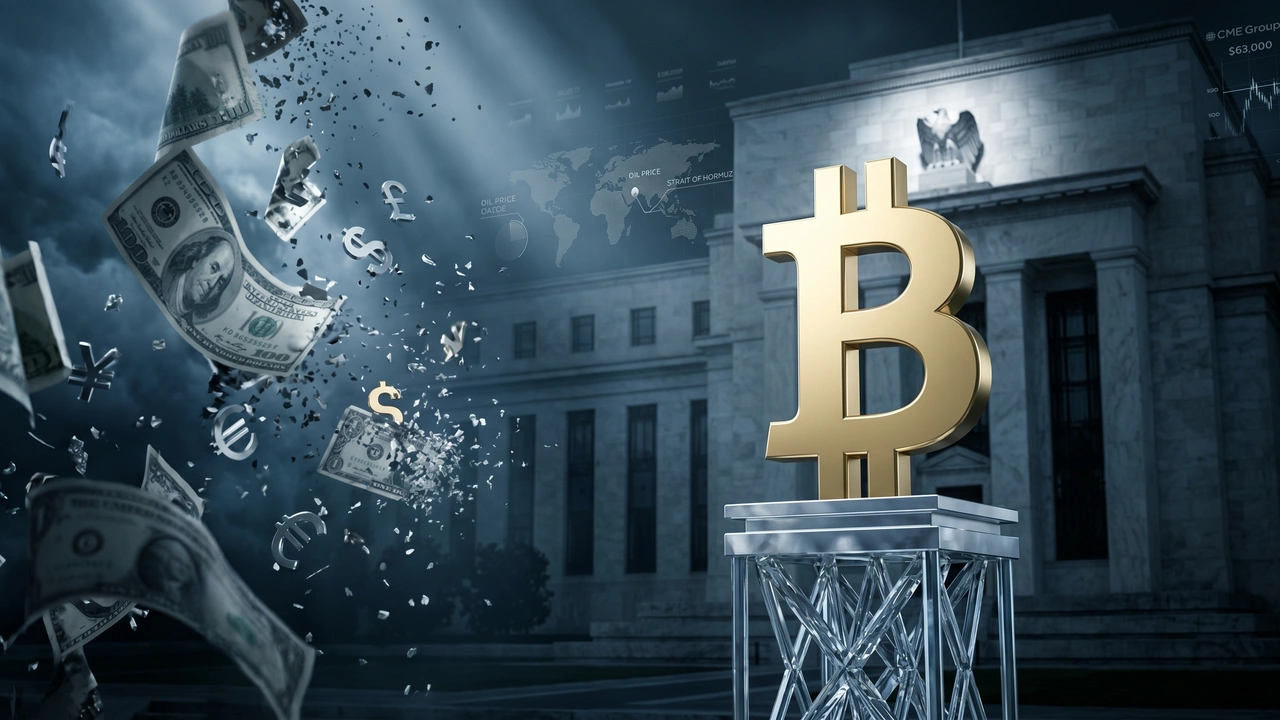
New Fed Chair Kevin Warsh's first FOMC meeting rattled risk assets and sent Bitcoin consolidating near $63,000 - but the bigger story is what his struggle to manage the dollar reveals about Bitcoin's structural advantage.
Key Takeaways
- Warsh's inaugural FOMC meeting was more hawkish than markets anticipated, driving July rate-hike odds to nearly 40% and pushing Bitcoin to eight-day lows before a partial recovery above $63,000.
- By eliminating much of the Fed's traditional forward guidance, Warsh has introduced a new layer of macro uncertainty that is likely to amplify volatility across risk assets, including Bitcoin.
- Multiple analysts see a potential liquidity sweep into the $50,000-$60,000 range as the most probable path to a bear-market bottom, with September cited as a possible timeframe for that low.
- The ongoing Iran-Strait of Hormuz standoff represents a geopolitical wildcard that could disrupt energy markets and compound macro uncertainty, keeping the black-swan risk alive in this cycle.
- Every FOMC meeting that requires human intervention to defend dollar purchasing power underscores Bitcoin's structural differentiation: a supply schedule enforced by code rather than by committee.
Warsh's Hawkish Debut Puts Bitcoin's Fixed Supply in Sharp Relief
When Kevin Warsh took the chair at his inaugural Federal Open Market Committee meeting this week, markets were braced for a softer touch. What they got instead was a pointed reminder that the dollar's stability is never guaranteed - it must be fought for, meeting by meeting, statement by statement. Bitcoin, consolidating near $63,000 in the aftermath, looked less like a volatile speculation and more like a system that simply does not require that kind of constant maintenance.
The contrast cuts to the heart of something Bitcoin advocates have argued for years: that the fiat monetary architecture is not merely imperfect but structurally dependent on human intervention. Warsh's disciplined debut makes that dependency more visible, not less.
The Facts
Bitcoin climbed back above $63,000 on Friday, but the move carried little conviction [1]. After Warsh's FOMC meeting concluded Wednesday with rates left unchanged, broader risk assets retreated and BTC/USD slipped to its lowest print in eight days before stabilizing [1]. The holiday closure of US equity markets for Juneteenth left crypto as the primary arena for digesting the week's macro shifts.
Warsh's tone at the meeting surprised traders who had anticipated a more accommodating posture, particularly given US President Donald Trump's persistent public calls for rate reductions [1]. Instead, the new chair delivered a shorter, more austere policy statement than his predecessor Jerome Powell favored, stripping out much of the forward guidance that markets had come to rely on [1]. In his post-meeting remarks, Warsh stated that "Inflation remains elevated relative to the Committee's 2 percent goal," signaling that price stability would be the dominant priority [1]. He also raised the possibility of overhauling - or scrapping entirely - standard Fed communication tools including the dot plot and regular press briefings, a move that trading desk The Kobeissi Letter flagged as a meaningful escalation of market uncertainty [1].
FedWatch pricing from CME Group placed the odds of a rate increase at the late-July FOMC meeting at nearly 40% following Wednesday's session [1]. That figure - close to a coin-flip on a hike - reflects how completely Warsh upended the consensus expectation of an extended pause. Markets had entered the week pricing in a Fed on the sidelines; they exited it reconsidering that assumption.
Geopolitical noise added another layer. Despite a memorandum of understanding signed between the US and Iran, tensions around the Strait of Hormuz resurfaced by week's end, with Iran asserting that maritime transit through the route depends on its approval [1]. The MoU reportedly covers only a 60-day window, leaving longer-term access unresolved. WTI crude held near $75 per barrel, not far above multi-month lows, as the market weighed whether the diplomatic détente was durable [1]. Analyst Rekt Capital, monitoring Bitcoin's behavior through the turbulence, warned his followers that bear markets historically tend to produce at least one severe, unexpected shock in their later stages - a so-called black swan - and that this cycle may not be finished delivering surprises [1].
On the price structure side, pseudonymous trader Killa outlined a scenario in which Bitcoin front-runs the large concentration of resting liquidity sitting below the $60,000 level before reversing [2]. His argument centers on the observation that order-book liquidity pools are often swept before a genuine trend change, and that a dip into the $50,000-$60,000 zone - if it occurred and then recovered without a secondary breakdown - could mark the bear market's terminal low by September [2]. Fellow analyst Daan Crypto Trades struck a more cautious note, warning that a failure to defend the $61,000-$62,000 band would likely accelerate selling pressure [2]. Meanwhile, Exitpump flagged a notable increase in short positioning among Binance traders on shorter timeframes, describing the resulting setup as bearing a distinctly bearish character [2].
Zooming out, the structural argument framing all of this comes from Bitcoin's core design. The dollar has shed roughly 88% of its purchasing value since the US abandoned gold convertibility in 1971, while US M2 money supply has expanded from hundreds of billions to north of $22 trillion [3]. Every chairman - however hawkish - operates within a system where expanding the money supply is always an available option, and history suggests it tends to be exercised [3]. Bitcoin's issuance, by contrast, follows a schedule encoded in its protocol: new supply halves approximately every four years across 210,000-block intervals, with total supply asymptotically approaching its ceiling near the year 2140 [3]. No committee vote can alter that trajectory.
Analysis & Context
Warsh's willingness to strip away Fed communication tools is being read by some as a hawkish signal, but it carries a second-order risk that deserves attention: reduced transparency from the world's most important central bank tends to amplify volatility across all asset classes. When traders cannot anchor expectations to dot plots or press-conference guidance, they reprice risk more aggressively on each data release. For Bitcoin - already sensitive to macro liquidity conditions - that environment cuts both ways. A genuine rate hike in July could pressure risk appetite further; but a surprise pivot would likely ignite a sharp relief rally from wherever BTC is trading at that point.
The deeper pattern here is one Bitcoin has navigated before. During the 2022 tightening cycle, aggressive Fed hawkishness initially crushed BTC alongside equities, but Bitcoin ultimately bottomed before the Fed's terminal rate was even reached. The lesson was not that Fed policy does not matter to Bitcoin - it clearly does in the short run - but that the market tends to price in the worst-case monetary scenario before it fully arrives. With July hike odds now sitting near 40% and sentiment already cautious, a meaningful portion of the tightening fear may already be reflected in current prices around $63,000.
What Warsh's debut actually does, perhaps unintentionally, is sharpen Bitcoin's value proposition for a specific audience: corporate treasury managers sitting on large dollar-denominated reserves. A Fed chair openly wrestling with how to prevent currency erosion is, functionally, an advertisement for assets whose scarcity does not depend on any chair's good intentions [3].
Sources
AI-Assisted Content
This article was created with AI assistance. All facts are sourced from verified news outlets.