Washington Moves to Embed Bitcoin Into the American Economic Fabric
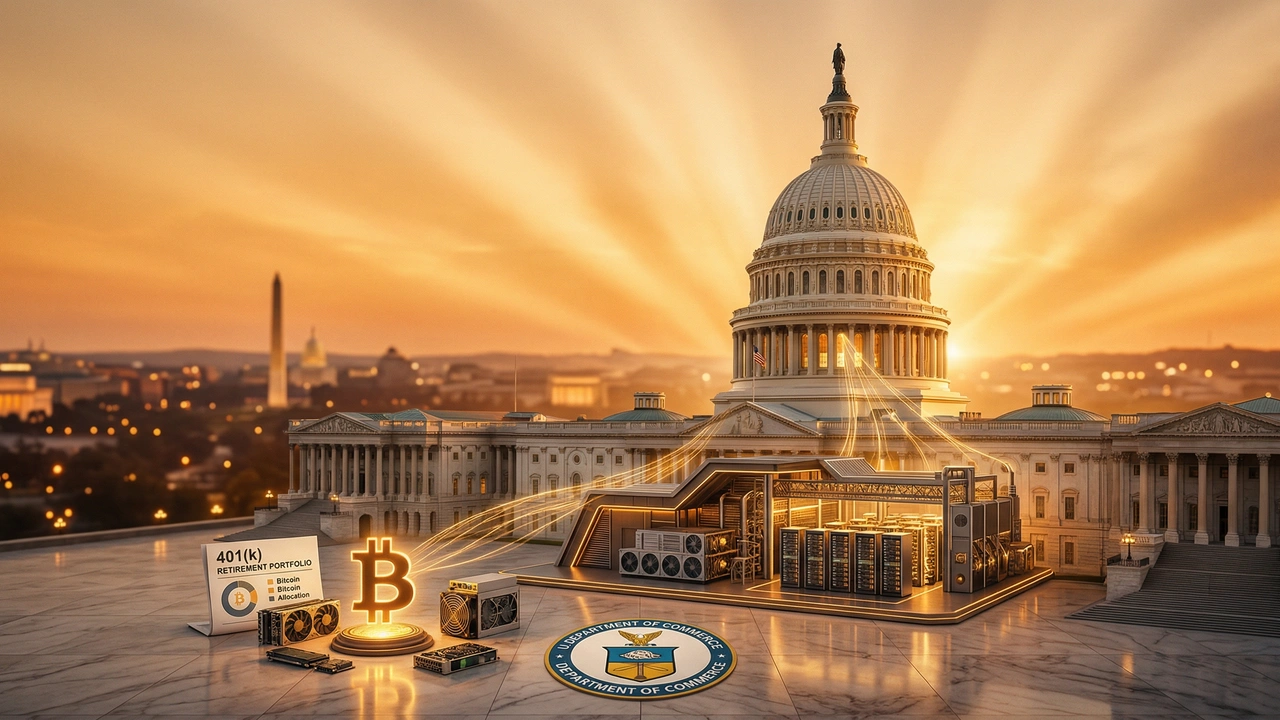
A landmark Senate bill to certify domestic mining and formalize a Strategic Bitcoin Reserve, combined with a Labor Department proposal opening 401(k)s to Bitcoin, signals a coordinated federal pivot toward institutionalizing Bitcoin across U.S. industrial, financial, and retirement policy.
Key Takeaways
- The "Mined in America Act" represents the first serious congressional attempt to address Bitcoin's hardware supply chain vulnerability, targeting a situation where 97% of mining equipment is Chinese-made despite the U.S. controlling 38% of global hash rate — a national security argument that is likely to resonate across party lines [1].
- The bill's Strategic Bitcoin Reserve provisions create a novel, budget-neutral mechanism: a capital gains tax exemption for miners who sell Bitcoin directly to the government, potentially establishing the U.S. Treasury as a persistent, incentivized buyer of domestic production [1].
- The DOL's proposed 401(k) rule effectively reverses Biden-era anti-crypto retirement guidance and establishes safe harbor protections for fiduciaries who include Bitcoin or Bitcoin-exposed funds, opening the door to trillions in potential long-term capital [2].
- These two developments are not isolated — they reflect a coordinated, administration-wide strategy to institutionalize Bitcoin across industrial policy, federal reserves, and household savings simultaneously, making any future policy reversal structurally harder.
- Investors and industry participants should monitor the certification standards and timeline specifics of the Mined in America Act closely, as the definition of compliant domestic hardware will shape which mining companies and manufacturers stand to benefit most from this legislative shift [1].
Washington Moves to Embed Bitcoin Into the American Economic Fabric
Something significant is happening in Washington, and it goes well beyond isolated legislative gestures. Within the span of a single news cycle, two separate arms of the federal government have advanced proposals that, taken together, represent the most ambitious attempt yet to weave Bitcoin into the structural fabric of the American economy. One targets the supply chain and national security dimensions of mining. The other unlocks the retirement savings of tens of millions of American workers. The direction of travel is unmistakable.
These are not coincidental developments. They reflect a deliberate, administration-wide posture shift — one that treats Bitcoin not as a speculative curiosity to be managed at arm's length, but as a legitimate component of U.S. industrial strategy, national reserves, and long-term household wealth. The implications for the network, its price discovery, and its geopolitical standing are profound.
The Facts
Republican Senators Bill Cassidy and Cynthia Lummis introduced the "Mined in America Act" on Monday, a sweeping piece of legislation designed to restructure the domestic crypto mining industry while simultaneously placing Donald Trump's Strategic Bitcoin Reserve on formal statutory footing [1]. The bill directs the Department of Commerce to create a voluntary "Mined in America" certification program for mining facilities and pools that meet defined security and domestic sourcing standards [1].
The urgency behind the supply chain provisions is grounded in a stark reality: while the United States accounts for roughly 38% of global Bitcoin hash rate, an estimated 97% of specialized mining hardware is manufactured by Chinese companies, principally Bitmain and MicroBT [1]. Legislators and industry advocates argue this dependency constitutes both an economic vulnerability and a national security risk, citing documented instances of firmware vulnerabilities in imported mining rigs that raised concerns about potential remote access capabilities [1]. Certified operators would be required to transition away from such hardware on a phased timeline, targeting full compliance by the end of the decade [1].
To support the development of genuinely domestic mining hardware, the bill tasks the National Institute of Standards and Technology and the Manufacturing Extension Partnership with providing technical assistance, while integrating certified projects into existing federal energy and manufacturing programs rather than authorizing new standalone expenditures [1]. Senator Cassidy framed it plainly: "Digital asset mining is a big part of our economy. We should be doing it here in America" [1].
The reserve provisions are equally significant. The bill proposes a "budget-neutral" mechanism for expanding federal Bitcoin holdings: revenue from staking rewards and airdrops on other seized digital assets would be directed toward Bitcoin purchases, and certified domestic miners would gain the option to sell newly mined Bitcoin directly to the government in exchange for a capital gains tax exemption — effectively incentivizing a discounted supply pipeline into the reserve [1]. The industry group Satoshi Action Fund endorsed the legislation as a comprehensive framework linking energy policy, manufacturing, and digital asset strategy [1].
On a parallel track, the Department of Labor unveiled a proposed rule that could dramatically expand Bitcoin's footprint inside American retirement accounts [2]. Released by the Employee Benefits Security Administration, the proposal would reduce regulatory uncertainty for plan fiduciaries considering alternative investments — including digital assets — by establishing "safe harbor" frameworks that protect plan managers who conduct thorough, well-documented due diligence [2]. Labor Secretary Lori Chavez-DeRemer stated the goal directly: "This greater diversity will drive innovation and result in a major win for American workers, retirees, and their families" [2]. The proposal explicitly reverses the Biden administration's 2022 guidance, which had cautioned fiduciaries against offering cryptocurrency in retirement plans [2]. Deputy Labor Secretary Keith Sonderling was categorical: "The department's days of picking winners and losers are over" [2].
Analysis & Context
To understand why this legislative cluster matters so much, consider the historical trajectory. For most of Bitcoin's existence, its relationship with Washington was defined by enforcement actions, regulatory ambiguity, and an implicit presumption of guilt. The SEC's prolonged resistance to spot Bitcoin ETFs, the Biden DOL's 2022 crypto warning, and congressional inaction on digital asset frameworks all reflected a federal establishment that was, at best, indifferent and, at worst, openly hostile. What we are witnessing now is a categorical reversal — and reversals of this magnitude, once institutionalized in statute and regulation, are extraordinarily difficult to unwind regardless of which administration follows.
The mining provisions deserve particular attention from a market structure perspective. A successful transition to domestically manufactured hardware — even partially — would fundamentally alter the cost basis and geopolitical resilience of American hash rate. It would also, over time, reduce the leverage that foreign hardware manufacturers currently hold over a critical segment of Bitcoin's security infrastructure. History suggests that when governments treat a technology as strategically vital — semiconductors being the clearest recent analogue — they tend to follow through with sustained support. The CHIPS Act precedent is instructive: once the logic of strategic manufacturing is accepted, the policy momentum tends to compound.
The 401(k) proposal may ultimately carry the larger long-term price signal. There are approximately $7.4 trillion held in 401(k) plans across the United States. Even modest allocation shifts — say, 1-2% of plan assets finding their way into Bitcoin-exposed products — would represent demand of a scale that dwarfs most prior institutional adoption events. The safe harbor framework is clever precisely because it does not mandate anything; it simply removes the legal fear that has kept most plan administrators on the sidelines. Combined with the already-approved spot Bitcoin ETF ecosystem, the infrastructure for fiduciaries to act is now largely in place. The DOL rule removes the last major regulatory barrier. What follows will depend on how quickly asset managers and plan sponsors move — but the direction is set.
Sources
AI-Assisted Content
This article was created with AI assistance. All facts are sourced from verified news outlets.