Washington's Crypto Reckoning: Clarity, Stablecoins, and the Stakes for America
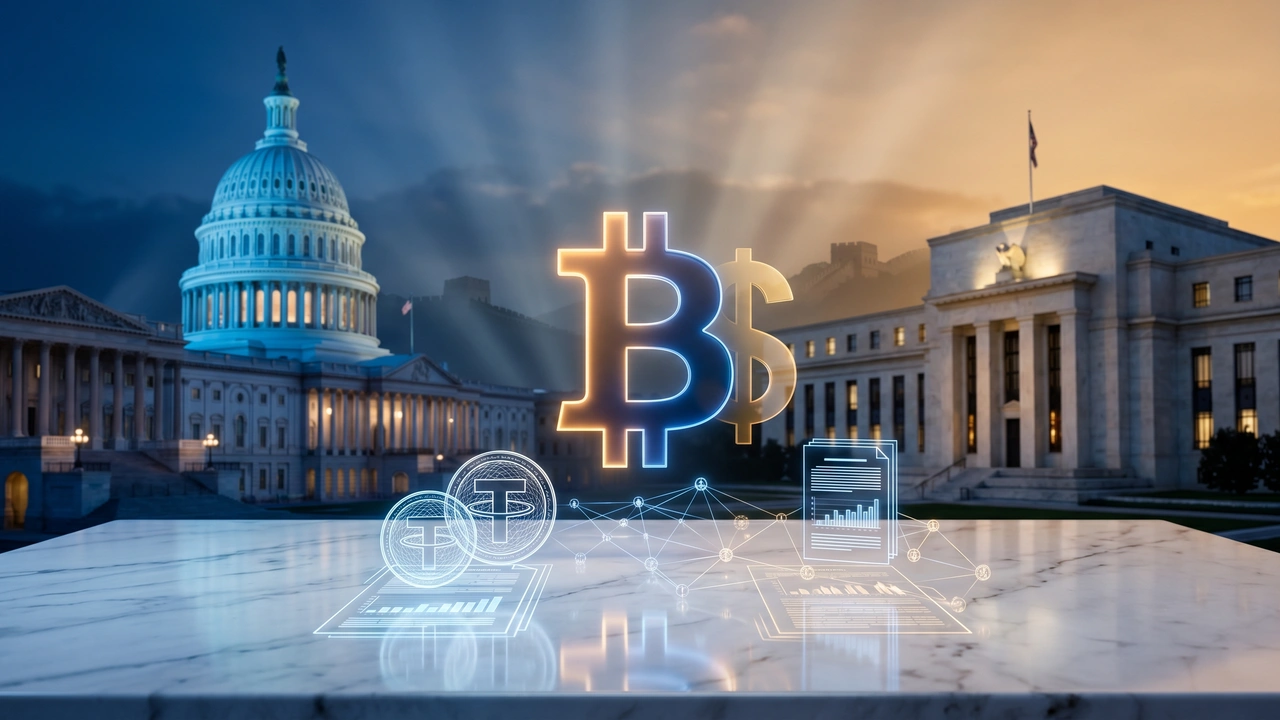
From a senator warning that China could seize digital-asset leadership to a Fed governor championing dollar-backed stablecoins, Washington's regulatory push is no longer a background story - it is the story. Here is what the latest developments mean for Bitcoin and the broader market.
Key Takeaways
- The CLARITY Act is Washington's primary vehicle for resolving the SEC-CFTC jurisdiction standoff over digital assets; its passage in the House marks progress, but Senate inaction continues to leave the market in legal limbo. [1]
- Senator Lummis frames regulatory clarity as a geopolitical imperative, warning that delay hands China an opening to set global digital-asset standards. [1]
- Fed Governor Waller's endorsement of dollar stablecoins reframes them as a tool of monetary reach rather than a threat to it - a significant shift in how a senior US central banker views the asset class. [3]
- The SEC's fraud case against Privvy Investments shows concretely how regulatory gaps enable sophisticated-sounding scams; AI branding has become a new layer of deception for bad actors in the crypto space. [2]
- The Bank of England's divergence from the Fed on stablecoin longevity signals that even as the US moves toward a framework, transatlantic alignment on digital-asset standards remains a distant prospect. [3]
Washington's Crypto Reckoning: Clarity, Stablecoins, and the Stakes for America
A striking consensus is forming in Washington: the question is no longer whether the United States will regulate digital assets, but whether it will do so before rivals set the terms for everyone else. Three separate threads - a senator's geopolitical alarm, a Fed governor's embrace of dollar stablecoins, and a brazen AI-trading fraud case - are, on closer inspection, all pulling at the same knot. What binds them is the absence of a clear legal framework, and the mounting cost of that vacuum.
The pressure to act has rarely sounded so urgent from so many directions at once. Legislators, central bankers, and enforcement agencies are all responding to the same structural gap - and their responses, taken together, sketch the contours of what US digital-asset policy could look like in the months ahead.
The Facts
Wyoming Senator Cynthia Lummis has renewed her push for the CLARITY Act, framing the legislation as nothing less than a matter of national financial sovereignty. In remarks made over the weekend, she argued that the US built the dominant global financial architecture of the 20th century and cannot afford to cede the equivalent ground in the digital era. Without a proper regulatory framework for digital assets, Lummis warned, other countries - most pointedly China - will write the rulebook that governs the next generation of financial markets. [1]
The CLARITY Act itself is designed to end years of jurisdictional ambiguity between the Securities and Exchange Commission and the Commodity Futures Trading Commission. Under the bill's provisions, most spot trading of qualifying tokens would fall under CFTC oversight, while the SEC would retain authority over primary offerings, disclosures, and investor protections. Lummis has also separately championed a proposal for the US to accumulate up to one million Bitcoin over a five-year horizon as a strategic national reserve - a position that underscores her view that Washington needs to treat digital assets as a geopolitical priority, not merely a regulatory nuisance. [1]
That geopolitical framing got reinforcement from an unexpected quarter: the Federal Reserve. Christopher Waller, a governor on the Fed's board, delivered remarks at the Dubrovnik Economic Conference in which he argued that dollar-denominated stablecoins could actually amplify the reach of American monetary policy rather than erode it. His logic: nations that adopt USD-pegged tokens effectively import US financial conditions alongside them, deepening the dollar's global footprint. Waller also took a notably dim view of central bank digital currencies, describing them as a solution in search of a problem - a pointed contrast to the enthusiasm some other central banks have shown for CBDCs. [3]
Not everyone in the global central banking community shares Waller's optimism. Megan Greene of the Bank of England offered a more skeptical outlook, predicting that stablecoins may lose relevance within a few years as tokenised bank deposits - essentially blockchain-native versions of conventional banking balances - gain traction. "I think tokenised deposits will likely replace stablecoins, and in five years we'll probably wonder why we were talking about stablecoins at all," Greene said. [3] The divergence between the two central bankers illustrates how far the debate still has to travel before any transatlantic consensus emerges.
Meanwhile, the SEC provided a vivid illustration of what regulatory ambiguity costs in practice. The agency moved against Nathan Fuller, founder of Privvy Investments, alleging he collected approximately $12.3 million from around 150 investors with promises that AI-powered trading bots would automatically execute profitable crypto arbitrage strategies. Projected returns ranged from 50 percent over a few weeks to, in some pitches, guaranteed gains of more than 100 percent. [2] According to the SEC's complaint, the reality bore little resemblance to the pitch: barely three percent of investor funds were ever put into any cryptocurrency, the bots lacked the advertised capabilities, and Fuller allegedly diverted at least $6.2 million for personal spending - including a roughly $1 million home, travel, and gambling. A further $5.5 million reportedly went to pay earlier investors in what the SEC characterises as a Ponzi-like structure. [2] To delay withdrawal requests, Fuller allegedly set up a fictitious compliance firm called Blockchain Audit Solutions and used ChatGPT to draft letters instructing investors that their accounts had been migrated and required KYC verification before funds could be released. [2]
Analysis & Context
The Privvy Investments case is a symptom of the same disease the CLARITY Act is meant to cure. When the boundary between securities and commodities remains blurred, and when no single regulator holds clear jurisdiction, the compliance bar for bad actors effectively drops to near zero. Fraudsters do not need to defeat regulatory oversight - they simply need to operate in the gap between agencies. The House passed the CLARITY Act in July 2025 with bipartisan support, but as of early 2026 it was still waiting for Senate action. That delay has real-world consequences: every month without a framework is another month in which investors lack the legal clarity needed to distinguish legitimate platforms from elaborate fictions dressed up in AI jargon.
Waller's stablecoin argument deserves particular attention because it repositions the entire debate. For years, dollar stablecoins were treated primarily as a crypto-market plumbing issue - useful for traders but peripheral to mainstream monetary policy. Waller's framing inverts that: if dollar-pegged tokens spread US monetary influence internationally, then getting stablecoin regulation right becomes a foreign-policy instrument, not just a consumer-protection exercise. That aligns closely with the Lummis argument that digital-asset leadership is a question of national competitiveness. The Greene-Waller divergence also signals that whatever framework the US settles on will face friction at the international level - making domestic clarity not the finish line but the starting point of a much longer negotiation.
Sources
- [1]btc-echo.de
- [2]btc-echo.de
- [3]btc-echo.de
AI-Assisted Content
This article was created with AI assistance. All facts are sourced from verified news outlets.