Whale Bets, Broken Correlations, and Bitcoin's Next Big Move
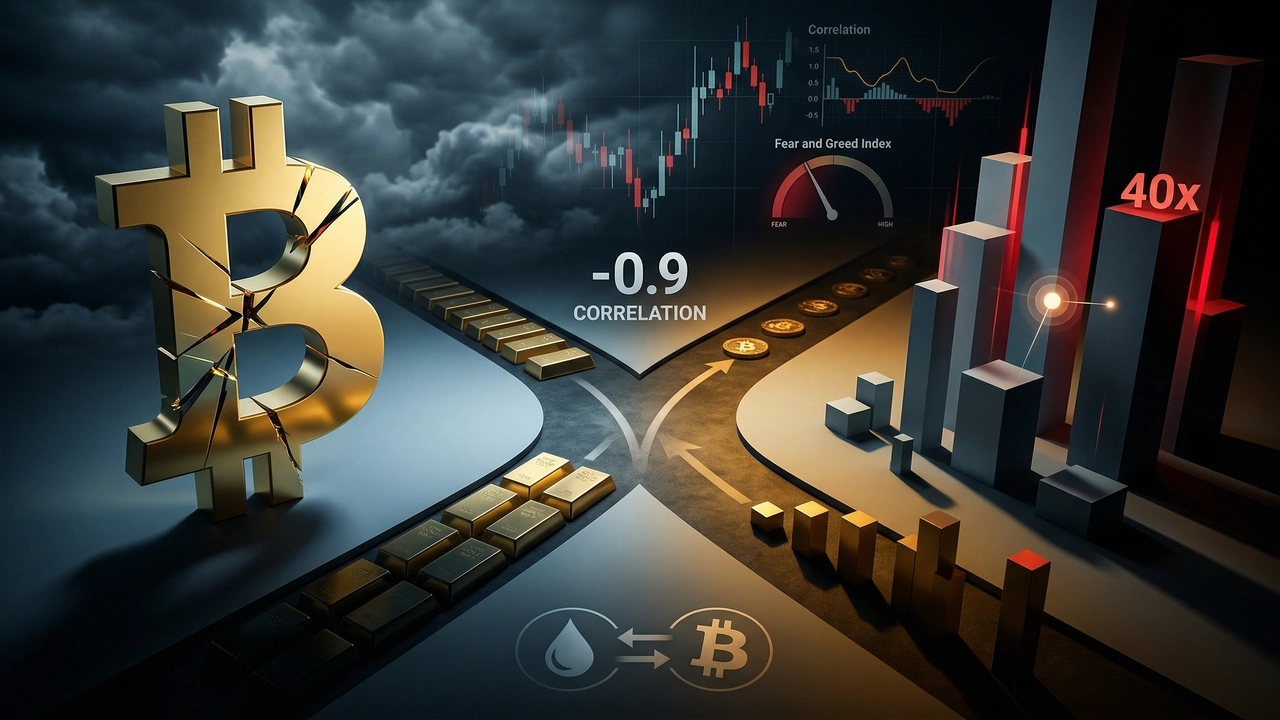
A mysterious whale's perfectly timed short trade and Bitcoin's historic divergence from gold are sending conflicting signals — but together they paint a revealing picture of where the market may be headed.
Key Takeaways
- A whale's $38.84M short on Bitcoin at 40x leverage — opened hours before a major geopolitical speech — generated over $3.6M in combined profits alongside an oil long, raising legitimate questions about informational asymmetry in unregulated crypto derivatives markets [1].
- Bitcoin's correlation with gold has collapsed to -0.9, the lowest level since the FTX crash of late 2022, suggesting a potential regime shift in how Bitcoin is being traded relative to traditional safe-haven assets [2].
- Analyst Michaël van de Poppe identifies the current 13-to-14-month bear market duration as historically consistent with prior Bitcoin bottoms measured against gold — a timing signal worth monitoring closely [2].
- The Fear and Greed Index has been locked in "extreme fear" for approximately two months; in previous cycles, prolonged fear readings of this nature have marked cycle lows rather than the beginning of further declines [2].
- Investors with long-term horizons may find the current environment — deep discount from all-time highs, extreme sentiment negativity, and a potential gold-Bitcoin ratio reversal — compelling from a historical pattern perspective, though near-term volatility driven by geopolitical uncertainty remains a real and material risk [1][2].
When a Whale Smells Blood: Bitcoin's Market Crossroads Revealed
Something unusual happened in the hours before geopolitical shockwaves hit global markets. A single trader quietly assembled a massive leveraged bet against Bitcoin on derivatives platform Hyperliquid — and when the dust settled, that position had turned into millions in profit. Simultaneously, Bitcoin's relationship with gold collapsed to its lowest correlation in over three years, raising a question that every serious investor should be asking right now: are we witnessing the death of one narrative and the birth of something far more powerful?
These two developments — a suspiciously well-timed whale trade and a historic decoupling from gold — are not isolated events. Together, they expose the fault lines of today's Bitcoin market and hint at where momentum could be building next.
The Facts
Shortly before Donald Trump delivered a speech signaling a potential military escalation, an unidentified large-scale trader opened a Bitcoin short position worth approximately $38.84 million on Hyperliquid, using 40x leverage and entering at a price of around $68,761 [1]. The timing proved extraordinary: Bitcoin subsequently dropped sharply toward the $66,000 level, and the position moved into profit by approximately $1.23 million [1]. The same trader simultaneously opened a leveraged long on oil with 20x leverage, correctly anticipating that geopolitical tension would push energy prices higher — a bet that generated roughly $2.41 million in gains [1]. The combined profit from both trades exceeded $3.6 million, and the precision of the positioning has sparked debate within the crypto community about whether this represents exceptional skill or something more troubling, such as an informational advantage. No evidence of insider trading has been presented, but the timing has drawn scrutiny [1].
On the macro front, April 2026 has produced a striking statistical anomaly. While Bitcoin has posted gains of approximately 7% month-to-date, gold has fallen by roughly 17% over the same period [2]. The result is a Bitcoin-to-gold correlation index that has collapsed to -0.9 according to CryptoQuant data — the lowest reading since late 2022, when Bitcoin was trading near $16,000 in the aftermath of the FTX collapse [2]. Crypto analyst Michaël van de Poppe has highlighted the Bitcoin-to-gold ratio as a critical indicator, suggesting that after Bitcoin's 70% decline relative to gold in recent months, the market may already have found its cyclical bottom [2]. He notes that Bitcoin has historically reached its trough against gold at roughly the 13-to-14-month mark of a bear market — a timeframe that aligns with the current period [2].
Bitcoin itself has experienced a turbulent stretch, correcting from approximately $126,000 in early October down to $60,000 in late February, before reclaiming the $70,000 level multiple times during March [2]. Meanwhile, the Fear and Greed Index has remained in "extreme fear" territory for roughly two months — a sustained negative sentiment reading that has, in past cycles, often coincided with market bottoms rather than further deterioration [2]. Gold advocate Peter Schiff, predictably contrarian, argues that even a potential end to military conflict would not meaningfully diminish gold's long-term appeal, citing the fiscal costs of rebuilding and ongoing inflationary pressures from government spending [2].
A Bitwise research report referenced in the analysis suggests that investors need not choose between gold and Bitcoin, with a portfolio allocating 7.5% to each asset alongside a traditional 60/40 stocks-and-bonds allocation demonstrating strong risk-adjusted performance historically [2].
Analysis & Context
The whale trade deserves careful interpretation. In traditional financial markets, the idea of a single participant positioning with near-perfect timing ahead of a major geopolitical announcement would trigger immediate regulatory scrutiny. In crypto, the absence of formal market surveillance mechanisms makes such trades legally ambiguous but informationally significant. Whether this was genius, luck, or something in between, it illustrates a persistent structural vulnerability in leveraged crypto markets: concentrated positions at key price levels can amplify moves in either direction, turning geopolitical events into outsized trading catalysts. For retail participants, the lesson is sobering — highly leveraged markets can be moved by actors with asymmetric information, and the 40x leverage involved here means the line between windfall and liquidation is razor-thin.
The Bitcoin-gold decoupling is arguably the more consequential story. Historically, when Bitcoin and gold move in opposite directions for extended periods, it signals a regime change in how the market perceives Bitcoin's identity. In 2020-2021, Bitcoin increasingly absorbed the "digital gold" narrative and traded in tandem with precious metals as a hedge against dollar debasement. The current divergence suggests that narrative may be temporarily fracturing — but that fracture could be a feature, not a bug. Bitcoin's fixed supply of 21 million coins, with over 95% already in circulation, creates a scarcity profile that gold fundamentally cannot replicate [2]. As van de Poppe's analysis implies, Bitcoin may be re-asserting a distinct identity: not just a debasement hedge, but a high-beta recovery asset poised to outperform in the next risk-on cycle. The parallel to post-FTX 2022 is instructive. That period also featured extreme fear readings and a gold-Bitcoin divergence — and it marked the final capitulation before one of the most powerful Bitcoin recoveries on record. History does not repeat with mechanical precision, but the pattern warrants serious attention.
The sustained Fear and Greed readings in "extreme fear" add another layer of context. Contrarian investors have long recognized that peak pessimism often precedes meaningful reversals. Two consecutive months of extreme fear, combined with Bitcoin trading roughly 40% below its all-time high, creates the kind of setup that has historically rewarded patient, thesis-driven positioning [2].
Sources
- [1]btc-echo.de
- [2]btc-echo.de
AI-Assisted Content
This article was created with AI assistance. All facts are sourced from verified news outlets.