When Security Fails: Bitcoin Theft and DeFi Losses Expose Human Vulnerability
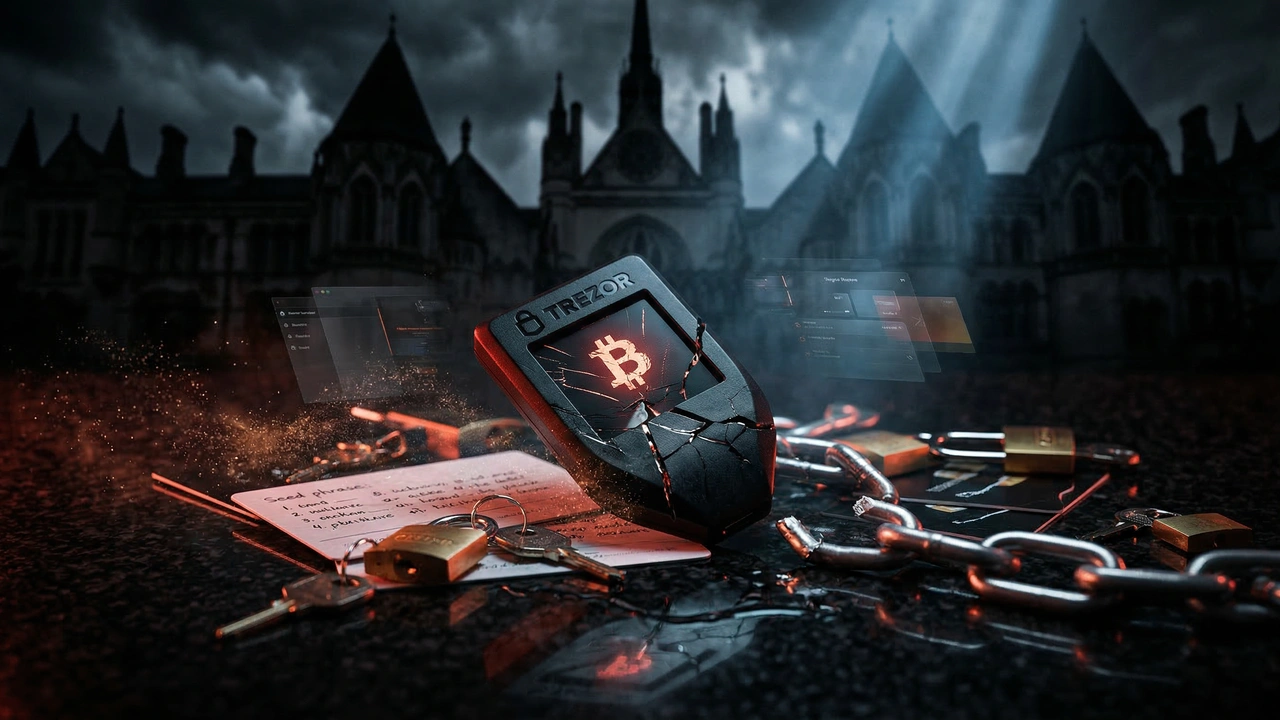
A £176 million Bitcoin theft allegedly orchestrated by a wife who filmed her husband's seed phrase, and a $50 million DeFi trading blunder, reveal that the greatest threats to crypto holdings are not sophisticated hackers — they are human error and misplaced trust.
Key Takeaways
- Physical security is as critical as digital security: The alleged theft of 2,323 BTC was not a technical hack but a surveillance operation targeting a seed phrase — a reminder that hardware wallet security is only as strong as the environment in which it is used [1].
- Never input or display your seed phrase where it can be observed: Cameras, smartphones, and trusted family members all represent potential attack vectors; operational security must be practised rigorously and consistently.
- DeFi's permissionless design demands user education: The $50 million Aave loss occurred despite clear on-screen warnings — underscoring that protocol safety features are meaningless if users do not understand what they are confirming [2].
- Aave Shield sets a useful precedent: Defaulting to a 25% price-impact cap with an opt-out mechanism is a mature design choice that other DeFi interfaces should consider adopting to reduce costly user errors [2].
- The Bitcoin held in frozen wallets represents a legal precedent in progress: The UK High Court's favourable assessment of Yuen's case and push for an early trial may establish important legal frameworks for how courts handle Bitcoin theft and asset recovery in common law jurisdictions [1].
When Security Fails: Bitcoin Theft and DeFi Losses Expose Human Vulnerability
The promise of Bitcoin has always rested on a foundational principle: self-sovereignty. Hold your own keys, control your own wealth, answer to no bank or government. But two recent incidents — one a deeply personal alleged betrayal worth $176 million, the other a catastrophic trading mistake that vaporised $50 million in seconds — remind us that the weakest link in any security model is almost always the human being operating it. These cases are not merely cautionary tales. They are a stark warning about what it truly means to be your own bank.
Taken together, they illustrate a broader and uncomfortable truth: as Bitcoin's value has soared, so too have the stakes of getting security wrong — whether through criminal intent, misplaced trust, or simple negligence at the confirmation screen.
The Facts
In a case before the UK's High Court of Justice, a man named Ping Fai Yuen has accused his estranged wife, Fun Yung Li, of stealing 2,323 Bitcoin — valued at approximately $176 million — from his Trezor hardware wallet in 2023 [1]. According to court documents reviewed by Justice Cotter, Yuen's legal team alleges that Fun and her sister covertly filmed Yuen to capture his seed phrase and wallet access codes, then used that information to transfer the Bitcoin across 71 separate wallet addresses [1].
The alleged plot reportedly began to unravel when Yuen was tipped off by his own daughter. He subsequently installed audio recording equipment and claims to have captured conversations in which Fun discussed the theft and strategies for moving large sums of money without triggering scrutiny from banks or law enforcement [1]. No movement has been recorded at any of the 71 destination wallet addresses since December 21, 2023 [1]. Yuen reported the alleged theft to police shortly after that final transfer, and authorities arrested Fun and seized several cold wallets and watches — though she was later released on bail, and police subsequently indicated there would be "no further action pending new evidence" [1].
In November 2024, Yuen applied for an asset preservation injunction to freeze the cryptocurrency and formally establish his ownership [1]. He also expressed concern that the wallets holding his alleged Bitcoin had been subjected to dusting attacks — a technique where small amounts of crypto are sent to large wallets in order to track activity and identify high-value targets for follow-up scams or physical threats [1]. Justice Cotter assessed the claimant's prospects favourably, writing that Yuen "has demonstrated a very high probability of success," noting that the transcripts were "damning" and that equipment capable of exfiltrating Bitcoin was found during the search of Fun's property [1]. The case has been flagged for an early trial, with the judge citing the "security threats to, and volatility of value of, the Bitcoin" as grounds for urgency [1].
Meanwhile, in the decentralised finance arena, the Aave protocol found itself at the centre of a very different kind of financial catastrophe. A trader used the Aave interface to swap 50 million USDT into AAVE governance tokens — and received back just 324 AAVE tokens worth approximately $36,100 [2]. The devastating loss came as a result of executing an enormous order in a market with minimal liquidity, producing a price impact of 99 percent. Aave was quick to clarify that its core protocol was not compromised; the swap was routed through CoW Swap, a third-party decentralised aggregator integrated into the Aave front-end [2]. Critically, Aave's interface displayed explicit warnings — including a notice that read "High Price Impact (99.9%). This route may return less due to low liquidity" — and required the user to manually confirm awareness of a "possible loss of 100%" before the transaction could proceed [2]. The team stated plainly: "The user manually confirmed this warning, thereby explicitly accepting the unfavourable price quote" [2]. In response, Aave announced the development of a new protective feature called "Aave Shield," which will by default block any swap with a price impact exceeding 25 percent, requiring users to actively override the protection to proceed [2]. Aave also confirmed it would reimburse the approximately $110,368 in fees generated by the ill-fated transaction [2].
Analysis & Context
What connects a domestic Bitcoin theft in the UK and a catastrophic DeFi swap? Both incidents expose the same fundamental vulnerability: human behaviour under conditions of incomplete information or misplaced trust. In the Yuen case, the security model of a hardware wallet — widely considered among the most robust available — was entirely circumvented not through any technical exploit, but through the oldest threat vector in existence: physical proximity and betrayal. A Trezor wallet is impenetrable to remote hackers; it is not impenetrable to someone sharing your home and your life. This case should force every serious Bitcoin holder to reconsider their operational security (OpSec) practices. Seed phrases must never be written down or entered in view of cameras, smart devices, or other people — including, as this case tragically illustrates, those closest to you. The $5 wrench attack, long discussed in Bitcoin security circles, has now been joined by the "seed phrase surveillance" attack as a real-world threat at scale.
The Aave incident is a different but equally instructive failure. The protocol did everything right from a technical standpoint — warnings were displayed, confirmations were required, and the underlying smart contracts functioned exactly as designed [2]. Yet $50 million evaporated because a user either failed to understand what they were confirming or misjudged the magnitude of the risk. This is the paradox of decentralised finance: self-custody and permissionless access are powerful freedoms, but they carry the full weight of personal responsibility. There is no customer service line to call, no chargeback mechanism, no fraud department. The immutability that makes Bitcoin valuable is the same property that makes these losses permanent. Aave Shield is a sensible step toward reducing user error, but it also highlights a broader UX challenge facing DeFi: protecting unsophisticated users without undermining the permissionless ethos that defines the space.
Historically, the most successful attacks on Bitcoin have rarely been cryptographic. From the early days of exchange hacks like Mt. Gox to clipboard-hijacking malware and SIM-swapping attacks, the pattern is consistent — attackers go after people and processes, not the protocol itself. These two cases reinforce that pattern emphatically.
Sources
AI-Assisted Content
This article was created with AI assistance. All facts are sourced from verified news outlets.