XRP and Midnight: Two Altcoins, One Hard Truth About Crypto Hype
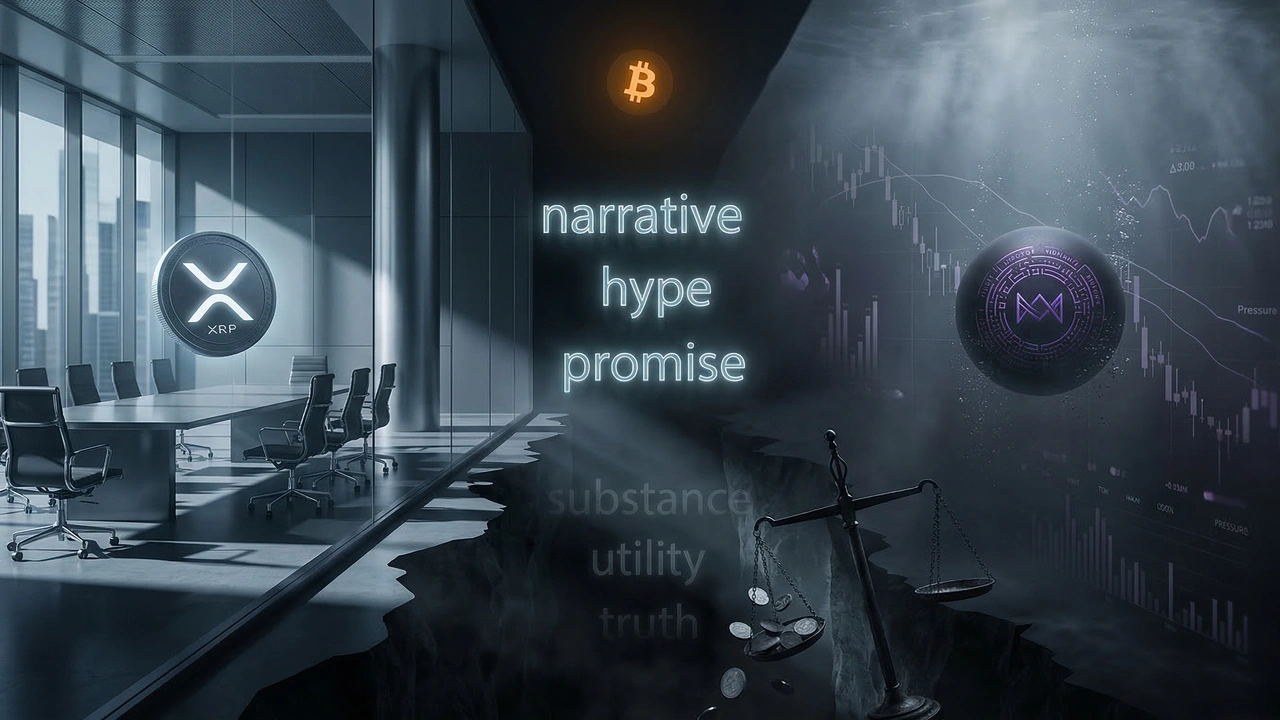
XRP remains a misunderstood middle ground between scam and revolution, while Midnight faces mounting technical selling pressure — together they illustrate the persistent gap between altcoin narrative and reality.
Key Takeaways
- XRP is neither a scam nor a payments revolution — it is a centrally managed enterprise settlement tool with real but narrow utility, and investors should price it accordingly rather than projecting either fraud or global dominance onto it [1].
- Ripple's 42 percent control over XRP supply is a genuine, ongoing structural risk that distinguishes XRP fundamentally from truly decentralized assets like Bitcoin [1].
- The expanding stablecoin ecosystem poses a credible and underappreciated competitive threat to XRP's core remittance use case, which should be factored into any long-term thesis on the token [1].
- Midnight's fundamental metrics are strong, but the token is in a technically fragile position — a failure to reclaim the $0.050 EMA level would likely extend the correction toward the $0.046 support zone [2].
- Both assets illustrate the same broader principle: in crypto markets, strong narratives and strong fundamentals are necessary but insufficient conditions for price performance — market structure and macro context ultimately set the tempo.
XRP and Midnight Expose the Uncomfortable Gap Between Altcoin Narrative and Market Reality
Two of crypto's more polarizing projects are back in the spotlight this week, and neither story is quite what the loudest voices in the room claim it to be. XRP continues to inspire fierce debate — simultaneously accused of being a corporate fraud and celebrated as the future backbone of global payments — while Midnight, the privacy-focused Cardano sidechain, is sliding technically even as its fundamental metrics look impressive. Taken together, these two assets offer a revealing window into one of crypto's most persistent problems: the dangerous distance between story and substance.
For Bitcoin maximalists and altcoin skeptics alike, these developments serve as a useful reminder that narrative momentum and genuine utility are not the same thing — and that markets, eventually, tend to sort the two.
The Facts
Ripple's XRP has occupied a unique and contested position in the crypto landscape since the project's founding in 2012 [1]. Unlike Bitcoin, Ripple was never conceived as an alternative to the existing financial system — it was explicitly designed as a bridge between traditional payment infrastructure and crypto rails, with XRP serving as a liquidity vehicle [1]. That design philosophy came with deliberate trade-offs: no mining, a fixed token supply created entirely at genesis, and a central company — Ripple Labs — acting as the dominant force in the ecosystem [1].
The token distribution remains one of the most contentious issues surrounding XRP. All 100 billion XRP tokens were minted at the network's launch in 2012, with approximately 80 billion allocated to Ripple and its founders [1]. While Ripple locked around 55 billion XRP into escrow contracts starting in 2017, the company still directly or indirectly controls roughly 42 percent of all XRP in circulation today [1]. The consensus mechanism adds another layer of controversy: rather than relying on economic incentives like proof-of-work or proof-of-stake, the XRP Ledger depends on a curated group of validators whose selection is largely influenced by Ripple itself [1]. This centralization argument became central to the SEC's years-long legal battle over whether XRP should be classified as a security [1].
Despite the criticism, the charge of outright fraud doesn't hold up under scrutiny. The XRP Ledger has operated continuously since 2012 without protocol breaks or retroactive rule changes, and no XRP tokens have ever been secretly minted [1]. The network's $85 billion market capitalization places it firmly among the largest crypto assets globally [1]. However, the bullish counternarrative — that XRP is destined to become the new SWIFT — is equally overstated. While Ripple has built a notable network of banking and payments partners, many of those institutions use Ripple's technology purely for messaging, compliance, or fiat settlement without ever touching XRP itself [1]. In practice, the token tends to appear only where Ripple's On-Demand Liquidity product delivers clear economic advantages, such as in remittance corridors — not in the large-bank infrastructure plays that XRP advocates routinely tout [1].
On the Midnight front, the picture is technically deteriorating despite genuinely strong fundamental numbers. The Cardano privacy project boasts more than 57,000 registered users, has grown over 300 percent since its Glacier Drop, and carries a market capitalization approaching $870 million [2]. Yet the token dropped roughly eight percent in the most recent session, trading between $0.053 and $0.048, with the current price sitting near the lower end of that range at approximately $0.048 [2]. Technically, Midnight has slipped below its 20-day exponential moving average — currently near $0.050 — and is printing a sequence of lower highs and lower lows, a classic sign of short-term bearish structure [2]. The RSI sits at around 41, below the neutral 50 threshold, indicating prevailing sell-side pressure without yet reaching oversold territory [2]. Key support sits at $0.048, with a breakdown potentially opening the door to $0.046 [2].
Analysis & Context
The XRP situation reflects a pattern that has played out repeatedly throughout Bitcoin's history: the confusion of infrastructure adoption with token value accrual. Ripple has been genuinely successful in selling enterprise software and integrations to financial institutions. That success, however, does not automatically translate into demand for the XRP token itself — a distinction that institutional buyers understand far better than retail speculators tend to. The honest assessment is that XRP is a centrally managed settlement experiment with real-world traction in narrow use cases, not the decentralized monetary revolution its most zealous supporters envision. The growing stablecoin ecosystem represents a more direct competitive threat to XRP's core remittance use case than most XRP holders appear to appreciate [1]. If dollar-pegged stablecoins on fast, cheap networks can replicate the liquidity benefits Ripple's ODL product offers, the marginal case for holding XRP shrinks considerably.
For Bitcoin-focused investors, the XRP story also reinforces why decentralization and credible neutrality matter as foundational properties. Bitcoin's value proposition rests on the fact that no single entity — not a company, not a government, not a foundation — can alter the rules of the network or dump supply onto the market. XRP's architecture makes both of those things structurally possible, and the 42 percent ownership concentration by Ripple Labs represents an ongoing, quantifiable supply-side risk that doesn't exist in Bitcoin [1].
Midnight's technical weakness amid strong fundamentals is a different kind of cautionary tale — one about the timing mismatch between project milestones and market sentiment cycles. Strong user growth and a rising market cap are meaningful data points, but they don't immunize a token from technical selling pressure, particularly in a broader market environment that has grown more risk-averse. Cardano's ecosystem has historically faced extended gaps between development progress and price performance, and Midnight appears to be navigating a similar dynamic. The controlled, non-impulsive nature of the current correction suggests this is profit-taking rather than panic — but traders will need to see a convincing reclaim of the $0.050 EMA level before the short-term outlook shifts [2].
Sources
- [1]btc-echo.de
- [2]btc-echo.de
AI-Assisted Content
This article was created with AI assistance. All facts are sourced from verified news outlets.