Yield vs. Utility: How Staking Returns and Lightning Shape Crypto's Future
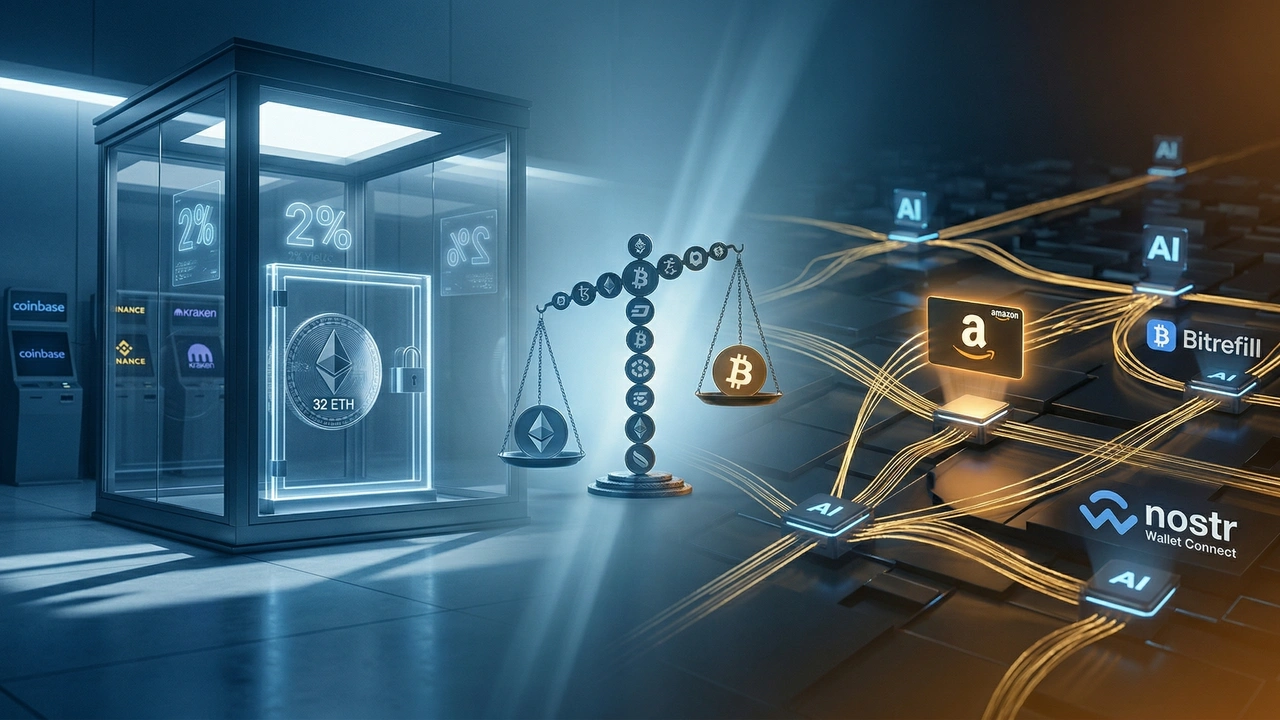
As Ethereum staking yields compress toward 2% annually and AI agents begin autonomously spending Bitcoin over the Lightning Network, two parallel developments reveal a fundamental divergence in how crypto networks generate and deliver value.
Key Takeaways
- Ethereum staking yields of ~2% annually function as a dilution hedge for long-term holders, not a primary income source — real returns remain deeply tied to ETH price performance, making the yield secondary to directional conviction [1]
- AI agents are already transacting autonomously over Lightning today — this is not a future possibility but a demonstrated reality, with practical infrastructure from Bitrefill, Lightning Labs, and Nostr Wallet Connect already operational [2]
- The Machine Payments Protocol (MPP) embedding Lightning as a native option alongside Visa and Mastercard is a landmark moment — for the first time, Bitcoin sits at a financial industry standards table as a peer payment method rather than an outsider alternative [2]
- The critical bottleneck for Lightning's agentic commerce adoption is supply-side depth: 379 verified L402 endpoints versus 5,600+ for x402 means developer focus on building Lightning-compatible APIs is now the most leverage-creating activity in the ecosystem [2]
- Investors should recognize these as fundamentally different value propositions: Ethereum staking rewards capital holders who already believe in ETH price appreciation, while Lightning's infrastructure build-out rewards those who believe Bitcoin's utility layer will capture a share of the multi-trillion-dollar autonomous machine economy taking shape right now [1][2]
Passive Income or Active Infrastructure? Crypto's Dual Identity Comes Into Focus
Two developments unfolding simultaneously in the crypto space this year crystallize a fundamental question every serious investor and builder must grapple with: Is a blockchain network primarily a yield-generating savings instrument, or is it programmable financial infrastructure? Ethereum's staking ecosystem and Bitcoin's Lightning Network are each answering that question differently — and the implications for how capital and utility flow through the broader market could not be more distinct.
While Ethereum holders weigh whether 2% annual yields justify locking up capital, Bitcoin developers are quietly building the payment rails that AI agents are already using to transact autonomously. These are not isolated stories. Together, they sketch the landscape of where blockchain technology is actually headed.
The Facts
Ethereum staking yields have contracted significantly over recent years and currently sit at modest levels across major platforms. Coinbase offers approximately 1.91% annually, Binance hovers around 2.5%, and Kraken reaches as high as 2.65%, making a working estimate of roughly 2% per year a reasonable benchmark [1]. Crucially, rewards are denominated in ETH rather than dollars, meaning real returns are entirely hostage to price performance. A $10,000 position at $2,000 per ETH produces around $200 in annual rewards at stable prices — but that same reward drops to $100 if ETH falls to $1,000, and climbs to $300 if the price reaches $3,000 [1].
The minimum barrier to running a solo Ethereum validator remains 32 ETH, pushing most retail participants toward custodial staking via exchanges or third-party providers [1]. This introduces counterparty risk and liquidity constraints, since staked ETH may not be immediately accessible depending on the chosen platform. The conclusion from the numbers is sobering: staking scales linearly with capital deployed, but even at $100,000 invested, annual rewards amount to roughly $2,000 at current yields — a supplement to directional price exposure, not a standalone income strategy [1].
On the Bitcoin side, an entirely different story is developing around the Lightning Network and its emerging role in agentic commerce. Jan-Paul, host of the Nodesignal podcast and a member of the Bitrefill team, recently demonstrated that an AI agent could autonomously purchase an Amazon gift voucher on Bitrefill, pay a Lightning invoice, and deliver the redemption code — all without any human interaction [2]. The architecture involved two components: Bitrefill's MCP (Model Context Protocol) server, which allows an AI agent to browse and order products, and Nostr Wallet Connect (NWC), which grants the agent authorized, budget-limited access to a Lightning wallet [2].
This practical experiment sits at the intersection of a much larger infrastructure battle. Major technology and financial companies are racing to define the payment layer for what the industry is calling "agentic commerce" — transactions executed autonomously by AI systems. OpenAI and Stripe have launched the Agentic Commerce Protocol (ACP), already active across more than one million Shopify and Etsy merchants. Google has developed the Universal Commerce Protocol (UCP) with Walmart, Target, and Shopify, supported by nearly 30 companies including Visa and Mastercard [2].
Critically for Bitcoin, the newly introduced Machine Payments Protocol (MPP) — co-developed by Stripe and Tempo, submitted to the IETF standards body, and backed by Visa, OpenAI, Anthropic, and Mastercard — is deliberately payment-method agnostic [2]. Lightning has already been integrated into MPP by Lightspark. Meanwhile, Lightning Labs' own L402 protocol offers something no competitor does: it fuses payment and access authorization into a single cryptographic step, eliminating the need for accounts, logins, or database lookups [2]. The 402 index currently tracks 379 verified L402 endpoints, compared to over 5,600 for Coinbase's competing x402 Stablecoin protocol [2].
Analysis & Context
The compression of Ethereum staking yields below 2% is not an accident — it is a structural consequence of the network's own success. As more ETH entered the staking pool following the Merge and subsequent upgrades, the rewards per validator were mathematically diluted. This mirrors what happened to Bitcoin mining profitability as hash rate expanded: the network became more secure, but the economics for individual participants thinned. For long-term ETH holders, staking remains a rational way to avoid dilution from newly issued rewards going to others. But framing it as passive income in the traditional sense is misleading when the underlying asset can swing 30-50% in either direction within a quarter.
The Lightning Network's role in agentic commerce, however, represents something categorically different. Historically, Bitcoin's primary use case argument has rested on store-of-value properties, with payments treated as a secondary or aspirational function. The emergence of AI agents as economic actors changes that calculus in a meaningful way. Machines do not need banks, credit histories, or KYC verification. They need instant, programmable, permission-minimized payment rails — and that is precisely what Lightning provides. The L402 protocol's built-in delegation model, where a primary agent can issue cryptographically constrained sub-authorizations to subordinate agents without touching a central server, is a genuinely novel capability that legacy payment systems cannot replicate natively [2].
The inclusion of Lightning inside MPP by Stripe and Visa is arguably the most underappreciated signal in this entire story. For years, Bitcoin's payment utility has been dismissed by financial incumbents. The fact that those same incumbents are now building a standards-track internet protocol that treats Lightning as a first-class payment option — alongside credit cards and stablecoins — marks a meaningful shift. The competitive risk is real: x402's 5,600-plus endpoints versus L402's 379 illustrates how far behind the Lightning ecosystem currently sits in terms of merchant adoption [2]. But protocol races have been won by technically superior solutions before, particularly when a heavyweight standards body becomes the arbitration venue.
Sources
AI-Assisted Content
This article was created with AI assistance. All facts are sourced from verified news outlets.