Zcash's Security Flaw Exposes the Price of Privacy Promises
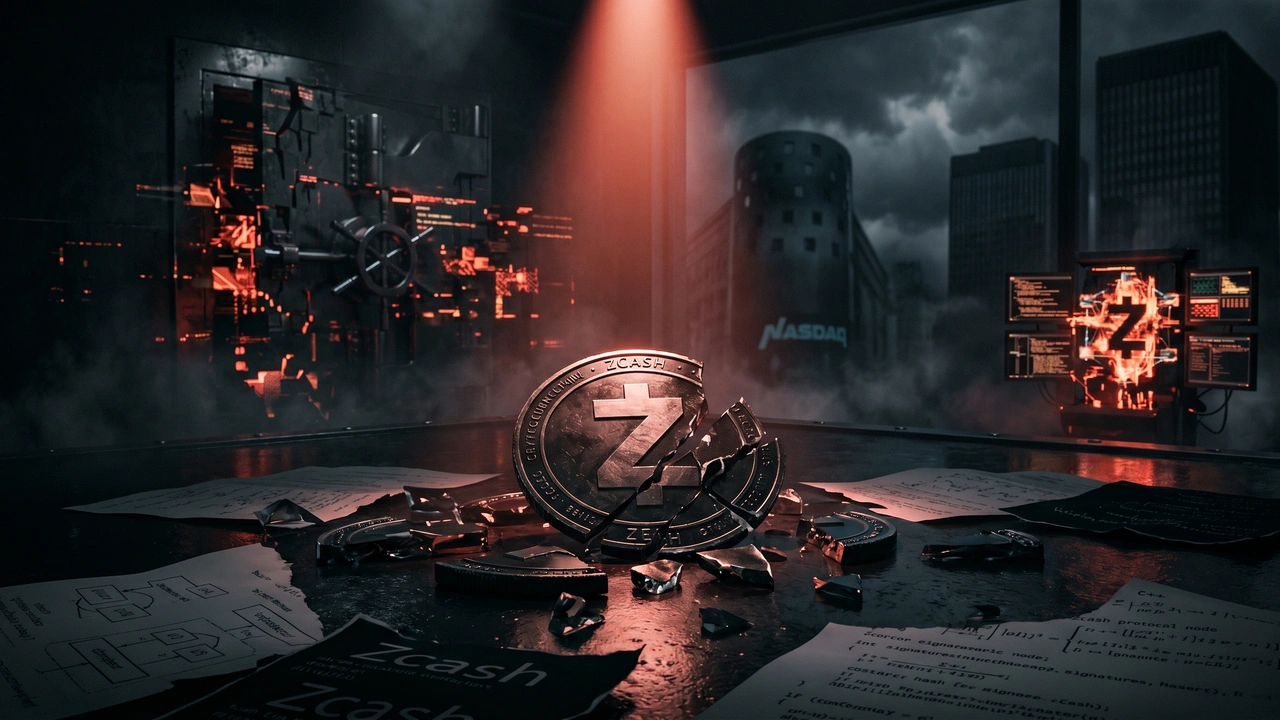
A disclosed vulnerability in Zcash's Orchard protocol triggered a 37% price collapse and prompted BitMEX co-founder Arthur Hayes to liquidate his entire ZEC position - revealing how uncompromising privacy narratives leave zero room for cryptographic uncertainty.
Key Takeaways
- The Zcash flaw did not produce a confirmed exploit - it produced confirmed uncertainty, and for a privacy coin, that ambiguity carries nearly the same market weight as an actual breach.
- Arthur Hayes's full exit from ZEC was driven by philosophical standards, not proven losses: if a privacy asset cannot make absolute cryptographic guarantees, its core value proposition is compromised regardless of how unlikely misuse was.
- Cypherpunk Technologies absorbed a roughly 40-percent single-day stock drop without altering its ZEC accumulation strategy, signaling that at least one institutional player views the disclosure as a process strength rather than a terminal failure.
- Liquidations exceeding $116 million within 24 hours reveal how much leveraged positioning had concentrated around ZEC, amplifying the price damage well beyond what spot selling alone would have caused.
- The proposed new shielded pool is the most consequential near-term development to watch: if it delivers auditable supply integrity, the narrative around this crisis could shift from vulnerability to resilience - with significant price implications either way.
Zcash's Security Flaw Exposes the Price of Privacy Promises
When a privacy coin stumbles on privacy, the market does not forgive easily. The public disclosure of a serious flaw in Zcash's core protocol sent ZEC into freefall this week, briefly cutting the coin's value to less than half its November 2024 peak. What makes this episode more than a routine crypto selloff is what it reveals about the impossible standards that privacy-focused assets must meet - and the fault lines opening between those who abandon ship and those digging in for the long haul.
The divergence is striking: on one side, a high-profile crypto billionaire walking away and citing philosophical grounds; on the other, a Nasdaq-listed treasury company doubling down and begging the market to stop panicking. Both reactions tell us something important about where Zcash - and the broader privacy coin thesis - actually stands.
The Facts
The crisis traces back to a vulnerability discovered in Zcash's Orchard protocol, the shielded transaction layer that sits at the heart of the network's privacy guarantees [2]. According to the project's own developers, the flaw theoretically could have allowed someone to create undetected counterfeit balances - in other words, to inflate the coin supply without leaving any obvious fingerprint [1]. The critical caveat, however, is that the developers cannot prove the bug was ever actually exploited. Equally, they cannot rule out that manipulation occurred [2]. That ambiguity, not a confirmed hack, is what set off the crisis.
The market reaction was swift and severe. ZEC had been trading near $700 as recently as November 2024 [1]. Within days of the disclosure, the coin briefly slipped below $300 before recovering partially to around $375 at time of writing [1]. Over the disclosure window, the price shed roughly 37 percent [2]. Liquidations tracked by CoinGlass topped $116 million within a single 24-hour stretch [2] - a figure that underlines how much leveraged exposure had built up around a coin many considered a bedrock privacy asset.
The most attention-grabbing exit came from Arthur Hayes, co-founder of BitMEX. Hayes confirmed he had sold his personal ZEC holdings and fully exited positions held through his investment vehicle Maelstrom [2]. His stated rationale went beyond simple loss-cutting. Writing on X, Hayes noted that while he personally considered it highly unlikely that new coins were minted illicitly, the absence of cryptographic proof made that confidence irrelevant for a coin built entirely on mathematical certainty. As he put it: "The narrative around privacy protection from AI, governments and Big Tech demands perfection, not probabilities" [1]. That framing - privacy assets live and die by their ability to make absolute guarantees - cuts to the core of why this flaw stung so much harder than it might have in another context.
Not everyone is retreating. Cypherpunk Technologies, a Nasdaq-listed firm whose entire strategy is built around accumulating ZEC, currently holds 314,185 ZEC - roughly 1.88 percent of circulating supply [1]. The company's stated target is five percent of the total 21-million-coin ceiling, and its investment chief Will McEvoy defended that roadmap publicly even as the stock itself collapsed roughly 40 percent in a single trading session [1]. Cypherpunk's leadership framed the episode as proof that Zcash possesses genuine institutional-grade security culture - the kind they argue will matter more, not less, as AI-driven surveillance scales up [1].
Support from other corners of the industry was measured but present. Craig Salm of Grayscale described the scenario of actual exploitation as unlikely [2]. Cameron Winklevoss, co-founder of Gemini and a Zcash backer, acknowledged that flaws surface in blockchain networks and argued the decisive factors are how quickly a team identifies and patches the problem [2] - a position that implicitly frames Zcash's disclosure as a mark of maturity rather than failure. On the development side, the Zcash team is now weighing additional safeguards, including the potential introduction of a new shielded pool designed to make supply integrity more auditable going forward [2].
Analysis & Context
This episode maps cleanly onto a recurring pattern in crypto history: the credibility premium collapse. Privacy coins - and Zcash in particular - have always commanded a valuation that incorporates not just utility but promise. Buyers are not just paying for a working product; they are paying for a guarantee that the system behaves exactly as mathematically advertised. The moment that guarantee becomes probabilistic rather than provable, the premium evaporates, often faster than the underlying fundamentals would justify.
What makes Hayes's exit analytically interesting is that it is not really about ZEC's current state. He said he thought actual exploitation was unlikely. This is an investor pricing the narrative risk, not the technical risk. For Bitcoin, similar logic has occasionally applied - debates around theoretical 51-percent attack scenarios have sometimes pressured miner economics even when no attack was imminent. But Bitcoin's value proposition is not built on cryptographic privacy in the same way. Zcash staked its identity on a standard that permits no gray zones, and that self-imposed bar is now being measured against an imperfect reality.
The forward-looking implication worth watching is whether the proposed new shielded pool actually rehabilitates institutional confidence. If Zcash can implement a mechanism that makes supply integrity independently verifiable, it transforms this crisis from a fatal flaw narrative into a stress-test-passed narrative. The difference between those two readings is potentially enormous for price recovery. Cypherpunk's willingness to absorb a 40-percent stock drawdown while maintaining its accumulation target suggests at least some institutional actors are betting on exactly that outcome.
Sources
- [1]btc-echo.de
- [2]btc-echo.de
AI-Assisted Content
This article was created with AI assistance. All facts are sourced from verified news outlets.