Caught Between Warsh and War: The Twin Macro Storms Battering Bitcoin
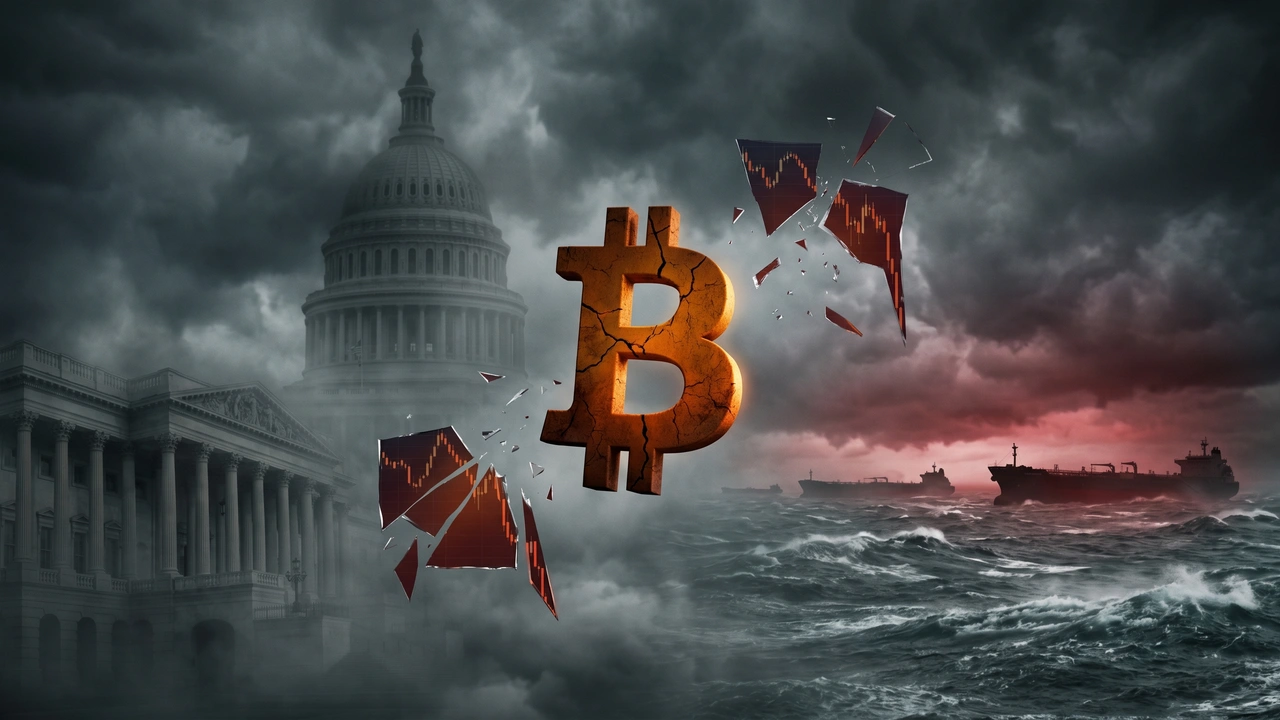
Bitcoin is navigating a dangerous confluence of two independent macro headwinds - a hawkish new Fed chair whose rate instincts contradict the crypto-friendly reputation traders priced in, and a fragile U.S.-Iran diplomatic standoff that sends the market lurching on every presidential post. The result is a market that reacts fast, recovers slowly, and trusts very little.
Key Takeaways
- Bitcoin's macro headwinds are structural, not headline-driven - the real driver is a 2-year Treasury yield above the Fed's own policy rate, a configuration that historically precedes tightening rather than easing, making quick rate relief unlikely regardless of who chairs the Fed [2].
- Diplomatic noise from the U.S.-Iran standoff is a source of volatility, not resolution - Trump's post moved Bitcoin by roughly $2,000 in hours, but was publicly contradicted by Iranian state media, underscoring that any Hormuz-related relief trade carries high reversal risk until verified by a formal agreement [1].
- Warsh being crypto-friendly on regulation does not translate to a dovish rate path - the distinction between regulatory sympathy and monetary policy is critical and the bond market has already priced in that difference with the 2-year yield climbing to its highest point since early 2025 [2].
- Historical Fed chair transitions have consistently preceded major Bitcoin drawdowns, suggesting the current weakness may be part of a recurring de-risking cycle tied to policy uncertainty rather than a fundamental deterioration of the asset [2].
- The compounding risk is a macro feedback loop - persistent energy price pressure from the Hormuz standoff keeps inflation elevated, which in turn gives the new Fed chair political cover to hold rates firm, extending the unfavorable liquidity environment for risk assets including Bitcoin [1][2].
Caught Between Warsh and War: The Twin Macro Storms Battering Bitcoin
Bitcoin is not losing ground because of anything happening on-chain. It is losing ground because the two largest macro forces shaping 2026 - Federal Reserve leadership and Middle East geopolitics - are both pointing in the same uncomfortable direction: higher uncertainty, tighter liquidity, and slower relief than the market had priced in.
This week crystallized that tension in two sharp episodes. Diplomatic signals out of Washington briefly pushed Bitcoin back above $77,000, only for Tehran to walk them back within hours. Meanwhile, in the background, a freshly confirmed Fed chair is being repriced by bond markets from crypto ally to potential rate hawk. Together, these developments tell a single, coherent story: the macro floor beneath Bitcoin is shakier than the bull narrative suggested.
The Facts
The geopolitical dimension arrived via a social media post from President Donald Trump, who declared that a deal with Iran was close and that the Strait of Hormuz - the channel through which approximately 20 percent of all global seaborne oil passes - would reopen [1]. Bitcoin, which had already slid beneath the $75,000 level for the first time since late April 2026, bounced sharply on the news, briefly reclaiming $77,000 before settling around $76,640, a 1.6 percent daily gain [1]. Ethereum moved in sympathy, climbing to $2,117 for a 2.6 percent 24-hour gain, while XRP held near $1.36 and Solana traded around $85 [1].
The relief, however, was short-lived in its credibility. Iranian state news agency Fars News contradicted Trump's characterization almost immediately, reporting that U.S. officials had privately acknowledged the statements were aimed at a domestic American audience rather than reflecting genuine diplomatic progress [1]. Tehran also disputed claims that negotiations even touched the nuclear program - a point Trump has treated as non-negotiable - let alone produced any agreement on it [1]. The Strait of Hormuz, in other words, is nowhere near reopened, diplomatically or literally.
On the monetary policy front, the picture is equally unsettling. The appointment of Kevin Warsh as Fed chair had been greeted with quiet optimism in crypto circles, given his history of supportive comments toward Bitcoin and his skepticism of central bank digital currencies [2]. But bond markets are telling a different story. The 2-year U.S. Treasury yield climbed to 4.14 percent, its highest reading since February 2025, comfortably above the Fed's existing 3.50-3.75 percent target range [2]. That spread matters: over the past three decades, whenever the 2-year yield has pushed above the federal funds rate by this kind of margin, the Fed has historically followed with rate hikes rather than cuts [2]. CME futures now assign meaningful probability to rates staying flat through most of 2026, with some contracts even pricing in a 25 basis point increase by December [2].
Analyst Crypto Patel captured the core misreading in the market's initial Warsh euphoria, writing that being "crypto-friendly on regulation is NOT the same as dovish on rates" [2]. Warsh, Patel noted, has a documented record as an inflation hawk, and the current environment - shaped by Iran-driven energy price risk and a stressed labor market - leaves him little political or economic room to cut aggressively [2].
Analysis & Context
The market's snap reaction to Trump's Iran post is a microcosm of a broader behavioral pattern that has defined Bitcoin in 2025-2026: aggressive sensitivity to geopolitical de-escalation signals, followed by painful repricing when those signals fail to materialize into policy. This is not irrational. The Strait of Hormuz disruption has functioned as a slow-burning inflation driver, keeping energy prices elevated and giving central banks a ready excuse to hold rates higher for longer. Any credible reopening would remove one of the Fed's biggest hawkish justifications overnight. Bitcoin's bounce was not speculation - it was a rational, if premature, trade on easing financial conditions.
The problem is the asymmetry of verification. Trump's social posts can move markets in minutes; diplomatic reality takes weeks to become undeniable. That gap creates a recurring pattern of relief rallies built on uncertain foundations, each one leaving a residue of damaged confidence when it unwinds. Until a signed, independently verified diplomatic framework exists - not a presidential post - any Iran-related Bitcoin bounce should be treated as a volatility event, not a trend reversal.
The Warsh dimension adds a layer of historical weight that deserves serious attention. Analyst Lucky's data point - that Bitcoin fell roughly 84 percent following Janet Yellen's January 2014 confirmation, around 73 percent after Jerome Powell took over in February 2018, and close to 60 percent after Powell's second term began in May 2022 - is striking [2]. The pattern is not coincidental. Fed chair transitions introduce genuine uncertainty about the path of rates, and uncertainty is the one variable Bitcoin cannot easily absorb. Traders de-risk first and ask questions later. What is different this time is that the de-risking is happening against a backdrop of already-elevated yields and an inflation problem that Warsh himself will inherit on day one. Former Cleveland Fed President Loretta Mester, who served alongside Warsh during his earlier Fed tenure, suggested that whatever his structural inclinations toward flexibility, his hands are tied by the current inflation problem - making the case for rate reductions difficult to present credibly in this environment [3]. That is not an imminent prospect.
The disambiguation here matters: nothing in this picture means Bitcoin is broken or entering a prolonged bear market. What it means is that the two catalysts traders were counting on to sustain a 2026 rally - a pivot-friendly Fed and a resolved Middle East conflict - have both been delayed and complicated simultaneously. The bullish thesis for Bitcoin rests on falling real rates and expanding global liquidity. Right now, both of those variables are moving in the wrong direction, and neither Warsh's confirmation nor a Trump social post changes that underlying dynamic. The second-order risk is a feedback loop: if the Iran situation escalates rather than de-escalates, oil-driven inflation stays elevated, which gives Warsh cover to hold rates firm, which keeps the 2-year yield above the funds rate, which continues to drain risk appetite from speculative assets including Bitcoin. Each link in that chain reinforces the next.
Sources
- [1]btc-echo.de
- [2]cointelegraph.com
- [3]cnbc.com
AI-Assisted Content
This article was created with AI assistance. All facts are sourced from verified news outlets.